


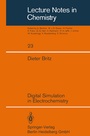
Digital Simulation in Electrochemistry
Published on 1. February 1981
Book
Paperback/Softback
X, 122 pages
978-3-540-10564-0 (ISBN)
Description
This book is the result of frustration. When I first became interested in digi tal simulation in 1967 (I didn't know the name then), there were no texts to tell one the how of it. This has not changed greatly since then; it is significant that just about all publications about the technique refer to a chapter by Feldberg in an electrochemical series, written in 1969. When I ran a course on the method recently, it became evident that this chapter is not enough for the raw beginner. Neither does he/she get much help from the mathematical textbooks which, at best, leave the special electrochemical aspects (if not a lot else) to one's imagination. This book, then, is written for practical digital simulators who do not have a friend who will tell them how to do it. The beauty of the digital approach is that one can separate out various dynamic processes taking place simultaneously. I have structured the book in this way. The major computing usually lies in the diffusion of substance, while the major program ming effort (and preparatory paper work) goes into the boundary conditions. These are treated separately.
More details
Other editions
New editions

Dieter Britz
Digital Simulation in Electrochemistry
Book
04/1988
2nd Edition
Springer
€85.59
Article exhausted; check for reprint
Additional editions
Content
1: Introduction.- 2: Basic Equations.- 3: Diffusional Transport - Digitally.- 4: Handling of Boundary Problems.- 5: Implicit Techniques and Other Complications.- 6: Accuracy and Choice.- 7: Non-Diffusional Concentration Changes.- 8: The Laplace Equation and Other Steady-State Systems.- 9: Programming Examples.