

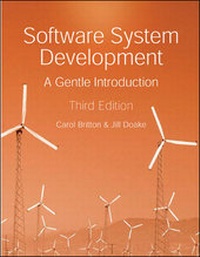
Software Sytems Development
3rd Edition
Published on 16. September 2002
Book
360 pages
978-0-07-709974-9 (ISBN)
Description
Rather than focusing on a specific software title, the authors explain the theories which are true for any system, and so provide a solid and structured background for aspiring software developers to build upon. With a new design and new features within the text, Software Systems Development is now even easier to follow and the examples and exercises are also been restructured to improve the knowledge flow to the student.This book takes a very accessible approach to systems analysis and design, suitable for Computer Science students on any introductory course, or for those coming from other disciplines with an interest in software development. The `just-a-line' case study which runs throughout the book takes a clear line from systems design, through development to implementation and release and provides coverage of Project Management techniques and testing and crisis management. Software Systems Development is supported by an Online Learning Centre with numerous resources for students and lecturers.
More details
Edition
3rd edition
Language
English
Place of publication
London
United Kingdom
Publishing group
McGraw-Hill Education - Europe
Target group
College/higher education
Dimensions
Height: 246 mm
Width: 188 mm
Thickness: 25 mm
Weight
780 gr
ISBN-13
978-0-07-709974-9 (9780077099749)
Copyright in bibliographic data and cover images is held by Nielsen Book Services Limited or by the publishers or by their respective licensors: all rights reserved.
Schweitzer Classification
Persons
Carol Britton is a principal lecturer in computer science at the University of Hertfordshire.
Jill Doake is an independent consultant.
Jill Doake is an independent consultant.
Content
1 Background case study2 Life cycles and development methods
3 The system requirements
4 Process moddelling
5 Data dictionary
6 Data modelling
7 Event modelling
8 Consistency checking and CASE tools
9 Implementation Issues
10 Testing and handover
11 Management and professional issues
12 alternatives to the traditional approach
Appendices
3 The system requirements
4 Process moddelling
5 Data dictionary
6 Data modelling
7 Event modelling
8 Consistency checking and CASE tools
9 Implementation Issues
10 Testing and handover
11 Management and professional issues
12 alternatives to the traditional approach
Appendices