

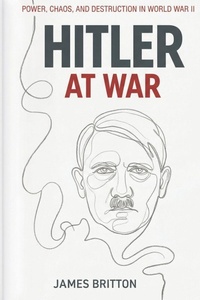
Hitler at War
Description
In the summer of 1940, Adolf Hitler stood at the peak of his power. France had fallen in six weeks. Europe lay at his feet. To millions, he appeared not merely as a political leader but as a military genius: bold, decisive, and seemingly unstoppable.
Five years later, that image lay in ruins alongside the regime that had created it.
Hitler at War traces the full arc of Hitler's military leadership, from the confident rearmament of the 1930s and the stunning early victories, through the catastrophic gamble of Operation Barbarossa, the disaster at Stalingrad, the failure to repel the Allied landings at Normandy, and the final collapse in the Berlin bunker in April 1945.
Drawing on the work of leading historians including Ian Kershaw, Antony Beevor, Alan Bullock, and Richard Evans, this book asks a deceptively simple question: how much of what appeared to be genius was, in reality, illusion?
The answer is both revealing and cautionary. Hitler's early successes owed as much to Allied weakness and professional military expertise as to his own judgment. The qualities that produced those victories (boldness, a willingness to override conventional wisdom, absolute confidence in personal intuition) became, in the wider and more demanding context of a world war, the precise mechanisms of catastrophic failure.
Hitler at War: Command, Myth and Catastrophe is the first volume in the Short Histories series: concise, authoritative narrative histories written for the curious general reader.