

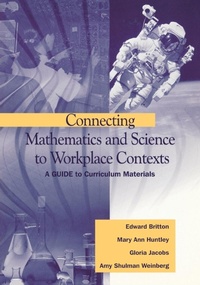
Connecting Mathematics and Science to Workplace Contexts
A Guide to Curriculum Materials
1st Edition
Published on 27. July 1999
Book
Paperback/Softback
272 pages
978-0-8039-6867-7 (ISBN)
Description
Engage students through real-world curriculum
It's no accident that employers complain that newly minted graduates are out of touch with the realities of work demands! Too often, there is a disconnect between what is taught in the classroom and what is demanded in the workplace, and students suffer the consequences. Mathematics and science curricula can play a critical role in solving this dilemma.
In this comprehensive review of 23 exemplary curricula/programs, the authors offer an easy-to-use guide for tying curriculum to workplace experiences-from a hematology laboratory to an agricultural setting to a soda bottling company-these programs illustrate concrete real-life situations to which students can relate and derive motivation.
Learn how to:
Meet the goals of science, mathematics, and technology education
Meet national curriculum standards
Chart key characteristics of successful curricula
Connect curriculum to workplace contexts
Create your own curriculum materials
This book is a must for mathematics and science educators, curriculum developers and supervisors, and educators in school-to-work programs and vocational courses.
It's no accident that employers complain that newly minted graduates are out of touch with the realities of work demands! Too often, there is a disconnect between what is taught in the classroom and what is demanded in the workplace, and students suffer the consequences. Mathematics and science curricula can play a critical role in solving this dilemma.
In this comprehensive review of 23 exemplary curricula/programs, the authors offer an easy-to-use guide for tying curriculum to workplace experiences-from a hematology laboratory to an agricultural setting to a soda bottling company-these programs illustrate concrete real-life situations to which students can relate and derive motivation.
Learn how to:
Meet the goals of science, mathematics, and technology education
Meet national curriculum standards
Chart key characteristics of successful curricula
Connect curriculum to workplace contexts
Create your own curriculum materials
This book is a must for mathematics and science educators, curriculum developers and supervisors, and educators in school-to-work programs and vocational courses.
Reviews / Votes
"A valuable asset to vocational and traditional educators who wish to make their curriculum more relevant." -- Brian C. Bertrand "A distinct contribution for science and math educators looking to link their academics to real-life applications." -- Maria Found "Very timely! School-to-work and tech prep programs are being developed in virtually every corner of the country." -- Jeanelle Bland HodgesMore details
Language
English
Place of publication
Thousand Oaks
United States
Target group
Professional and scholarly
Dimensions
Height: 254 mm
Width: 178 mm
Thickness: 15 mm
Weight
521 gr
ISBN-13
978-0-8039-6867-7 (9780803968677)
Copyright in bibliographic data and cover images is held by Nielsen Book Services Limited or by the publishers or by their respective licensors: all rights reserved.
Schweitzer Classification
Other editions
Additional editions
Edward Britton | Mary Ann Huntley | Gloria Jacobs
Connecting Mathematics and Science to Workplace Contexts
A Guide to Curriculum Materials
Book
08/1999
1st Edition
SAGE Publications Inc
€90.00
Shipment within 15-20 days
Persons
Edward (Ted) Britton is associate director of the National Center for Improving Science Education (NCISE), housed within the Mathematics, Science, and Technology program of WestEd. Dr. Britton brings long experience in research and evaluation of curriculum issues and materials to this book. In collaboration with Senta Raizen and others, he developed methods for a cross-national comparison of textbooks in the Third International Mathematics and Science Study (TIMSS). He led a review of curriculum materials that connect science and mathematics to workplace contexts, Connecting Mathematics and Science to Workplace Contexts. Britton currently serves on the Technology Education Advisory Council of the ITEA. His earlier NCISE research includes comparing high-stakes mathematics and science examinations across countries and studying U.S. innovations in mathematics and science education as part of an international study under the auspices of the Paris-based Organization of Economic Co-Operation and Development (OECD). As project director for Mary Budd Rowe of the University of Florida during the 1980s, Ted developed the first CD-ROM in science education and produced videotapes for the professional development of science teachers. During the late 1970s, he taught science courses for Grades 7-12 at a rural junior-senior high school in Florida. Britton earned an EdD in science education, an MS in analytical chemistry, and a BS in chemistry and education from the University of Florida.
Content
Foreword - Senta Raizen and Margaret Vickers
Why Should Mathematics and Science Connect to Workplace Contexts?
Six Ways that Curriculum Materials Can Connect to Workplace Contexts
How Materials Were Selected and Reviewed
Reviews of Mathematics Curricula
Reviews of Science and Integrated Curricula
Why Should Mathematics and Science Connect to Workplace Contexts?
Six Ways that Curriculum Materials Can Connect to Workplace Contexts
How Materials Were Selected and Reviewed
Reviews of Mathematics Curricula
Reviews of Science and Integrated Curricula