

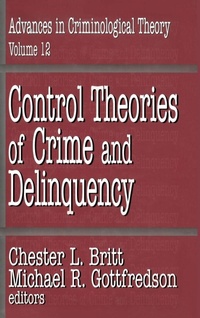
Control Theories of Crime and Delinquency
Advances in Criminological Theory
1st Edition
Published on 30. November 2003
Book
Hardback
290 pages
978-0-7658-0180-7 (ISBN)
Description
For the past twenty to thirty years, control theories of crime have been at the center of theoretical development in criminology. Key to the control theory perspective is the notion that crime is an inherently individual act, and its explanation requires that we focus on the characteristics of individuals who commit crimes. Consequently, control theory focuses on such issues as self-control and social control.
The contributions to this volume explicate and extend the application of control theory. It is divided into three general areas. Part 1 focuses on key assumptions and components of control theories. Contributors discuss the notion of learning, or socialization, in the context of control theory and the effects that families, peers, and the criminal justice system have on self-control, social ties, and criminal behavior.
Part 2 applies control theory to areas typically assumed to be out of the domain of self-control theory and social control theory, such as gender differences in crime, domestic violence, and group crime. Considering control theory's emphasis on explaining individual criminal acts, these chapters suggest an interesting area of development by highlighting the possibility that differences in crime across or within groups may begin with individual characteristics and then making inferences about groups and group processes.
Part 3 approaches the explanation of crime cross-nationally and at the macro-level. Although the authors take different approaches, they all illustrate that a theory of crime does not require culture-specific elements in order to be a valid cross-cultural explanation. Contributors to this volume include: Robert Agnew, Todd Armstrong, Leana Allen Bouffard, Augustine Brannigan, Chester Britt, Barbara Costello, Maja Dekovic, Matt DeLisi, Michael Gottfredson, Henriette Haas, Kelly H. Hardwick, Travis Hirschi, Marianne Junger, Martin Killias, Helen Mederer, Kevin Thompson, and Alexander Vazsonyi.
The contributions to this volume explicate and extend the application of control theory. It is divided into three general areas. Part 1 focuses on key assumptions and components of control theories. Contributors discuss the notion of learning, or socialization, in the context of control theory and the effects that families, peers, and the criminal justice system have on self-control, social ties, and criminal behavior.
Part 2 applies control theory to areas typically assumed to be out of the domain of self-control theory and social control theory, such as gender differences in crime, domestic violence, and group crime. Considering control theory's emphasis on explaining individual criminal acts, these chapters suggest an interesting area of development by highlighting the possibility that differences in crime across or within groups may begin with individual characteristics and then making inferences about groups and group processes.
Part 3 approaches the explanation of crime cross-nationally and at the macro-level. Although the authors take different approaches, they all illustrate that a theory of crime does not require culture-specific elements in order to be a valid cross-cultural explanation. Contributors to this volume include: Robert Agnew, Todd Armstrong, Leana Allen Bouffard, Augustine Brannigan, Chester Britt, Barbara Costello, Maja Dekovic, Matt DeLisi, Michael Gottfredson, Henriette Haas, Kelly H. Hardwick, Travis Hirschi, Marianne Junger, Martin Killias, Helen Mederer, Kevin Thompson, and Alexander Vazsonyi.
More details
Series
Language
English
Place of publication
Somerset
United Kingdom
Publishing group
Taylor & Francis Inc
Target group
College/higher education
Professional and scholarly
Dimensions
Height: 235 mm
Width: 157 mm
Thickness: 20 mm
Weight
574 gr
ISBN-13
978-0-7658-0180-7 (9780765801807)
Copyright in bibliographic data and cover images is held by Nielsen Book Services Limited or by the publishers or by their respective licensors: all rights reserved.
Schweitzer Classification
Other editions
Additional editions
Chester L. Britt | Michael R. Gottfredson
Control Theories of Crime and Delinquency
Advances in Criminological Theory
Book
01/2018
1st Edition
Routledge
€71.70
Shipment within 10-20 days
Chester L. Britt | Michael R. Gottfredson
Control Theories of Crime and Delinquency
E-Book
11/2017
Routledge
€64.49
Available for download
Chester L. Britt | Michael R. Gottfredson
Control Theories of Crime and Delinquency
E-Book
11/2017
Routledge
€64.49
Available for download
Persons
Chester L. Britt, Michael R. Gottfredson
Content
1: Self-Control and Opportunity; 2: Self-Control Pathology: The Elephant in the Living Room; 3: The Effect of Learning on Crime: Contrasting A General Theory of Crime and Social Learning Theory; 4: The Interactive Effects of Social Control Variables on Delinquency; 5: A Control Theory of Gender Difference in Crime and Delinquency *; 6: Genocide and General Theory; 7: Sexual Harassment and Low Self-Control: A Proposed Application of the General Theory of Crime; 8: Punishment of Children from the Perspective of Control Theory; 9: Self-Control, Group Solidarity, and Crime: An Integrated Control Theory; 10: Comparative Criminology: Content or Simply Methodology?; 11: Crime as Risk-Taking: Co-occurrence of Delinquent Behavior, Health-Endangering Behaviors, and Problem Behaviors; 12: The Versatility vs. Specialization Debate: Different Theories of Crime in the Light of a Swiss Birth Cohort 1; Contributors