

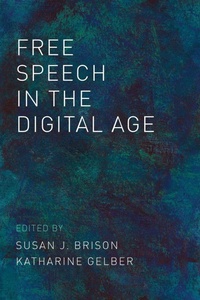
Free Speech in the Digital Age
Published on 2. May 2019
Book
Paperback/Softback
280 pages
978-0-19-088360-7 (ISBN)
Description
This collection of thirteen new essays is the first to examine, from a range of disciplinary perspectives, how the new technologies and global reach of the Internet are changing the theory and practice of free speech. The rapid expansion of online communication, as well as the changing roles of government and private organizations in monitoring and regulating the digital world, give rise to new questions, including: How do philosophical defenses of the right to freedom of expression, developed in the age of the town square and the printing press, apply in the digital age? Should search engines be covered by free speech principles? How should international conflicts over online speech regulations be resolved? Is there a right to be forgotten that is at odds with the right to free speech? How has the Internet facilitated new speech-based harms such as cyber-stalking, twitter-trolling, and revenge porn, and how should these harms be addressed?
The contributors to this groundbreaking volume include philosophers, legal theorists, political scientists, communications scholars, public policy makers, and activists.
The contributors to this groundbreaking volume include philosophers, legal theorists, political scientists, communications scholars, public policy makers, and activists.
Reviews / Votes
This is a valuable book. Not least because of the quality of research contained in each chapter, both philosophical and applied. But also, and perhaps more significantly, for what it achieves by putting these scholars in conversation both with the extant literature and with the fast-moving world-changing forces of the digital age. * Gregory Whitfield, Criminal Law and Philosophy *More details
Language
English
Place of publication
New York
United States
Target group
College/higher education
Professional and scholarly
Dimensions
Height: 234 mm
Width: 156 mm
Thickness: 16 mm
Weight
478 gr
ISBN-13
978-0-19-088360-7 (9780190883607)
Copyright in bibliographic data and cover images is held by Nielsen Book Services Limited or by the publishers or by their respective licensors: all rights reserved.
Schweitzer Classification
Other editions
Additional editions
Susan J. Brison | Katharine Gelber
Free Speech in the Digital Age
E-Book
02/2019
1st Edition
OUP eBook
€20.99
Available for download
Susan J. Brison | Katharine Gelber
Free Speech in the Digital Age
E-Book
02/2019
1st Edition
OUP eBook
€20.99
Available for download
Susan J. Brison | Katharine Gelber
Free Speech in the Digital Age
Book
04/2018
Oxford University Press Inc
€175.30
Shipment within 15-20 days
Persons
Susan J. Brison is Eunice and Julian Cohen Professor for the Study of Ethics and Human Values and Professor of Philosophy at Dartmouth College.
Katharine Gelber is Professor of Politics and Public Policy at the University of Queensland and a Fellow of the Academy of Social Sciences Australia.
Katharine Gelber is Professor of Politics and Public Policy at the University of Queensland and a Fellow of the Academy of Social Sciences Australia.
Editor
Eunice and Julian Cohen Professor for the Study of Ethics and Human Values and Professor of PhilosophyEunice and Julian Cohen Professor for the Study of Ethics and Human Values and Professor of Philosophy, Dartmouth College
Professor of Politics and Public PolicyProfessor of Politics and Public Policy, University of Queensland
Content
Introduction - Susan J. Brison and Katharine GelberChapter 1: Digital Dualism and the 'Speech as Thought' Paradox - Katharine Gelber, Susan BrisonChapter 2: Search Engines and Free Speech Coverage - Robert Simpson, Heather WhitneyChapter 3: Cyber Harassment and Free Speech: Drawing the Line Online - James WeinsteinChapter 4: Recipes, Plans, Instructions and the Free Speech Implications of Words that Are Tools - Frederick SchauerChapter 5: Free Speech Categories in the Digital Age - Ashutosh BhagwatChapter 6: Privacy, Speech and Digital Imagination - Robert PostChapter 7: Why Combatting Online Abuse is Good for Free Expression - Danielle Keats CitronChapter 8: 'Not Where Bodies Live': The Abstraction of Internet Expression - Mary Anne FranksChapter 9: Demographics, Design and Free Speech: How Demographics Have Produced Social Media Optimized for Abuse and the Silencing of Marginalized Voices - Soraya ChemalyChapter 10: Unmasking Hate on Twitter: Disrupting Anonymity by Tracking Trolls - Diana Ascher, Safiya NobleChapter 11: Online Dating Sites as Public Accommodations: Facilitating Racial Discrimination - Sonu BediChapter 12: The Meaning of Silence in Cyberspace: The Authority Problem and Online Hate Speech - Alexander BrownChapter 13: Regulating Online Speech: Keeping Humans, and Human Rights, at the Core - Dinah PoKempner