

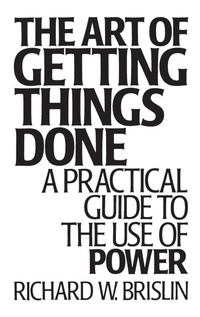
The Art of Getting Things Done
A Practical Guide to the Use of Power
Published on 6. March 1991
Book
Hardback
272 pages
978-0-275-93761-4 (ISBN)
Description
How is power acquired? Are there strategies and tactics that people can learn which will increase their chances of becoming more powerful? Richard Brislin claims there are. In this work he reveals the unwritten rules for obtaining power, and presents an analysis of power as a tool in developing clout and in implementing decisions. This framework for looking at why and how certain groups have a greater understanding of the role of power in the worlds of business, education, human services, law, and politics integrates relevant scholarly literature with interviews of more than one hundred powerholders.
Focusing on the workplace and community environments, Brislin makes the reader more savvy about the role power plays in gaining support for proposals, in formulating policy, and in molding a career. He discusses the role of power in the personalities of people; why the power motive is stronger in some individuals than in others; the use of resources and resource exchange; ethics and the use of power; and strategies and tactics in the acquisition and application of power. He also suggests means to develop a sophisticated view of power as a tool in the service of leadership. Anyone interested in achieving more power, in holding his or her own against others in power, or in gaining insights into policy formulation and decision-making will find The Art of Getting Things Done to be particularly valuable.
Focusing on the workplace and community environments, Brislin makes the reader more savvy about the role power plays in gaining support for proposals, in formulating policy, and in molding a career. He discusses the role of power in the personalities of people; why the power motive is stronger in some individuals than in others; the use of resources and resource exchange; ethics and the use of power; and strategies and tactics in the acquisition and application of power. He also suggests means to develop a sophisticated view of power as a tool in the service of leadership. Anyone interested in achieving more power, in holding his or her own against others in power, or in gaining insights into policy formulation and decision-making will find The Art of Getting Things Done to be particularly valuable.
More details
Language
English
Place of publication
United States
Publishing group
Bloomsbury Publishing Plc
Target group
College/higher education
Interest Age: From 7 to 17 years
Dimensions
Height: 240 mm
Width: 161 mm
Thickness: 19 mm
Weight
573 gr
ISBN-13
978-0-275-93761-4 (9780275937614)
Copyright in bibliographic data and cover images is held by Nielsen Book Services Limited or by the publishers or by their respective licensors: all rights reserved.
Schweitzer Classification
Person
Richard W. Brislin, PhD, is a psychologist who coordinates research and educational programs at the Institute of Culture and Communication, East-West Center in Honolulu and serves on the graduate faculty of the University of Hawaii.
Content
Foreword by Paul Pedersen
Preface
Introduction: Thinking about Power
The Background of Power Acquisition: Politics, People, and Resources
Abilities and Skills for Power Acquisition
Strategies for Power Acquisition and Maintenance
Tactics in Power Acquisition and Maintenance: Gaining Support
Tactics in Power Acquisition and Maintenance: Dealing with Opponents
Developing a Knowledge of Resource Exchanges, Strategies, and Tactics
Summary: What the Sophisticated Know
Bibliography
Index
Preface
Introduction: Thinking about Power
The Background of Power Acquisition: Politics, People, and Resources
Abilities and Skills for Power Acquisition
Strategies for Power Acquisition and Maintenance
Tactics in Power Acquisition and Maintenance: Gaining Support
Tactics in Power Acquisition and Maintenance: Dealing with Opponents
Developing a Knowledge of Resource Exchanges, Strategies, and Tactics
Summary: What the Sophisticated Know
Bibliography
Index