

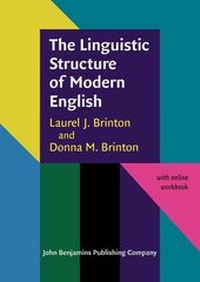
The Linguistic Structure of Modern English
2nd Edition
Published on 29. July 2010
Book
Paperback/Softback
426 pages
978-90-272-1172-9 (ISBN)
Description
This text is for advanced undergraduate and graduate students interested in contemporary English, especially those whose primary area of interest is English as a second language, primary or secondary-school education, English stylistics, theoretical and applied linguistics, or speech pathology. The emphasis is on empirical facts of English rather than any particular theory of linguistics; the text does not assume any background in language or linguistics. In this newly revised edition numerous example sentences are taken from the Corpus of Contemporary American English. A full glossary of key terms, an additional chapter on pedagogy and new sections on cognitive semantics and politeness have been added. Other changes include: completely updated print references; web links to sites of special interest and relevance; and a revised, reader-friendly layout. A companion website that includes a complete workbook with self-testing exercises and a comprehensive list of web links accompanies the book. The website can be found at the following address: https://doi.org/10.1075/z.156.workbook.
Students completing the text and workbook will acquire: a knowledge of the sound system of contemporary English; an understanding of the formation of English words; a comprehension of the structure of both simple and complex sentence in English; a recognition of complexities in the expression of meaning; an understanding of the context and function of use upon the structure of the language; and an appreciation of the importance of linguistic knowledge to the teaching of English to first and second-language learners.
Laurel J. Brinton is Professor of English Language at the University of British Columbia.
Donna M. Brinton is Senior Lecturer in TESOL at the University of Southern California's Rossier School of Education.
The Linguistic Structure of Modern English is a revised edition of The Structure of Modern English by Laurel J. Brinton (2000).
Students completing the text and workbook will acquire: a knowledge of the sound system of contemporary English; an understanding of the formation of English words; a comprehension of the structure of both simple and complex sentence in English; a recognition of complexities in the expression of meaning; an understanding of the context and function of use upon the structure of the language; and an appreciation of the importance of linguistic knowledge to the teaching of English to first and second-language learners.
Laurel J. Brinton is Professor of English Language at the University of British Columbia.
Donna M. Brinton is Senior Lecturer in TESOL at the University of Southern California's Rossier School of Education.
The Linguistic Structure of Modern English is a revised edition of The Structure of Modern English by Laurel J. Brinton (2000).
More details
Edition
2nd Revised edition
Language
English
Place of publication
Amsterdam
Netherlands
Target group
College/higher education
Professional and scholarly
Edition type
Revised edition
Illustrations
+ index
Dimensions
Height: 240 mm
Width: 170 mm
Weight
845 gr
ISBN-13
978-90-272-1172-9 (9789027211729)
Copyright in bibliographic data and cover images is held by Nielsen Book Services Limited or by the publishers or by their respective licensors: all rights reserved.
Schweitzer Classification
Other editions
Previous edition
Book
07/2000
John Benjamins Publishing Co
€31.80
Article exhausted; check for reprint
Persons
Content
1. Preface to the second edition; 2. Chapter 1. The nature of language and linguistics; 3. Chapter 2. Consonants and vowels; 4. Chapter 3. Phonology, phonotactics, and suprasegmentals; 5. Chapter 4. The internal structure of words and processes of word formation; 6. Chapter 5. Grammatical categories and word classes; 7. Chapter 6. Lexical semantics; 8. Chapter 7. Phrasal structure and verb complementation; 9. Chapter 8. Adverbials, auxiliaries, and sentence types; 10. Chapter 9. Finite and nonfinite clauses; 11. Chapter 10. Sentence semantics; 12. Chapter 11. Information structuring and speech acts; 13. Chapter 12. Linguistics in language teaching (by Williams, Howard); 14. References; 15. Glossary; 16. Appendices