

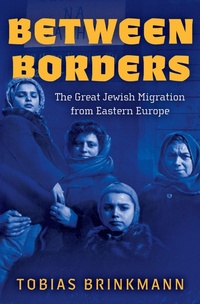
Between Borders
The Great Jewish Migration from Eastern Europe
Published on 25. September 2024
Book
Hardback
336 pages
978-0-19-765565-8 (ISBN)
Description
Between the 1860s and the early 1920s, more than two million Jews moved from Eastern Europe to the United States while smaller groups moved to other destinations, such as Western Europe, Palestine, and South Africa. During and after the First World War hundreds of thousands of Jews were permanently displaced across Eastern Europe. Migration restrictions that were imposed after 1914, especially in the United States, prevented most from reaching safe havens, and an unknown but substantial number of Jews perished during the Holocaust-as they had been displaced in Eastern Europe years before they were deported to ghettos and killing sites. Even after the Holocaust, tens of thousands of Jewish survivors were stranded in permanent transit for many years.
Between Borders tells and contextualizes the stories of these Jewish migrants and refugees before and after the First World War. It explains how immigration laws in countries such as the United States influenced migration routes around the world. Using memoirs, letters, and accounts by investigative journalists and Jewish aid workers, Tobias Brinkmann sheds light on the experiences of individual migrants, some of whom laid the foundation for migration and refugee studies as a field of scholarship, even coining terms such as "displaced person," and contributing to its legal definition at the 1951 United Nations Refugee Convention. The stories of these migrants and refugees were used to propose a new future for the United States, reimagining it as a pluralistic society-one comprised of immigrants.
Between Borders tells and contextualizes the stories of these Jewish migrants and refugees before and after the First World War. It explains how immigration laws in countries such as the United States influenced migration routes around the world. Using memoirs, letters, and accounts by investigative journalists and Jewish aid workers, Tobias Brinkmann sheds light on the experiences of individual migrants, some of whom laid the foundation for migration and refugee studies as a field of scholarship, even coining terms such as "displaced person," and contributing to its legal definition at the 1951 United Nations Refugee Convention. The stories of these migrants and refugees were used to propose a new future for the United States, reimagining it as a pluralistic society-one comprised of immigrants.
Reviews / Votes
In this compact yet comprehensive study, Tobias Brinkmann provides a global and holistic survey of Jewish migration from the mid-nineteenth to the mid twentieth century. With provocative analysis and meticulous research, Brinkmann weaves together the motivations and experiences of Jewish migrants, state policies on migration, and Jewish philanthropic efforts on the migrants' behalf. An essential addition to modern Jewish historiography. * Derek Penslar, Harvard University * Tobias Brinkmann challenges the trope of the 'wandering Jew,' while also revealing how Jewish writers contributed to its creation. Ultimately, he posits World War I as a watershed moment when states sought to stabilize an 'artificial and shifting divide between the flight from persecution and the quest for a better life.' * Donna R. Gabaccia, Professor Emerita of History, University of Toronto * Surprisingly few scholars have tackled the question of migration as a process: not simply a departure and an arrival, but a complex series of movements, arrangements, interventions, intermittent halts, and individual experiences in transit. However, in Between Borders, Tobias Brinkmann comprehensively mines and explains the process and the experience of mass migration, seen and documented both by individuals and at the macro level, as seen by official agencies or the retrospective research of scholars. Brinkmann corrects misapprehensions or inaccuracies and offers an important series of new and original insights and noteworthy innovations in the field of modern Jewish migration out of Eastern Europe. * Eli Lederhendler, Professor emeritus, Institute of Contemporary Jewry, The Hebrew University of Jerusalem * In this pathbreaking study, based on vast archival and scholarly research, Brinkmann, a prolific historian of Jewish migration history, depicts in detail a historic 80-year period of population movement and digs deeply into several of its key dimensions-e.g., the logistics of movement, the institutions involved, the participants and professional analysts who sought to define this phenomenon, and the larger international context in which millions of Jews left their homelands and resettled elsewhere between the 1860s and the end of WW II....With its helpful maps, evocative illustrations, copious notes, and extensive bibliography, this dense monograph encourages similarly ambitious investigations of the contemporary politics of global immigration. * Choice * Between Borders fills an important space in the scholarship and will amplify understanding of a crucial subject. * Hasia R. Diner, AJS Review * Between Borders is a wonderful addition to the Jewish migration historiography and a must-read for all interested in the topic. * Anastasiia Strakhova, Pardes * In recovering the prevalence of economic motives, logisticalconsiderations, and everyday struggles, Brinkmann provides a much-needed corrective to longstanding narratives and a welcome point of departure for new inquiries into the great Jewish migration from Eastern Europe. * Benjamin P. Hein, German Studies Review * Tobias Brinkmann has produced a well-researched, smart, and engaging book. Between Borders will fit well in courses on immigration/migration history at the graduate level, and undergraduates in immigration/migration courses would benefit from select, excerpted chapters. * Carl Bon Tempo, Jewish History * [Between Borders] is a must-read for scholars of modern Jewish history, transnational migration, and international law, but will benefit any reader interested in the question of borders, migration, and refugees. * American Historical Review * a fascinating book filled with new research and thought-provoking conclusions. * English Historical Review * the analytical clarity and expanded chronology that Brinkmann brings to the study of Jewish mass migration from eastern Europe makes this book a valuable addition to the historiography. * Slavic Review *More details
Language
English
Place of publication
New York
United States
Illustrations
15, b/w
Dimensions
Height: 237 mm
Width: 158 mm
Thickness: 29 mm
Weight
576 gr
ISBN-13
978-0-19-765565-8 (9780197655658)
Copyright in bibliographic data and cover images is held by Nielsen Book Services Limited or by the publishers or by their respective licensors: all rights reserved.
Schweitzer Classification
Other editions
Additional editions
E-Book
07/2024
OUP USA
€24.99
Available for download
E-Book
07/2024
OUP USA
€24.99
Available for download
Person
Tobias Brinkmann is Malvin and Lea Bank Associate Professor of Jewish Studies and History at Pennsylvania State University. He is the author of Sundays at Sinai: A Jewish Congregation in Chicago.
Content
Acknowledgements Abbreviations Introduction Chapter 1: Early Jewish Migration from Lithuania Chapter 2: The 1881/82 Pogroms and the Brody Crisis Chapter 3: Jewish Mobilities and the Business of Migration Chapter 4: Migrant Journeys Chapter 5: Protective Umbrella: The Transnational Jewish Support Network Chapter 6: The First World War and its Aftermath: Displacement and Permanent Transit Chapter 7: The Interwar Years: Alternative Destinations and Dead Ends Chapter 8: A Not So Typical Journey Chapter 9: Jewish Migrations or Wandering Jews? Chapter 10: Epilogue: Migrants Become Immigrants Conclusion: Migrants and Refugees Bibliography