

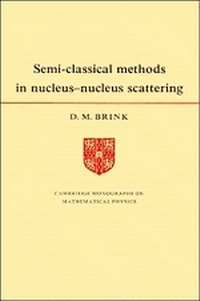
Semi-Classical Methods for Nucleus-Nucleus Scattering
Published on 9. January 1986
Book
Hardback
240 pages
978-0-521-23940-0 (ISBN)
Description
During past years many countries constructed large accelerators for investigating heavy ion collisions, and new theoretical techniques for analysing results and making predictions were developed. Semi-classical methods were studied in the early days of quantum mechanics. Their application to heavy ion collisions has led to new advances and a number of different schools have grown up, each one emphasising different aspects of the theory. The aim of this book is to present a unified treatment of various lines of development. This book will be of great interest to graduate students wishing to learn about semi-classical methods in nuclear physics and to theoretical and experimental nuclear physicists, especially those working in heavy ion physics. It will also be of interest to research workers in other areas, such as atomic physics and quantum chemistry, where similar techniques are used.
More details
Series
Language
English
Place of publication
Cambridge
United Kingdom
Target group
College/higher education
Illustrations
Worked examples or Exercises
Dimensions
Height: 228 mm
Width: 152 mm
Thickness: 20 mm
Weight
466 gr
ISBN-13
978-0-521-23940-0 (9780521239400)
Copyright in bibliographic data and cover images is held by Nielsen Book Services Limited or by the publishers or by their respective licensors: all rights reserved.
Schweitzer Classification
Other editions
New editions
Book
06/2009
Cambridge University Press
€55.40
Shipment within 15-20 days
Additional editions
Book
06/2009
Cambridge University Press
€55.40
Shipment within 15-20 days
Content
Preface; 1. Introduction; 2. Elastic scattering and the optical model; 3. The semi-classical phase shift; 4. The semi-classical scattering amplitude; 5. Frahn's diffraction theory; 6. Surface transparent potentials; 7. Feynmann's path integral in one dimension; 8. Elastic scattering by the path integral method; 9. Inelastic scattering; 10. Non-local potentials; 11. Fusion reactions; Appendices A-F; References; Index.