

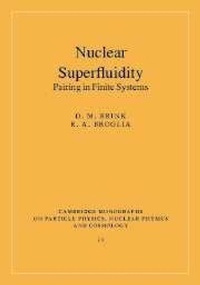
Nuclear Superfluidity
Pairing in Finite Systems
Published on 8. June 2005
Book
Hardback
392 pages
978-0-521-39540-3 (ISBN)
Description
Nuclear Superfluidity is an advanced text devoted exclusively to pair correlations in nuclei. It begins by exploring pair correlations in a variety of systems including superconductivity in metals at low temperatures and superfluidity in liquid 3He and in neutron stars. The book goes on to introduce basic theoretical methods, symmetry breaking and symmetry restoration in finite many-body systems. The last four chapters are devoted to introducing results on the role of induced interactions in the structure of both normal and exotic nuclei. The most important of these is the renormalization of the pairing interaction due to the coupling of pairs of nucleons to low energy nuclear collective excitations. This book will be essential reading for researchers and students in both experimental and theoretical nuclear physics, and related research fields such as metal clusters, fullerenes and quantum dots.
More details
Series
Language
English
Place of publication
Cambridge
United Kingdom
Target group
Professional and scholarly
Product notice
Laminated cover
Dimensions
Height: 254 mm
Width: 176 mm
Thickness: 26 mm
Weight
925 gr
ISBN-13
978-0-521-39540-3 (9780521395403)
Copyright in bibliographic data and cover images is held by Nielsen Book Services Limited or by the publishers or by their respective licensors: all rights reserved.
Schweitzer Classification
Other editions
New editions
Book
07/2023
Cambridge University Press
€145.50
Shipment within 15-20 days
Additional editions
E-Book
09/2005
1st Edition
Cambridge University Press
€44.49
Available for download
Persons
David M. Brink obtained his first degree at the University of Tasmania in 1951 and his D.Phil. at Oxford University in 1955. Between 1958 and 1993 he held academic positions in the University of Oxford, including a Fellowship at Balliol College and the Moseley Readership in Theoretical Physics and taught many branches of physics at graduate and undergraduate level. From 1993 to 1998 he was Professor of the History of Physics at the University of Trento in Italy. Professor Brink is a Fellow of the Royal Society and in 1982 was a recipient of the Rutherford Medal of the Institute of Physics. Ricardo A. Broglia earned his Ph.D. at the University of Cuyo, Argentina, in 1965. Following positions at the University of Buenos Aires, the Niels Bohr Institute and the University of Minnesota, he joined the staff of the Niels Bohr Institute in 1970, where he is now adjunct Professor. He has held visiting positions at the State University of New York at Stony Brook, Brookhaven National Laboratory, Los Alamos Scientific Laboratory and Oak Ridge National Laboratory. In 1985 he was called to occupy the chair of Nuclear Structure at the University of Milan.
Content
Preface; 1. Introduction; 2. The pairing force and seniority; 3. The BCS theory; 4. Spontaneous symmetry breaking; 5. Pairing vibrations; 6. Phase transitions; 7. Plastic behaviour of nuclei and other finite systems; 8. Sources of pairing in nuclei; 9. Beyond mean field; 10. Induced interaction; 11. Pairing in exotic nuclei; Appendices; References; Index.