

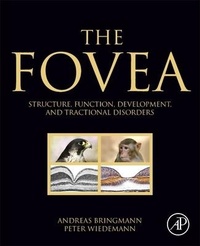
The Fovea
Structure, Function, Development, and Tractional Disorders
Published on 27. August 2021
Book
Paperback/Softback
290 pages
978-0-323-90467-4 (ISBN)
Description
The Fovea: Structure, Function, Development, and Disease summarizes the current biological knowledge regarding the two types of the vertebrate fovea (and its main structural elements, the Mueller cells). This information is then used to explain different aspects of human vision, foveal development, and macular disorders. Sections give an overview of the retinal structure and the different types of retinal glia, survey the structure and function of the primate and non-mammalian fovea types, discuss foveal development-with a focus on the human fovea, cover the roles of Mueller cells and astrocytes in the pathogenesis and regeneration of various human macular disorders are described.
Using a translational approach, this reference is a valuable text for scientists, clinicians and physicians interested in the fovea. Readers will gain a new understanding of the cellular basics of the fovea, which is the most important part of the eye.
Using a translational approach, this reference is a valuable text for scientists, clinicians and physicians interested in the fovea. Readers will gain a new understanding of the cellular basics of the fovea, which is the most important part of the eye.
More details
Language
English
Place of publication
Oxford
United Kingdom
Publishing group
Elsevier Science & Technology
Target group
Professional and scholarly
Ophthalmologists, ophthalmology researchers, physicians and scientists who deal with the fovea at various levels: cell and developmental biologists, histologists, behavioural scientists, comparative biologists
Product notice
Paperback (trade)
Unsewn / adhesive bound
Illustrations
100 illustrations (50 in full color); Illustrations
Dimensions
Height: 235 mm
Width: 191 mm
Weight
810 gr
ISBN-13
978-0-323-90467-4 (9780323904674)
Copyright in bibliographic data and cover images is held by Nielsen Book Services Limited or by the publishers or by their respective licensors: all rights reserved.
Schweitzer Classification
Other editions
Additional editions
Andreas Bringmann | Peter Wiedemann MD
The Fovea
Structure, Function, Development, and Tractional Disorders
E-Book
08/2021
Academic Press
€144.00
Available for download
Persons
Since 1996, the research focus of Dr. Andreas Bringmann has been the Mueller cell and the retina. He studied Biology (Animal Physiology) and worked in the basic sciences after the study. He was from 1990 to 2002 scientific assistant at the Department of Neurophysiology, Paul Flechsig Institute of Brain Research, Medical Faculty of the University of Leipzig (Head of the Department: Andreas Reichenbach, MD). Since 2002, he is the Head of the Research Laboratory of the Department of Ophthalmology and Eye Clinic, Medical Faculty of the University of Leipzig, Leipzig, Germany. He has published 181 peer-reviewed original papers, 30 review articles, 10 book chapters, and 2 books. Dr. Peter Wiedemann is Professor of Ophthalmology at Leipzig University. He is a vitreoretinal specialist whose expertise includes complex vitreoretinal surgery and macular disorders.
Dr. Wiedemann earned his medical degree at Erlangen University, Germany. He started ophthalmic research at the Doheny Eye Institute, Los Angeles, with Dr. Stephen Ryan and completed residency and fellowship in ophthalmology at Cologne University with Prof. Klaus Heimann. In his research Dr. Wiedemann studies retinal and macular disorders and Mueller cells pathophysiology.
He has authored over 500 peer reviewed publications in ophthalmology and is co-editor of the textbook Ryan?s Retina. He is a member of the German National Academy of Sciences Leopoldina, the German Ophthalmological Society, the American Academy of Ophthalmology and the Club Jules Gonin. He is also a Fellow of the Academia Ophthalmologica Internationalis (AOI), the European Academy of Ophthalmology, and a Board Member of the International Council of Ophthalmology (ICO).
Dr. Wiedemann earned his medical degree at Erlangen University, Germany. He started ophthalmic research at the Doheny Eye Institute, Los Angeles, with Dr. Stephen Ryan and completed residency and fellowship in ophthalmology at Cologne University with Prof. Klaus Heimann. In his research Dr. Wiedemann studies retinal and macular disorders and Mueller cells pathophysiology.
He has authored over 500 peer reviewed publications in ophthalmology and is co-editor of the textbook Ryan?s Retina. He is a member of the German National Academy of Sciences Leopoldina, the German Ophthalmological Society, the American Academy of Ophthalmology and the Club Jules Gonin. He is also a Fellow of the Academia Ophthalmologica Internationalis (AOI), the European Academy of Ophthalmology, and a Board Member of the International Council of Ophthalmology (ICO).
Content
1. Introduction: Optical properties of the retina
2. Basic structure of the retina
3. Retinal glia
4. Nonmammalian fovea
5. Primate Fovea
6. Comparison of the nonmammalian and primate fovea
7. Development of the fovea
8. Tractional disorders of the human fovea
2. Basic structure of the retina
3. Retinal glia
4. Nonmammalian fovea
5. Primate Fovea
6. Comparison of the nonmammalian and primate fovea
7. Development of the fovea
8. Tractional disorders of the human fovea