

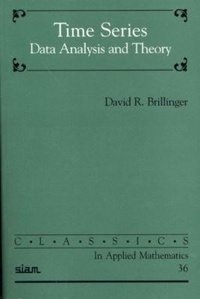
Time Series
Data Analysis and Theory
Published on 1. September 2001
Book
Paperback/Softback
570 pages
978-0-89871-501-9 (ISBN)
Description
Intended for students and researchers, this text employs basic techniques of univariate and multivariate statistics for the analysis of time series and signals. It provides a broad collection of theorems, placing the techniques on firm theoretical ground. The techniques, which are illustrated by data analyses, are discussed in both a heuristic and a formal manner, making the book useful for both the applied and the theoretical worker. An extensive set of original exercises is included.
Time Series: Data Analysis and Theory takes the Fourier transform of a stretch of time series data as the basic quantity to work with and shows the power of that approach. It considers second- and higher-order parameters and estimates them equally, thereby handling non-Gaussian series and nonlinear systems directly. The included proofs, which are generally short, are based on cumulants.
Time Series: Data Analysis and Theory takes the Fourier transform of a stretch of time series data as the basic quantity to work with and shows the power of that approach. It considers second- and higher-order parameters and estimates them equally, thereby handling non-Gaussian series and nonlinear systems directly. The included proofs, which are generally short, are based on cumulants.
More details
Edition
Revised edition
Language
English
Place of publication
Philadelphia
United States
Target group
Professional and scholarly
Product notice
Paperback (trade)
Unsewn / adhesive bound
Dimensions
Height: 228 mm
Width: 152 mm
Thickness: 28 mm
Weight
721 gr
ISBN-13
978-0-89871-501-9 (9780898715019)
Schweitzer Classification
Content
Preface; 1. The nature of time series and their frequency analysis; 2. Foundations; 3. Analytic properties of Fourier transforms and complex matrices; 4. Stochastic properties of finite Fourier transforms; 5. The estimation of power spectra; 6: Analysis of a linear time invariant relation between a stochastic series and several deterministic series; 7. Estimating the second-order spectra of vector-valued series; 8. Analysis of a linear time invariant relation between two vector-valued stochastic series; 9. Principal components in the frequency domain; 10. The canonical analysis of time series; Proofs of theorems; References; Notation index; Author index; Subject index; Addendum.