

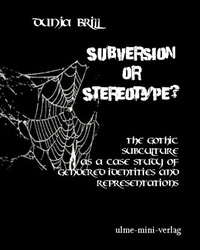
Subversion or Stereotype?
The Gothic Subculture as a Case Study of Gendered Identities and Representations
1st Edition
Published on 11. October 2006
Book
Paperback/Softback
312 pages
978-3-9809038-9-9 (ISBN)
Description
This thesis undertakes a qualitative analysis of gendered identities and representations in the sartorial styles and alternative media of the Gothic subculture in Britain and Germany. The aim is to explore discursive constructions of masculinity and femininity within this subculture, and particularly to highlight the tension between 'subversive' and 'stereotypical' elements in such constructions. Through an in-depth textual analysis of ethnographic interviews, Internet forum content and music fanzines/magazines, gender-related norms and values in Goth are traced across different practices or aspects of the subculture; namely dress, male-female relations, sexualities and music. The analysis reveals a gendered hierarchy of subcultural capital (i.e. subcultural mechanisms of status attainment) lurking behind the ideology of 'genderlessness' pervading Goth rhetoric. Certain constitutive practices of the Gothic scene which supposedly hold progressive or subversive implications in terms of gender - e.g. the idealisation of male androgyny in Goth style, or the veneration of alternative sexualities as a trope of transgression - are shown to partly serve the cementation of stereotypical gender norms within the subculture. However, the analysis also points to the potential for progressive gender politics some of these practices offer. In the sartorial, musical and discursive practices of Goths, many explorative renegotiations of traditional constructions of masculinity and femininity can be found. It is concluded that to reach a full understanding of the socio-political relevance of subcultural practices, it is imperative to consider both the micro-political (i.e. individual or intra-subcultural) and macro-political (i.e. concerning general culture) dimensions of such practices. From this dual perspective, it becomes apparent that gender-related codes and practices which cement restrictive gender norms and status hierarchies internal to a subculture can simultaneously work to challenge gender stereotypes in society at large, and vice versa. Finally, the notion of subculture as a postmodern preserve for collective Utopian impulses is rendered problematic.
More details
Thesis
Doctoral thesis
2006
University of Sussex
Edition
1., Aufl.
Language
English
Place of publication
Giessen
Germany
Target group
Professional and scholarly
Adult education
Young adult
Illustrations
22
22 s/w Abbildungen
Dimensions
Height: 21 cm
Width: 14.8 cm
ISBN-13
978-3-9809038-9-9 (9783980903899)
Schweitzer Classification
Persons
Author
Editor
Kulturwissenschaftlerin
Martina Claus-Bachmann ist promovierte und habilitierte Kulturwissenschaftlerin, Ethnomusikologin und Musikpädagogin mit Feldforschungserfahrung in Indonesien und Sri Lanka, langjähriger Lehrerfahrung an allgemeinbildenden Schulen, Instituten und Universitäten und Erfahrung als Mediengestalterin für den ulme-mini-verlag. Schwerpunkt ihrer Forschung, Lehre und Publikationsaktivität ist die Frage nach der kulturellen Identität des einzelnen, seiner Konstruktionskompetenz und Teilnahme an dynamischen kulturellen Systemen. Zu letzteren zählen neben traditionellen auch urbane und als Subkulturen bezeichnete kulturelle Systeme. Weiterführende Informationen zu Person und Werk auf folgender Webpage: http://www.ethnomusicscape.de/mclba.htm.
GND:
Martina Claus-Bachmann ist promovierte und habilitierte Kulturwissenschaftlerin, Ethnomusikologin und Musikpädagogin mit Feldforschungserfahrung in Indonesien und Sri Lanka, langjähriger Lehrerfahrung an allgemeinbildenden Schulen, Instituten und Universitäten und Erfahrung als Mediengestalterin für den ulme-mini-verlag. Schwerpunkt ihrer Forschung, Lehre und Publikationsaktivität ist die Frage nach der kulturellen Identität des einzelnen, seiner Konstruktionskompetenz und Teilnahme an dynamischen kulturellen Systemen. Zu letzteren zählen neben traditionellen auch urbane und als Subkulturen bezeichnete kulturelle Systeme. Weiterführende Informationen zu Person und Werk auf folgender Webpage: http://www.ethnomusicscape.de/mclba.htm.
GND: