

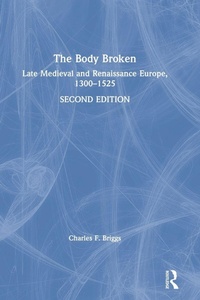
The Body Broken
Late Medieval and Renaissance Europe, 1300-1525
2nd Edition
Published on 15. July 2019
Book
Hardback
348 pages
978-1-138-84227-4 (ISBN)
Description
The Body Broken is a thematic survey of Europe in the late Middle Ages, a period of huge crisis, conflict and religious change that included the Black Death, the Reformation, the Peasants' Revolt and the Renaissance.
This thoroughly updated and revised second edition retains the thematic approach of the first edition, combining sweeping interpretive synthesis with careful attention to recent and revisionist scholarship. It also devotes more attention to the histories of women and religious minorities, Renaissance humanism, politics and government in Italy and eastern Europe, and the religious reformations of the early sixteenth century. Examining late medieval and Renaissance Europe in the context of its place within global history, this book covers all the key areas, including:
society and the economy - disaster and demography; individuals, families and communities; trade, technology, exploration and new discoveries;
politics - government and the state; political developments; war, chivalry and crusading;
religion - the institutional Church; Catholic devotion; religious minorities and dissenting beliefs and practices; religious reformations;
culture - schooling and intellectual developments; language, literacy and the arts.
Equipped with maps, tables, illustrations, a chronology and an annotated bibliography, The Body Broken is an essential and complete student's guide to Europe in the fourteenth to early sixteenth centuries.
This thoroughly updated and revised second edition retains the thematic approach of the first edition, combining sweeping interpretive synthesis with careful attention to recent and revisionist scholarship. It also devotes more attention to the histories of women and religious minorities, Renaissance humanism, politics and government in Italy and eastern Europe, and the religious reformations of the early sixteenth century. Examining late medieval and Renaissance Europe in the context of its place within global history, this book covers all the key areas, including:
society and the economy - disaster and demography; individuals, families and communities; trade, technology, exploration and new discoveries;
politics - government and the state; political developments; war, chivalry and crusading;
religion - the institutional Church; Catholic devotion; religious minorities and dissenting beliefs and practices; religious reformations;
culture - schooling and intellectual developments; language, literacy and the arts.
Equipped with maps, tables, illustrations, a chronology and an annotated bibliography, The Body Broken is an essential and complete student's guide to Europe in the fourteenth to early sixteenth centuries.
Reviews / Votes
'The Body Broken is a lucid and carefully considered study of the structures of power in Europe after 1300. Charles Briggs confidently handles the dynamic ideals and the messy realities of medieval life, as individuals and communities sought to make themselves into a whole body out of the suffering fragments they all too often saw around them. A book which will stimulate teachers, and inform and inspire students.'Miri Rubin, Queen Mary University of London, UK
'The first edition of The Body Broken received glowing reviews and so students, teachers and general readers will welcome this revised and updated second edition. The book provides an ideal introduction to European history in the fourteenth, fifteenth and early sixteenth centuries and is attractively and engagingly written. It is comprehensive in its scope, ranging across economic, social, political, intellectual and cultural history, dispels many myths about the period, and engages with the most recent scholarship in the field. The volume is well-provided with illustrations and maps and makes a telling use of quotations from contemporary primary sources. Even those who are already familiar with this period will find new information, ideas and approaches within its pages.'
Stephen H. Rigby, University of Manchester, UK
'This is by far the best textbook available for undergraduates studying late medieval and Renaissance Europe. Students are introduced with admirable clarity and concision to the latest scholarly perspectives on all the major themes in this period, including to complex and hotly contested topics such as the origins and spread of Italian humanism (one of several areas updated and expanded in this second edition). Briggs has an eye for the most evocative examples to illustrate his points. His writing is simultaneously accessible and able to convey sophisticated interpretations, which link key themes together in ways that students getting to grips with the fourteenth and fifteenth centuries are sure to appreciate.'
Duncan Hardy, University of Central Florida, USA
More details
Edition
2nd edition
Language
English
Place of publication
London
United Kingdom
Publishing group
Taylor & Francis Ltd
Target group
College/higher education
Illustrations
25 s/w Photographien bzw. Rasterbilder, 1 s/w Zeichnung, 11 s/w Tabellen
11 Tables, black and white; 1 Line drawings, black and white; 25 Halftones, black and white
Dimensions
Height: 260 mm
Width: 183 mm
Thickness: 23 mm
Weight
854 gr
ISBN-13
978-1-138-84227-4 (9781138842274)
Copyright in bibliographic data and cover images is held by Nielsen Book Services Limited or by the publishers or by their respective licensors: all rights reserved.
Schweitzer Classification
Other editions
Additional editions

E-Book
07/2019
2nd Edition
Routledge
€40.49
Not yet available
E-Book
07/2019
2nd Edition
Routledge
€40.49
Not yet available
Book
07/2019
2nd Edition
Routledge
€62.00
Shipment within 10-20 days
Previous edition
Book
10/2010
1st Edition
Routledge
€178.56
Withdrawn from sale
Person
Charles F. Briggs is Senior Lecturer in History at the University of Vermont. He has published numerous books and articles on the history of late medieval intellectual and political culture, including the recent edited volume (with P.S. Eardley) A Companion to Giles of Rome (2016).
Content
PART I Social and economic change; 1 The demography of disaster; 2 Individuals, families and communities; 3 Trade, technology and exploration; PART II Political developments; 4 The theory and ideology of government; 5 The lineaments and limits of state power; 6 War, chivalry and crusading; PART III Religion and devotion; 7 The Bride of Christ: the institutional Church; 8 Devotion: Catholic and dissenting beliefs and practices; PART IV Cultural change; 9 Schools, schooling and intellectual developments; 10 Language, literacy and the arts; Conclusion: A new Europe?; Chronology; Suggested further reading; Bibliography; Index of persons; Index of places; Subject index