

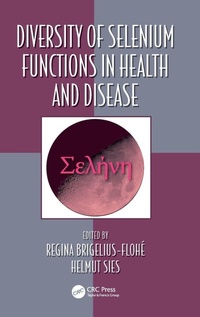
Diversity of Selenium Functions in Health and Disease
1st Edition
Published on 14. August 2015
Book
Hardback
430 pages
978-1-4822-5126-5 (ISBN)
Description
Named after Selene, Greek goddess of the moon, selenium (Se) has moved has moved from being thought of as a toxicant to being considered an essential nutrient with the potential to reduce cancer risk in the span of seven decades. Diversity of Selenium Functions in Health and Disease focuses on current knowledge of aspects of Se research relevant to its medical use, and particularly to chemoprevention of cancer. It covers how Se is integrated into selenoproteins, selenium compounds with individual functions and dual functions, and unexpected links to Se such as with diabetes. The text ends with a discussion of polymorphisms and mutations in genes of selenoproteins.
The chapters elucidate why studies undertaken to prevent diseases with selenium ended with disappointing outcomes and often with the opposite result, i.e. disease promotion. They show that benefit, failure, or side effects depend on:
The chemical form and dose of selenium
The selenium status of the individual ingesting selenium
The capacity of selenium form to serve as a source for selenoprotein biosynthesis
The function of selenoproteins reacting to a change in the selenium status
The stage of the disease (mainly cancer) at the time point of intervention
The genetic background of individuals to be treated
Bringing together the accumulated evidence regarding selenium biochemistry, the book covers aspects not found in available general monographs. The narrow focus on medical uses of Se helps resolve the present confusion about potential benefits and hazards of selenium in human health. The book gives you a solid scientific basis for optimum use of selenium in preventing or treating human diseases and answering the questions: Why is selenium essential? How much is required? What are the health consequences of low selenium and can selenium reduce cancer risk?
The chapters elucidate why studies undertaken to prevent diseases with selenium ended with disappointing outcomes and often with the opposite result, i.e. disease promotion. They show that benefit, failure, or side effects depend on:
The chemical form and dose of selenium
The selenium status of the individual ingesting selenium
The capacity of selenium form to serve as a source for selenoprotein biosynthesis
The function of selenoproteins reacting to a change in the selenium status
The stage of the disease (mainly cancer) at the time point of intervention
The genetic background of individuals to be treated
Bringing together the accumulated evidence regarding selenium biochemistry, the book covers aspects not found in available general monographs. The narrow focus on medical uses of Se helps resolve the present confusion about potential benefits and hazards of selenium in human health. The book gives you a solid scientific basis for optimum use of selenium in preventing or treating human diseases and answering the questions: Why is selenium essential? How much is required? What are the health consequences of low selenium and can selenium reduce cancer risk?
More details
Language
English
Place of publication
Bosa Roca
United States
Publishing group
Taylor & Francis Inc
Target group
College/higher education
Professional Reference
Illustrations
36 b/w images and 18 tables
Dimensions
Height: 240 mm
Width: 161 mm
Thickness: 28 mm
Weight
810 gr
ISBN-13
978-1-4822-5126-5 (9781482251265)
Copyright in bibliographic data and cover images is held by Nielsen Book Services Limited or by the publishers or by their respective licensors: all rights reserved.
Schweitzer Classification
Other editions
Additional editions
Regina Brigelius-Flohe | Helmut Sies
Diversity of Selenium Functions in Health and Disease
Book
09/2019
1st Edition
CRC Press
€84.24
Shipment within 15-20 days
Regina Brigelius-Flohe | Helmut Sies
Diversity of Selenium Functions in Health and Disease
E-Book
08/2015
CRC Press
€89.99
Available for download
Regina Brigelius-Flohe | Helmut Sies
Diversity of Selenium Functions in Health and Disease
E-Book
08/2015
CRC Press
€89.99
Available for download
Persons
Helmut Sies, M.D., Ph.D.(hon), studied medicine at the Universities of Tuebingen, Paris and Munich, and did the habilitation for physiological chemistry and physical biochemistry at the University of Munich. He spent sabbaticals at the University of Buenos Aires, Argentina, University of California at Berkeley, USA, at the University of Siena, Italy, and the Heart Research Institute, Sydney, Australia. He was chair of the Department of Biochemistry and Molecular Biology I at Heinrich-Heine-University Duesseldorf, Germany, where he now is an emeritus professor. He also is senior scientist at the Leibniz Research Institute for Environmental Medicine at Duesseldorf, and adjunct professor at the University of Southern California, and a professor of biochemistry at King Saud University, Riyadh, Saudi-Arabia. He served as president of the Society for Free Radical Research International and of the Oxygen Club of California (OCC). He is a Fellow of the National Foundation for Cancer Research (NFCR), Bethesda, MD, USA, and of the Royal College of Physicians (FRCP), London, England. He is member of the German National Academy of Sciences Leopoldina. His research interests include hydrogen peroxide metabolism, oxidative stress, redox signaling and micronutrients, notably flavonoids, carotenoids and selenium.
Regina Brigelius-Flohe received her PhD in Biochemistry in Tuebingen and Muenster, Germany in 1978. During a post-doctoral fellowship in Munich and Duesseldorf together with Helmut Sies she investigated the cellular thiol-disulfide status in perfused organs under various conditions of oxidative stress. The detection and analysis of mixed disulfides of proteins and glutathione provided a basis for the regulation of enzyme activities by thiol modification, a field which is now expanding and known as redox regulation. In 1984 changed to pharmaceutical industry and was heading a Molecular Biology Lab and later the Department of M
Regina Brigelius-Flohe received her PhD in Biochemistry in Tuebingen and Muenster, Germany in 1978. During a post-doctoral fellowship in Munich and Duesseldorf together with Helmut Sies she investigated the cellular thiol-disulfide status in perfused organs under various conditions of oxidative stress. The detection and analysis of mixed disulfides of proteins and glutathione provided a basis for the regulation of enzyme activities by thiol modification, a field which is now expanding and known as redox regulation. In 1984 changed to pharmaceutical industry and was heading a Molecular Biology Lab and later the Department of M
Content
INTRODUCTION. Who Can Benefit from Selenium? SE COMPOUNDS AS A SOURCE FOR SELENOPROTEIN BIOSYNTHESIS. Selenium Metabolism. The Molecular Regulation of Selenocysteine Incorporation into Proteins in Eukaryotes. Selenocysteine tRNA[Ser]Sec: The Central Component of Selenoprotein Biosynthesis. SE COMPOUNDS WITH SPECIFIC FUNCTIONS. Redox Cycling and the Toxicity of Selenium Compounds: A Historical View. Selenite in Cancer Therapy. Forms of Selenium in Cancer Prevention. DUAL FUNCTIONS OF SELENOPROTEINS IN CANCER. Thioredoxin Reductase. Glutathione Peroxidase. The 15-kDa Selenoprotein (Sep15). UNEXPECTED LINKS. Multifaceted and Intriguing Effects of Selenium and Selenoproteins on Glucose Metabolism and Diabetes. Selenoproteins and the Metabolic Syndrome. Thioredoxin Reductase: A Coordinator in Metabolic Activities. Selenium Mediates a Switch in Macrophage Polarization. SELENOPROTEIN POLYMORPHISMS AND MUTATIONS. Genetic Polymorphisms in Selenoprotein Genes: Functionality and Disease Risk. Mutations in SECISBP.