

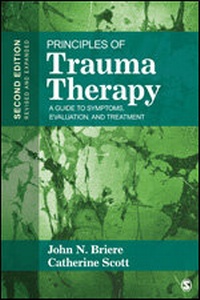
Principles of Trauma Therapy
A Guide to Symptoms, Evaluation, and Treatment
2nd Edition
Published on 11. October 2012
Book
Paperback/Softback
384 pages
978-1-4129-8143-9 (ISBN)
Description
This is a book on modern treatment of psychological trauma that is both comprehensive in scope yet highly practical in application.It is written for the average trauma clinician (or clinician new to the field who is confronted with a trauma client) to use in his or her daily work.
- easy-to-read writing style
- translating complex medical and neurological concepts for therapists and practitioners
- comprehensive pharmacology update
- coverage of all stages of symptoms, evaluation and treatment
- easy-to-read writing style
- translating complex medical and neurological concepts for therapists and practitioners
- comprehensive pharmacology update
- coverage of all stages of symptoms, evaluation and treatment
More details
Edition
2nd Revised edition
Language
English
Place of publication
Thousand Oaks
United States
Target group
Professional and scholarly
Edition type
Revised edition
Dimensions
Height: 254 mm
Width: 178 mm
Weight
615 gr
ISBN-13
978-1-4129-8143-9 (9781412981439)
Copyright in bibliographic data and cover images is held by Nielsen Book Services Limited or by the publishers or by their respective licensors: all rights reserved.
Schweitzer Classification
Other editions
New editions
John N. Briere | Catherine Scott
Principles of Trauma Therapy
A Guide to Symptoms, Evaluation, and Treatment ( DSM-5 Update)
Book
05/2014
2nd Edition
SAGE Publications Inc
€141.50
Article exhausted; check for reprint
Previous edition
John N. Briere | Catherine Scott
Principles of Trauma Therapy
A Guide to Symptoms, Evaluation, and Treatment
Book
07/2006
1st Edition
SAGE Publications Inc
€69.51
Article exhausted; check for reprint
Persons
John N. Briere, PhD is Professor Emeritus of Psychiatry and the Behavioral Sciences at the Keck School of Medicine, University of Southern California, and is past director of the Psychological Trauma Program at Los Angeles County + USC Medical Center. A past president of the International Society for Traumatic Stress Studies (ISTSS), he is recipient of the Award for Outstanding Contributions to the Science of Trauma Psychology from the American Psychological Association, the Robert S. Laufer Memorial Award for Scientific Achievement from ISTSS, the Presidential Award for Contribution to Methods from the Association for Scientific Advancement in Psychological Injury and Law, and the William N. Friedrich Lecturer: Outstanding Contribution to the Field of Child Psychology from the Mayo Clinic. A long-term student of Buddhist psychology, he has been Remote Faculty at the Institute for Meditation and Psychotherapy since 2013.
Catherine Scott, MD, is Assistant Clinical Professor of Psychiatry and the Behavioral Sciences at the Keck School of Medicine of the University of Southern California. Her academic background includes Harvard College, Columbia University College of Physicians and Surgeons, and psychiatric residency training at both Cornell and USC. Previously, Dr. Scott served as Medical Director of the Psychological Trauma Program at Los Angeles County + USC Medical Center, and the Associate Medical Director of the Psychiatric Emergency Service at Los Angeles County + USC Medical Center. In that capacity she taught and supervised resident physicians and medical students in the assessment and treatment of trauma-related disorders arising from sexual and physical violence, torture, child abuse, and other forms of interpersonal violence. She continues to practice as well as teach residents at USC, and serves as an expert witness in the areas of trauma and posttraumatic stress. Her clinical and research interests include women's issues, treatment of adult survivors of child abuse, human rights, and the remediation of sexual violence and its effects.
Catherine Scott, MD, is Assistant Clinical Professor of Psychiatry and the Behavioral Sciences at the Keck School of Medicine of the University of Southern California. Her academic background includes Harvard College, Columbia University College of Physicians and Surgeons, and psychiatric residency training at both Cornell and USC. Previously, Dr. Scott served as Medical Director of the Psychological Trauma Program at Los Angeles County + USC Medical Center, and the Associate Medical Director of the Psychiatric Emergency Service at Los Angeles County + USC Medical Center. In that capacity she taught and supervised resident physicians and medical students in the assessment and treatment of trauma-related disorders arising from sexual and physical violence, torture, child abuse, and other forms of interpersonal violence. She continues to practice as well as teach residents at USC, and serves as an expert witness in the areas of trauma and posttraumatic stress. Her clinical and research interests include women's issues, treatment of adult survivors of child abuse, human rights, and the remediation of sexual violence and its effects.
Content
Introduction
Part I: Trauma, Effects, and Assessment
1. What is Trauma?
2. The Effects of Trauma
3. Assessing Trauma and Posttraumatic Outcomes
Part II: Clinical Interventions
4. Central Issues in Trauma Treatment
5. Psychoeducation
6. Distress Reduction and Affect Regulation Training
7. Cognitive Interventions
8. Emotional Processing
9. Increasing Identity and Relational Functioning
10. Mindfulness in Trauma Treatment
11. Treating the Effects of Acute Trauma
12. Psychobiology and Psychopharmacology of Trauma
13. Conclusions
References
Part I: Trauma, Effects, and Assessment
1. What is Trauma?
2. The Effects of Trauma
3. Assessing Trauma and Posttraumatic Outcomes
Part II: Clinical Interventions
4. Central Issues in Trauma Treatment
5. Psychoeducation
6. Distress Reduction and Affect Regulation Training
7. Cognitive Interventions
8. Emotional Processing
9. Increasing Identity and Relational Functioning
10. Mindfulness in Trauma Treatment
11. Treating the Effects of Acute Trauma
12. Psychobiology and Psychopharmacology of Trauma
13. Conclusions
References