

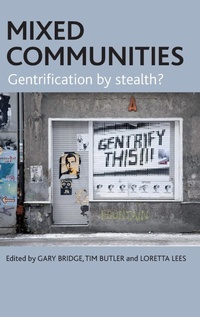
Mixed Communities
Gentrification by Stealth?
1st Edition
Published on 19. October 2011
Book
Hardback
384 pages
978-1-84742-493-8 (ISBN)
Description
Encouraging neighbourhood social mix has been a major goal of urban policy and planning in a number of different countries. This book draws together a range of case studies by international experts to assess the impacts of social mix policies and the degree to which they might represent gentrification by stealth.
The contributions consider the range of social mix initiatives in different countries across the globe and their relationship to wider social, economic and urban change. The book combines understandings of social mix from the perspectives of researchers, policy makers and planners and the residents of the communities themselves. Mixed Communities also draws out more general lessons from these international comparisons - theoretically, empirically and for urban policy. It will be highly relevant for urban researchers and students, policy makers and practitioners alike.
The contributions consider the range of social mix initiatives in different countries across the globe and their relationship to wider social, economic and urban change. The book combines understandings of social mix from the perspectives of researchers, policy makers and planners and the residents of the communities themselves. Mixed Communities also draws out more general lessons from these international comparisons - theoretically, empirically and for urban policy. It will be highly relevant for urban researchers and students, policy makers and practitioners alike.
Reviews / Votes
"This volume is extremely useful for anyone hoping to get to grips with the complex and little-understood issues regarding social mix policy and gentrification." LSE Review of Books "This collection is the definitive analysis of today's urban policy paradox: a friendly language of community and inclusion used to justify policies that threaten exactly what they name - social mix and diversity." Elvin Wyly, Chair of Urban Studies Programme, University of British ColumbiaMore details
Edition
First Edition
Language
English
Place of publication
Bristol
United Kingdom
Publishing group
Bristol University Press
Target group
College/higher education
Illustrations
Not illustrated
Dimensions
Height: 240 mm
Width: 161 mm
Thickness: 25 mm
Weight
743 gr
ISBN-13
978-1-84742-493-8 (9781847424938)
Copyright in bibliographic data and cover images is held by Nielsen Book Services Limited or by the publishers or by their respective licensors: all rights reserved.
Schweitzer Classification
Other editions
Additional editions
Book
10/2012
1st Edition
Policy Press
€46.00
Shipment within 15-20 days
E-Book
10/2011
1st Edition
Policy Press
€124.09
Available for download
Persons
Gary Bridge is Professor of Urban Studies at the School for Policy Studies, University of Bristol. He has published extensively on gentrification, class and social change in cities as well as on questions of urban theory.
Tim Butler is Professor of Human Geography at King's College, London and the Vincent Wright Visiting Professor of Sociology at Sciences Po, Paris. He is the author of several books on social change in London and has also written on social class and inequality.
Loretta Lees is Professor of Geography at King's College London, U.K. She has published extensively on gentrification, urban regeneration and urban policy in both Europe and North America.
Tim Butler is Professor of Human Geography at King's College, London and the Vincent Wright Visiting Professor of Sociology at Sciences Po, Paris. He is the author of several books on social change in London and has also written on social class and inequality.
Loretta Lees is Professor of Geography at King's College London, U.K. She has published extensively on gentrification, urban regeneration and urban policy in both Europe and North America.
Content
Introduction: Gentrification and social mix ~ Loretta Lees, Tim Butler and Gary Bridge; Part one: Reflections on social mix policy: Why do birds of a feather flock together? Social mix and social welfare: A quantitative appraisal ~ Paul Cheshire; Social mix and urban policy ~ Patrick Le Gales; Mixed communities and urban policy: Reflections from the UK ~ Rebecca Tunstall; Gentrification without social mixing in the rapidly urbanising world of Australasia ~ Wendy Shaw; Part two: Social mix in liberal and neoliberal times: Social mixing and the historical geography of gentrification ~ David Ley; HafenCity, Hamburg, Germany: Social mix as a 21st century planning goal ~ Juergen Bruns-Berentelg; Part three: Social mix policies and gentrification: Mixed income schools and housing policy in Chicago: A critical examination of the gentrification/education/'racial' exclusion nexus ~ Pauline Lipman; Social mix as the aim of a controlled gentrification process: The example of the Goutte d'Or district in Paris ~ Marie-Helene Bacque and Yankel Fijalkow; Beware the Trojan horse: Contructions of social mix in Melbourne ~ Kate Shaw; Part four: The rhetoric and reality of social mix policies: Social mixing as a cure for negative neighbourhood effects: Evidence based policy or urban myth? ~ David Manley, Maarten van Ham and Joe Doherty; Meanings, politics and realities of social mix and gentrification - A view from Brussels ~ Mathieu Van Criekingen; 'Regeneration' in interesting times: A story of privatisation and gentrification in a peripheral Scottish city ~ Sarah Glynn; HOPE VI: Calling for modesty in its claims ~ James Fraser, James DeFilippis and Joshua Bazuin; Part five: Experiencing social mix: The impossibility of gentrification and social mixing ~ Mark Davidson; Not the only power in town? Challenging binaries and bringing the working class into gentrification research ~ Kirsteen Patton; From social mix to political marginalisation? The redevelopment of Toronto's public housing and the dilution of tenant organizational power ~ Martine August and Alan Walks; Mixture without mating: Partial gentrification in the case of Rotterdam, the Netherlands ~ Talja Blokland and Gwen van Eijk; Afterword ~ Gary Bridge, Tim Butler and Loretta Lees.