

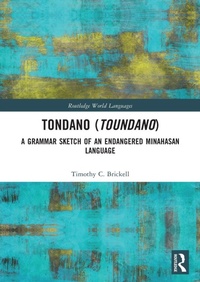
Tondano (Toundano)
A Grammar Sketch of an Endangered Minahasan Language
1st Edition
Published on 26. August 2024
Book
Paperback/Softback
266 pages
978-1-032-25302-2 (ISBN)
Description
This monograph is a grammatical description of Tondano, an endangered and under-documented Austronesian (AN) language spoken in the northern part of the island of Sulawesi, Indonesia. It is a modified version of the related doctoral dissertation completed at La Trobe University, Bundoora, Victoria, Australia (2015). The chapters herein begin by outlining relevant socio-historical information relating to the Tondano speech community, before providing detailed explanations of the sound system (phonetics and phonology), word structure (morphology), and phrase and sentence structure (syntax) of the language. This description seeks to be as complete as possible, while at the same time acknowledging any descriptive shortcomings, either due to a lack of data, a lack of analytical clarity, or simply due to considerations of space.
The data used for this grammar come from extensive in situ fieldwork (2011-2015). In essence, the analysis takes a theory-neutral approach. While it does not utilise a specific theoretical framework, parts of the terminology, methodology, and analysis conform to those of Basic Linguistic Theory. There is a strong emphasis on using data which are as naturalistic as possible, and which has been collected, collated, and analysed in collaboration with native speakers in the Tondano speech community. For all levels of linguistic structure under description, language examples taken from primarily spontaneous communicative events are provided. In terms of issues relating to Austronesian typology, and aspects of broader cross-linguistic typology, these are mentioned where deemed necessary but are not the primary focus of this work.
The principal audience for this book is scholars and students of languages and linguistics, along with anyone with an interest in the anthropology and linguistics of the Austronesian cultures of Maritime Southeast Asia.
The data used for this grammar come from extensive in situ fieldwork (2011-2015). In essence, the analysis takes a theory-neutral approach. While it does not utilise a specific theoretical framework, parts of the terminology, methodology, and analysis conform to those of Basic Linguistic Theory. There is a strong emphasis on using data which are as naturalistic as possible, and which has been collected, collated, and analysed in collaboration with native speakers in the Tondano speech community. For all levels of linguistic structure under description, language examples taken from primarily spontaneous communicative events are provided. In terms of issues relating to Austronesian typology, and aspects of broader cross-linguistic typology, these are mentioned where deemed necessary but are not the primary focus of this work.
The principal audience for this book is scholars and students of languages and linguistics, along with anyone with an interest in the anthropology and linguistics of the Austronesian cultures of Maritime Southeast Asia.
More details
Series
Language
English
Place of publication
London
United Kingdom
Publishing group
Taylor & Francis Ltd
Target group
Professional and scholarly
Academic
Illustrations
15 s/w Abbildungen, 14 s/w Photographien bzw. Rasterbilder, 1 s/w Zeichnung, 77 s/w Tabellen
77 Tables, black and white; 1 Line drawings, black and white; 14 Halftones, black and white; 15 Illustrations, black and white
Dimensions
Height: 246 mm
Width: 174 mm
Thickness: 15 mm
Weight
511 gr
ISBN-13
978-1-032-25302-2 (9781032253022)
Copyright in bibliographic data and cover images is held by Nielsen Book Services Limited or by the publishers or by their respective licensors: all rights reserved.
Schweitzer Classification
Other editions
Additional editions
E-Book
12/2022
1st Edition
Routledge
€55.49
Available for download
E-Book
12/2022
1st Edition
Routledge
€55.49
Available for download
Book
12/2022
1st Edition
Routledge
€186.40
Shipment within 10-20 days
Person
Timothy C. Brickell is a linguist who is currently based at the University of Melbourne. He has been conducting fieldwork-based research in North Sulawesi since 2011 with the aim of documenting and describing the languages and cultures of indigenous communities in the Minahasa and Southeast Minahasa regencies. This research has produced digital multi-media content documenting traditional work-related, crafting, social, and ritualistic activities, as well as descriptions of various levels of language structure, such as those put forward in this monograph.
Content
Contents
List of figures
List of tables
Acknowledgements
Abbreviations
1 Introduction
1.1 Minahasa: population, geography, and economy
1.2 History and culture of the region
1.2.1 Minahasa in pre-colonial times
1.2.2 Colonisation: the 1500s onwards
1.2.3 Minahasa in the modern age
1.3 The languages of North Sulawesi
1.3.1 Indigenous languages of North Sulawesi
1.3.2 The Minahasan micro-group
1.3.3 Languages of wider communication
1.3.4 Linguistic vitality
1.3.5 Community attitudes
1.3.6 Previous descriptive work and major sources
1.4 Fieldwork and the data corpus
2 Phonetics and phonology
2.1 Phoneme inventory
2.1.1 Evidence for phonemic contrasts: minimal pairs
2.2 Distribution and allophonic variation
2.2.1 Consonant phonemes
2.2.2 Oral plosives
2.2.3 Nasals
2.2.4 Glides
2.2.5 Liquids
2.2.6 Fricatives
2.2.7 Vowel phonemes
2.3 Syllable structure and phonotactics
2.3.1 Syllable structure
2.3.2 Consonant clusters
2.3.3 Vowel sequences
2.3.4 Syllable sequences
2.3.5 Stress assignment
2.4 Morphophonological processes
2.4.1 Nasal assimilation
2.4.2 Nasal substitution
2.4.3 Pseudo nasal substitution
2.4.4 Reduplication
2.4.5 Vowel deletion
2.4.6 Consonant deletion
2.4.7 Epenthesis .
3 Morphology and word formation
3.1 Words: phonological and grammatical
3.1.1 Phonological words
3.1.2 Grammatical words
3.2 Roots and stems
3.2.1 Roots
3.2.2 Stems
3.3 Inflection and derivation
3.4 Affixes
3.4.1 Prefixes
3.4.2 Infixes .
3.4.3 Suffixes
3.4.4 Circumfixes
3.4.5 Affix ordering
3.5 Clitics
3.5.1 Proclitics
3.5.2 Enclitics
3.5.3 Clitic ordering
4 Lexical categories
4.1 Lexical categories and morphosyntactic categories
4.2 Nouns
4.2.1 Common and proper nouns
4.2.2 Temporal nouns
4.2.3 Locative nouns
4.2.4 Nominalisation
4.3 Verbs
4.3.1 Monovalent verbs
4.3.2 Bivalent verbs
4.3.3 Modal auxiliary verbs
4.4 Pronouns
4.4.1 Independent pronouns
4.4.2 Proclitic pronouns
4.4.3 Enclitic pronouns
4.4.4 Non-specific referents anu and ano
4.5 Adverbs
4.5.1 Degree adverbs
4.5.2 Focussing adverbs
4.5.3 Evidential and epistemic adverbs
4.5.4 Temporal adverbs
4.6 Demonstratives
4.6.1 Demonstrative attributives
4.6.2 Demonstrative pronouns
4.7 Quantifiers (non-numeral)
4.8 Numerals
4.8.1 Simplex cardinal numerals
4.8.2 Complex cardinal numerals
4.8.3 Ordinal numerals
4.8.4 Fractions
4.8.5 Multiplicatives
4.9 Prepositions
4.10 Conjunctions
4.11 Particles
4.11.1 Interjections and exclamations
4.11.2 Directional particles =la, =mee, and =mi
4.11.3 Completive =mou and incompletive =pe'
4.11.4 Verbal particle nei
5 Basic morphosyntax
5.1 Grammatical relations and semantic roles
5.1.1 Nominative
5.1.2 Accusitive
5.1.3 Genitive
5.2 Transitivity
5.2.1 Intransitive clauses
5.2.2 Transitive clauses
5.3 Verbal clause structure
5.3.1 Actor voice clauses
5.3.2 Undergoer voice clauses
5.3.3 Topicalisation
5.4 Non-verbal clauses
5.4.1 Existential clauses
5.4.2 Equative and attributive clauses
5.5 Other clause types
5.5.1 Question formation
5.5.2 Negation and prohibitives
5.5.3 Imperatives and adhortatives
5.6 Noun phrases and prepositional phrases
5.6.1 Noun phrases
5.6.2 Phrase marking
5.6.3 Possession
5.6.4 Prepositional phrases
5.7 Complex clauses
5.7.1 Complex multi-verbal predicates
5.7.2 Coordination
5.7.3 Relative clauses
5.7.4 Adverbial clauses
5.7.5 Complement clauses
5.7.6 Indirect speech
6 Major verbal alternations 183
6.1 Voice marking
6.1.1 Morphosyntactic typology and alignment
6.1.2 Actore voice
6.1.3 Patient voice
6.1.4 Locative voice
6.1.5 Conveyance voice
6.2 Dynamic, Potentive, and Stative morphology
6.2.1 Dynamic pa-/peN-
6.2.2 Potentive ka-
6.2.3 Stative ka-
6.3 Tense, aspect, and mood
6.3.1 Tense
6.3.2 Aspect
6.3.3 Mood
6.4 Completive prefix paka-
6.5 Manner marking prefix kapa-
6.6 Causative prefix pa-
6.7 Reciprocal and comitative (mutual) suffix -an
6.8 Reflexives: sandiri, nu esa, and nu waya
6.9 Requestive prefix paki-
7 Example text 224
7.1 Collecting and cooking wate 'sago grubs'
Bibliography
List of figures
List of tables
Acknowledgements
Abbreviations
1 Introduction
1.1 Minahasa: population, geography, and economy
1.2 History and culture of the region
1.2.1 Minahasa in pre-colonial times
1.2.2 Colonisation: the 1500s onwards
1.2.3 Minahasa in the modern age
1.3 The languages of North Sulawesi
1.3.1 Indigenous languages of North Sulawesi
1.3.2 The Minahasan micro-group
1.3.3 Languages of wider communication
1.3.4 Linguistic vitality
1.3.5 Community attitudes
1.3.6 Previous descriptive work and major sources
1.4 Fieldwork and the data corpus
2 Phonetics and phonology
2.1 Phoneme inventory
2.1.1 Evidence for phonemic contrasts: minimal pairs
2.2 Distribution and allophonic variation
2.2.1 Consonant phonemes
2.2.2 Oral plosives
2.2.3 Nasals
2.2.4 Glides
2.2.5 Liquids
2.2.6 Fricatives
2.2.7 Vowel phonemes
2.3 Syllable structure and phonotactics
2.3.1 Syllable structure
2.3.2 Consonant clusters
2.3.3 Vowel sequences
2.3.4 Syllable sequences
2.3.5 Stress assignment
2.4 Morphophonological processes
2.4.1 Nasal assimilation
2.4.2 Nasal substitution
2.4.3 Pseudo nasal substitution
2.4.4 Reduplication
2.4.5 Vowel deletion
2.4.6 Consonant deletion
2.4.7 Epenthesis .
3 Morphology and word formation
3.1 Words: phonological and grammatical
3.1.1 Phonological words
3.1.2 Grammatical words
3.2 Roots and stems
3.2.1 Roots
3.2.2 Stems
3.3 Inflection and derivation
3.4 Affixes
3.4.1 Prefixes
3.4.2 Infixes .
3.4.3 Suffixes
3.4.4 Circumfixes
3.4.5 Affix ordering
3.5 Clitics
3.5.1 Proclitics
3.5.2 Enclitics
3.5.3 Clitic ordering
4 Lexical categories
4.1 Lexical categories and morphosyntactic categories
4.2 Nouns
4.2.1 Common and proper nouns
4.2.2 Temporal nouns
4.2.3 Locative nouns
4.2.4 Nominalisation
4.3 Verbs
4.3.1 Monovalent verbs
4.3.2 Bivalent verbs
4.3.3 Modal auxiliary verbs
4.4 Pronouns
4.4.1 Independent pronouns
4.4.2 Proclitic pronouns
4.4.3 Enclitic pronouns
4.4.4 Non-specific referents anu and ano
4.5 Adverbs
4.5.1 Degree adverbs
4.5.2 Focussing adverbs
4.5.3 Evidential and epistemic adverbs
4.5.4 Temporal adverbs
4.6 Demonstratives
4.6.1 Demonstrative attributives
4.6.2 Demonstrative pronouns
4.7 Quantifiers (non-numeral)
4.8 Numerals
4.8.1 Simplex cardinal numerals
4.8.2 Complex cardinal numerals
4.8.3 Ordinal numerals
4.8.4 Fractions
4.8.5 Multiplicatives
4.9 Prepositions
4.10 Conjunctions
4.11 Particles
4.11.1 Interjections and exclamations
4.11.2 Directional particles =la, =mee, and =mi
4.11.3 Completive =mou and incompletive =pe'
4.11.4 Verbal particle nei
5 Basic morphosyntax
5.1 Grammatical relations and semantic roles
5.1.1 Nominative
5.1.2 Accusitive
5.1.3 Genitive
5.2 Transitivity
5.2.1 Intransitive clauses
5.2.2 Transitive clauses
5.3 Verbal clause structure
5.3.1 Actor voice clauses
5.3.2 Undergoer voice clauses
5.3.3 Topicalisation
5.4 Non-verbal clauses
5.4.1 Existential clauses
5.4.2 Equative and attributive clauses
5.5 Other clause types
5.5.1 Question formation
5.5.2 Negation and prohibitives
5.5.3 Imperatives and adhortatives
5.6 Noun phrases and prepositional phrases
5.6.1 Noun phrases
5.6.2 Phrase marking
5.6.3 Possession
5.6.4 Prepositional phrases
5.7 Complex clauses
5.7.1 Complex multi-verbal predicates
5.7.2 Coordination
5.7.3 Relative clauses
5.7.4 Adverbial clauses
5.7.5 Complement clauses
5.7.6 Indirect speech
6 Major verbal alternations 183
6.1 Voice marking
6.1.1 Morphosyntactic typology and alignment
6.1.2 Actore voice
6.1.3 Patient voice
6.1.4 Locative voice
6.1.5 Conveyance voice
6.2 Dynamic, Potentive, and Stative morphology
6.2.1 Dynamic pa-/peN-
6.2.2 Potentive ka-
6.2.3 Stative ka-
6.3 Tense, aspect, and mood
6.3.1 Tense
6.3.2 Aspect
6.3.3 Mood
6.4 Completive prefix paka-
6.5 Manner marking prefix kapa-
6.6 Causative prefix pa-
6.7 Reciprocal and comitative (mutual) suffix -an
6.8 Reflexives: sandiri, nu esa, and nu waya
6.9 Requestive prefix paki-
7 Example text 224
7.1 Collecting and cooking wate 'sago grubs'
Bibliography