

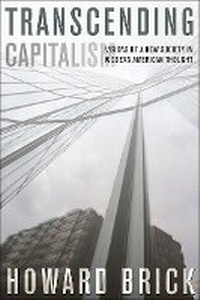
Transcending Capitalism
Visions of a New Society in Modern American Thought
Published on 18. March 2016
Book
Paperback/Softback
304 pages
978-0-8014-9904-3 (ISBN)
Description
In Transcending Capitalism, Howard Brick explains why many influential midcentury American social theorists came to believe it was no longer meaningful to describe modern Western society as "capitalist," but instead preferred alternative terms such as "postcapitalist," "postindustrial," or "technological." Considering the discussion today of capitalism and its global triumph, it is important to understand why a prior generation of social theorists imagined the future of advanced societies not in a fixed capitalist form but in some course of development leading beyond capitalism.
Brick locates this postcapitalist vision within a long history of social theory and ideology. He challenges the common view that American thought and culture utterly succumbed in the 1940s to a conservative cold war consensus that put aside the reform ideology and social theory of the early twentieth century. Rather, expectations of the shift to a new social economy persisted and cannot be disregarded as one of the elements contributing to the revival of dissenting thought and practice in the 1960s.
Rooted in a politics of social liberalism, this vision held influence for roughly a half century, from its interwar origins until the right turn in American political culture during the 1970s and 1980s. In offering a historically based understanding of American postcapitalist thought, Brick also presents some current possibilities for reinvigorating critical social thought that explores transitional developments beyond capitalism.
Brick locates this postcapitalist vision within a long history of social theory and ideology. He challenges the common view that American thought and culture utterly succumbed in the 1940s to a conservative cold war consensus that put aside the reform ideology and social theory of the early twentieth century. Rather, expectations of the shift to a new social economy persisted and cannot be disregarded as one of the elements contributing to the revival of dissenting thought and practice in the 1960s.
Rooted in a politics of social liberalism, this vision held influence for roughly a half century, from its interwar origins until the right turn in American political culture during the 1970s and 1980s. In offering a historically based understanding of American postcapitalist thought, Brick also presents some current possibilities for reinvigorating critical social thought that explores transitional developments beyond capitalism.
Reviews / Votes
Brick asks thinkers from Marx to Radcliffe-Brown to Reisman to Talcott Parsons a single question: What can you tell us about what a postcapitalist society might be like as such a society appears to be emerging? An impressive scholarly effort. Highly recommended.(Choice) Howard Brick's Transcending Capitalism is a bold and penetrating analysis of modern social thought in the twentieth-century United States.
(Journal of American History) Where most historians of the social sciences study the social sciences one at a time, Brick... links intellectual movements within sociology to those in cultural anthropology, political science, social psychology, and particularly economics.... Transcending Capitalism is a rich and imaginative historical argument, one from which sociologists will learn much about a major intellectual current in the development of their field.
(American Journal of Sociology)
More details
Language
English
Place of publication
Ithaca
United States
Target group
Adult education
Professional and scholarly
Product notice
Paperback (trade)
Dimensions
Height: 235 mm
Width: 155 mm
Thickness: 21 mm
Weight
907 gr
ISBN-13
978-0-8014-9904-3 (9780801499043)
Copyright in bibliographic data and cover images is held by Nielsen Book Services Limited or by the publishers or by their respective licensors: all rights reserved.
Schweitzer Classification
Other editions
Additional editions
E-Book
09/2015
Cornell University Press
€29.99
Available for download
Person
Howard Brick is Professor of History and Louis Evans Chair in U.S. History at the University of Michigan at Ann Arbor. He is the author of Age of Contradiction: American Thought and Culture in the 1960s, also from Cornell, and Daniel Bell and the Decline of Intellectual Radicalism: Social Theory and Political Reconciliation in the 1940s.
Content
Introduction. To Name a New Society in the Making1. Capitalism and Its Future on the Eve of World War I2. The American Theory of Organized Capitalism3. The Interwar Critique of Competitive Individualism4. Talcott Parsons and the Evanescence of Capitalism5. The Displacement of Economy in an Age of Plenty6. The Heyday of Dynamic Sociology7. The Great ReversalConclusion. On Transitional Developments beyond CapitalismNotes
Index
Index