

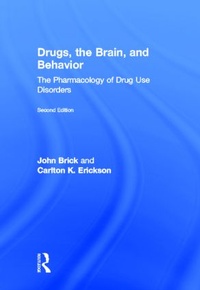
Drugs, the Brain, and Behavior
The Pharmacology of Drug Use Disorders
2nd Edition
Published on 29. November 2012
Book
Hardback
226 pages
978-0-7890-3527-1 (ISBN)
Description
Explore the brain and discover the clinical and pharmacological issues surrounding drug abuse and dependence. The authors, research scientists with years of experience in alcohol and drug studies, provide definitions, historic discoveries about the nervous system, and original, eye-catching illustrations to discuss the brain/behavior relationship, basic neuroanatomy, neurophysiology, and the mechanistic actions of mood-altering drugs.
You will learn about:
* how psychoactive drugs affect cognition, behavior, and emotion
* the brain/behavior relationship
* the specific effects of major addictive and psychoactive drug groups
* new definitions and thinking about abuse and dependence
* the medical and forensic consequences of drugs use
Drugs, the Brain, and Behavior uses a balance of instruction, illustrations, and tables and formulas that will give you a broad, lasting introduction to this intriguing subject. Whether you're a nurse, chemical dependency counselor, psychologist, or clinician, this book will be a quick reference guide long after the first reading.
You will learn about:
* how psychoactive drugs affect cognition, behavior, and emotion
* the brain/behavior relationship
* the specific effects of major addictive and psychoactive drug groups
* new definitions and thinking about abuse and dependence
* the medical and forensic consequences of drugs use
Drugs, the Brain, and Behavior uses a balance of instruction, illustrations, and tables and formulas that will give you a broad, lasting introduction to this intriguing subject. Whether you're a nurse, chemical dependency counselor, psychologist, or clinician, this book will be a quick reference guide long after the first reading.
Reviews / Votes
"Drugs, the Brain, and Behavior takes a fascinating, but at times complex subject, and explains it in a way that health professionals from a variety of backgrounds can both learn and enjoy the learning. The authors, who are scientists and educators, have given us a useful up to date guide to this important area." - Herbert D. Kleber, MD, Professor of Psychiatry; Director, Division on Substance Abuse, Columbia University, New YorkMore details
Edition
2nd edition
Language
English
Place of publication
New York
United States
Publishing group
Taylor & Francis Inc
Target group
Professional and scholarly
Illustrations
27 s/w Photographien bzw. Rasterbilder, 9 s/w Zeichnungen, 36 s/w Tabellen, 36 s/w Abbildungen
36 Tables, black and white; 9 Line drawings, black and white; 27 Halftones, black and white; 36 Illustrations, black and white
Dimensions
Height: 229 mm
Width: 152 mm
Weight
590 gr
ISBN-13
978-0-7890-3527-1 (9780789035271)
Copyright in bibliographic data and cover images is held by Nielsen Book Services Limited or by the publishers or by their respective licensors: all rights reserved.
Schweitzer Classification
Other editions
New editions
Book
03/2024
3rd Edition
Routledge
€207.00
Shipment within 10-20 days
Additional editions
John Brick | Carlton K. Erickson
Drugs, the Brain, and Behavior
The Pharmacology of Drug Use Disorders
Book
11/2012
2nd Edition
Routledge
€84.36
Article exhausted; check for reprint
Persons
John Brick, PhD, is a research scientist and educator with over 35 years of experience in alcohol and drug studies. Dr. Brick is Executive Director of Intoxikon International, and former Chief of Research, Center of Alcohol Studies, Education and Training Division, and Chairman of the Graduate Curriculum on the Biology of Alcohol at Rutgers University.
Carlton (Carl) K. Erickson, PhD, a research scientist, has been studying the effects of alcohol on the brain for over 45 years. He presently is the Pfizer Centennial Professor of Pharmacology/Toxicology, Associate Dean for Research and Graduate Studies, and Director of the Addiction Science Research and Education Center in the College of Pharmacy at the University of Texas at Austin.
Carlton (Carl) K. Erickson, PhD, a research scientist, has been studying the effects of alcohol on the brain for over 45 years. He presently is the Pfizer Centennial Professor of Pharmacology/Toxicology, Associate Dean for Research and Graduate Studies, and Director of the Addiction Science Research and Education Center in the College of Pharmacy at the University of Texas at Austin.
Content
1. What Is a Drug? 2. Is There a Brain-Behavior Relationship? 3. Pharmacokinetics: How Do Drugs Get There and What Do They Do? 4. Functional Neuroanatomy: Where Do Psychoactive Drugs Act? 5. Neurophysiology: How Do Psychoactive Drugs Act? 6. Alcohol: The Socially Accepted Addictive Drug 7. Cocaine and Other Stimulants: Drugs That Make Us High 8. Opioids: Drugs That Calm Our Pain 9. Nicotine: Of What Value? 10. Marijuana: The Illegal Recreational Plant 11. Inhalants: Not Just Bad Breath! 12. Hallucinogens: Drugs That Make Us Crazy 13. Antipsychotics: Drugs That Make Us Sane 14. Anxiolytics: Drugs That Calm Us Down 15. Antidepressants: Drugs That Lift Us Up 16. Addiction: The Chronic Medical Illness 17. Forensic Issues in Psychopharmacology