

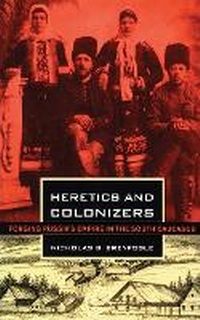
Heretics and Colonizers
Forging Russia's Empire in the South Caucasus
Published on 17. May 2005
Book
Hardback
376 pages
978-0-8014-4242-1 (ISBN)
Description
In Heretics and Colonizers, Nicholas B. Breyfogle explores the dynamic intersection of Russian borderland colonization and popular religious culture. He reconstructs the story of the religious sectarians (Dukhobors, Molokans, and Subbotniks) who settled, either voluntarily or by force, in the newly conquered lands of Transcaucasia in the nineteenth century. By ordering this migration in 1830, Nicholas I attempted at once to cleanse Russian Orthodoxy of heresies and to populate the newly annexed lands with ethnic Slavs who would shoulder the burden of imperial construction.
Breyfogle focuses throughout on the lives of the peasant settlers, their interactions with the peoples and environment of the South Caucasus, and their evolving relations with Russian state power. He draws on a wide variety of archival sources, including a large collection of previously unexamined letters, memoirs, and other documents produced by the sectarians that allow him unprecedented insight into the experiences of colonization and religious life. Although the settlers suffered greatly in their early years in hostile surroundings, they in time proved to be not only model Russian colonists but also among the most prosperous of the Empire's peasants. Banished to the empire's periphery, the sectarians ironically came to play indispensable roles in the tsarist imperial agenda.
The book culminates with the dramatic events of the Dukhobor pacifist rebellion, a movement that shocked the tsarist government and received international attention. In the early twentieth century, as the Russian state sought to replace the sectarians with Orthodox settlers, thousands of Molokans and Dukhobors immigrated to North America, where their descendants remain to this day.
Breyfogle focuses throughout on the lives of the peasant settlers, their interactions with the peoples and environment of the South Caucasus, and their evolving relations with Russian state power. He draws on a wide variety of archival sources, including a large collection of previously unexamined letters, memoirs, and other documents produced by the sectarians that allow him unprecedented insight into the experiences of colonization and religious life. Although the settlers suffered greatly in their early years in hostile surroundings, they in time proved to be not only model Russian colonists but also among the most prosperous of the Empire's peasants. Banished to the empire's periphery, the sectarians ironically came to play indispensable roles in the tsarist imperial agenda.
The book culminates with the dramatic events of the Dukhobor pacifist rebellion, a movement that shocked the tsarist government and received international attention. In the early twentieth century, as the Russian state sought to replace the sectarians with Orthodox settlers, thousands of Molokans and Dukhobors immigrated to North America, where their descendants remain to this day.
Reviews / Votes
Heretics and Colonizers builds on the vision of the Russian Empire as a complex and multilevel system marked by social and administrative diversity. It is a very important book that should appeal to students of religion, nationalism, and empire in both Russian and European contexts.(American Historical Review) An outstanding work of scholarship, Heretics and Colonizers offers fresh insight into the subtle and complex relationships between religious sectarianism, tsarist nation-building, and frontier identity. By delving into the lives of Dukhobors, Molokans, and Subbotniks in the Caucasus, Nicholas B. Breyfogle reveals the rich tapestry of Russia's sectarian past. It is the most comprehensive, the most reliable, and the most readable book on this subject and period that I have encountered.
(Doukhobor Genealogy Website) Breyfogle's book is an important contribution to the social, cultural, and environmental history of Russian imperialism and popular religiosity.
(Slavic Review) The long history of Russia's self-colonization has been marked by a combination of compulsion and voluntarism. Here Nicholas B. Breyfogle explores a fascinating element of that history, which illustrates graphically the contradictions in the policies pursued by the Russian state.
(Slavonic and East European Review) This is a book that all specialists in imperial Russia, the Caucasus, and Russian religion need to read. It should also be required for those interested in Russian frontiers or environmental history. It is, finally, accessible and well suited to classroom use.
(Canadian American Slavic Studies)
More details
Language
English
Place of publication
Ithaca
United States
Product notice
Paper over boards
Illustrations
5 maps, 18 halftones - 23 Maps
Dimensions
Height: 235 mm
Width: 155 mm
Thickness: 28 mm
Weight
907 gr
ISBN-13
978-0-8014-4242-1 (9780801442421)
Copyright in bibliographic data and cover images is held by Nielsen Book Services Limited or by the publishers or by their respective licensors: all rights reserved.
Schweitzer Classification
Other editions
Additional editions
E-Book
08/2011
1st Edition
Cornell University Press
€162.99
Available for download
Person
Nicholas B. Breyfogle is Associate Professor of History at The Ohio State University. He is coeditor of Peopling the Russian Periphery: Borderland Colonization in Eurasian History and the online magazine Origins: Current Events in Historical Perspective.
Content
Acknowledgments
Note on Translation and Transliteration
Abbreviations
Maps
Introduction
PART I: THE ROAD TO TRANSCAUCASIA
1. Toleration through Isolation
The Edict of 1830 and the Origins of Russian Colonization in Transcaucasia
2. To a Land of Promise
Sectarians and the Resettlement Experience
PART II: LIFE ON THE SOUTH CAUCASIAN FRONTIER
3. "In the Bosom of an Alien Climate"
Ecology, Economy, and Colonization
4. Heretics into Colonizers
Changing Roles and Transforming Identities on the Imperial Periphery
5. Frontier Encounters
Conflict and Coexistence between Colonists and South Caucasians
PART III: THE DUKHOBOR MOVEMENT
6. From Colonial Settlers To Pacifist Insurgents
The Origins of the Dukhobor Movement, 1887-1895
7. Peasant Pacifism and Imperial Insecurities
The Burning of Weapons, 1895-1899
The End of an Era and Its Meanings
Selected Bibliography
Index
Note on Translation and Transliteration
Abbreviations
Maps
Introduction
PART I: THE ROAD TO TRANSCAUCASIA
1. Toleration through Isolation
The Edict of 1830 and the Origins of Russian Colonization in Transcaucasia
2. To a Land of Promise
Sectarians and the Resettlement Experience
PART II: LIFE ON THE SOUTH CAUCASIAN FRONTIER
3. "In the Bosom of an Alien Climate"
Ecology, Economy, and Colonization
4. Heretics into Colonizers
Changing Roles and Transforming Identities on the Imperial Periphery
5. Frontier Encounters
Conflict and Coexistence between Colonists and South Caucasians
PART III: THE DUKHOBOR MOVEMENT
6. From Colonial Settlers To Pacifist Insurgents
The Origins of the Dukhobor Movement, 1887-1895
7. Peasant Pacifism and Imperial Insecurities
The Burning of Weapons, 1895-1899
The End of an Era and Its Meanings
Selected Bibliography
Index