

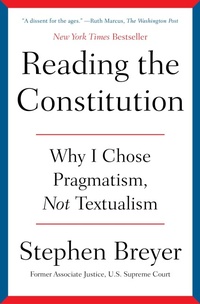
Reading the Constitution
Why I Chose Pragmatism, Not Textualism
Published on 10. June 2025
Book
Paperback/Softback
368 pages
978-1-6680-2154-5 (ISBN)
Description
New York Times Bestseller
In a provocative and brilliant analysis, retired Supreme Court Justice Stephen Breyer deconstructs the textualist philosophy of the current Supreme Court’s supermajority and makes the case for a more pragmatic approach of the Constitution.
“You will not read a more important legal work this election year.” —Bob Woodward, Washington Post reporter and author of fifteen #1 New York Times bestselling books
“A dissent for the ages.” —The Washington Post
“Breyer’s candor about the state of the court is refreshing and much needed.” —The Boston Globe
The relatively new judicial philosophy of textualism dominates the Supreme Court. Textualists claim that the right way to interpret the Constitution and statutes is to read the text carefully and examine the language as it was understood at the time the documents were written.
This, however, is not Justice Breyer’s philosophy nor has it been the traditional way to interpret the Constitution since the time of Chief Justice John Marshall. Justice Breyer recalls Marshall’s exhortation that the Constitution must be a workable set of principles to be interpreted by subsequent generations.
Most important in interpreting law, says Breyer, is to understand the statutes as well as the consequences of deciding a case one way or another. He illustrates these principles by examining some of the most important Supreme Court cases in the nation’s history, among them the Dobbs and Bruen decisions from 2022 that he argues were wrongly decided and have led to harmful results.
In a provocative and brilliant analysis, retired Supreme Court Justice Stephen Breyer deconstructs the textualist philosophy of the current Supreme Court’s supermajority and makes the case for a more pragmatic approach of the Constitution.
“You will not read a more important legal work this election year.” —Bob Woodward, Washington Post reporter and author of fifteen #1 New York Times bestselling books
“A dissent for the ages.” —The Washington Post
“Breyer’s candor about the state of the court is refreshing and much needed.” —The Boston Globe
The relatively new judicial philosophy of textualism dominates the Supreme Court. Textualists claim that the right way to interpret the Constitution and statutes is to read the text carefully and examine the language as it was understood at the time the documents were written.
This, however, is not Justice Breyer’s philosophy nor has it been the traditional way to interpret the Constitution since the time of Chief Justice John Marshall. Justice Breyer recalls Marshall’s exhortation that the Constitution must be a workable set of principles to be interpreted by subsequent generations.
Most important in interpreting law, says Breyer, is to understand the statutes as well as the consequences of deciding a case one way or another. He illustrates these principles by examining some of the most important Supreme Court cases in the nation’s history, among them the Dobbs and Bruen decisions from 2022 that he argues were wrongly decided and have led to harmful results.
More details
Language
English
Product notice
Paperback (trade)
Unsewn / adhesive bound
Dimensions
Height: 211 mm
Width: 140 mm
Thickness: 26 mm
Weight
296 gr
ISBN-13
978-1-6680-2154-5 (9781668021545)
Copyright in bibliographic data and cover images is held by Nielsen Book Services Limited or by the publishers or by their respective licensors: all rights reserved.
Schweitzer Classification
Other editions
Additional editions
E-Book
03/2024
Simon + Schuster LLC
€12.85
Available for download
Person
Stephen Breyer