

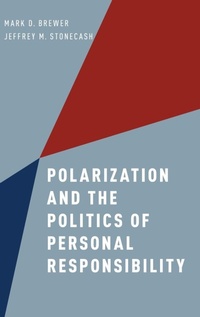
Polarization and the Politics of Personal Responsibility
Published on 29. October 2015
Book
Hardback
224 pages
978-0-19-023981-7 (ISBN)
Description
Contemporary American politics is highly polarized, and it is increasingly clear that this polarization exists at both the elite and mass levels. What is less clear is the source of this polarization. Social issues are routinely presented by some as the driver of polarization, while others point to economic inequality and class divisions. Still others single out divisions surrounding race and ethnicity, or gender, or religion as the underlying source of the deep political divide that currently exists in the United States. All of these phenomena are undoubtedly highly relevant in American politics, and it is also beyond question that they represent significant cleavages within the American polity. We argue, however, that disagreement over a much more fundamental matter lies at the foundation of the polarization that marks American politics in the early 21st century. That matter is personal responsibility. Some Americans fervently believe that an individual's lot in life is primarily if not exclusively his or her own responsibility. Opportunity is widespread in American society, and individuals succeed or fail based on their own talents and efforts. Society greatly benefits from such an arrangement, and as such government policies should support and reward individual initiative and responsibility. Other Americans see personal responsibility-while fine in theory-as an unjust organizing principle for contemporary American society. For these Americans, success or failure in life is far too often not the result of personal effort but of large forces well beyond the control of the individual. Opportunity is not widespread, and is by no means equally available to all Americans. In light of these basic facts of American life, it is the responsibility of the state to step in and implement policies that alleviate inequality and assist those who fail by no fault of their own. These basic differences surrounding the idea of personal responsibility are what separate Republicans and Democrats, conservatives and liberals, in contemporary American politics.
Reviews / Votes
"Brewer and Stonecash make a strong case that conflicting ideas about personal responsibility lie at the heart of the conflict between Democrats and Republicans in American politics today. By restoring ideas to a central role in shaping political conflict, this book should have a major influence on the way political scientists, journalists and interested citizens understand the causes of deepening partisan polarization." -Alan Abramowitz, Professor ofPolitical Science, Emory University, and author of The Polarized Public
"Brewer and Stonecash's clear presentation of the distinctions between modern American conservative and liberal thought is a very inviting means to engage students in discussions about democratic values and party politics." -Marjorie R. Hershey, Professor of Political Science, Indiana University
"Brewer and Stonecash shed a novel, essential light on a key element of intense partisan polarization. Highly charged disputes, like health care reform, spring from varying assessments of blame-the system or the individual. This important book sends us back to the basics, thankfully." -Daniel M. Shea, Professor of Government, Colby College
More details
Other editions
Additional editions
Mark D. Brewer | Jeffrey M. Stonecash
Polarization and the Politics of Personal Responsibility
Book
11/2015
Oxford University Press Inc
€52.10
Shipment within 15-20 days
Persons
Mark D. Brewer is Professor of Political Science at the University of Maine, where he teaches broadly in American politics and government and in the Honors College. Brewer's research focuses on American political parties and electoral behavior and religion and politics in the US. He is currently at work on a project examining the place of populism in American politics. Brewer lives in Orono, ME with his wife and four children.
Jeffrey M. Stonecash studies political parties and their role in organizing the electorate to represent differing political views within American society. He is presently working on a book about the presumed rise in the incumbency effect in recent decades. The focus is why academics devoted so much attention to an increase that evidence suggests did not occur and how the resulting research affected our understanding of American politics.
Jeffrey M. Stonecash studies political parties and their role in organizing the electorate to represent differing political views within American society. He is presently working on a book about the presumed rise in the incumbency effect in recent decades. The focus is why academics devoted so much attention to an increase that evidence suggests did not occur and how the resulting research affected our understanding of American politics.
Content
Preface ; I: The Sources of Conflict in American Politics ; 1. Political Conflict in America: Over What? ; II: The Evolution of Liberal Thought ; 2. America's Commitment to Individualism ; 3. Social Conditions and a Role for Government ; 4. Expanding the Concept of Societal Effects ; 5. Inequality and Social Justice ; III: The Conservative Response ; 6. Limited Government, Fiscal Restraint and Free Markets ; 7. The Threats of Communism, Socialism and Redistribution ; 8. Tradition, Religion and Rejection of Moral Relativism ; IV: Politics, Policy and the Personal Responsibility Debate ; 9. Focusing the Debate: Growing Partisan Differences ; 10. Policy Battles Over Responsibility ; 11. What Is and What Should Be ; Appendix: NES Questions ; Bibliography