

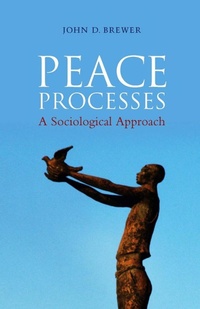
Peace Processes
A Sociological Approach
1st Edition
Published on 12. January 2010
Book
Hardback
272 pages
978-0-7456-4776-0 (ISBN)
Description
Peace processes are mostly very fragile. This engagingly written book takes a bold new approach to the topic by beginning from the premise that sociology can identify those factors that help to stabilize them. The book draws a distinction between the political and social dimensions of peace processes, arguing that each is dependent on the other. Consideration of the social peace process, neglected in conventional treatments of the subject, is made central to this volume. While complementing current approaches that emphasize institutional reform in politics, law and economics, it pays due attention to sociological factors such as gender, civil society, religion, the deconstruction of violent masculinities, restorative justice, emotions, hope, forgiveness, truth recovery, social memory and public victimhood. These important themes are fully illustrated with examples and in-depth case studies from across the globe.
The book locates itself within the growing debate about the positive impact of global civil society on peace and identifies the new forms of peace work engendered by globalization. It will be essential reading for students and scholars of peace studies in politics, international relations and sociology departments.
The book locates itself within the growing debate about the positive impact of global civil society on peace and identifies the new forms of peace work engendered by globalization. It will be essential reading for students and scholars of peace studies in politics, international relations and sociology departments.
Reviews / Votes
"In many ways a culmination of John D. Brewer's life work, Peace Processes is simply a remarkable achievement. It should be required reading for scholars, policy makers and practitioners who are concerned with peace."Glady Ganiel, Sociology
"A very valuable, pioneering study that simultaneously highlights the centrality of sociological analysis for understanding peace processes and opens sociology to such neglected but central topics as peace, war and organized violence."
Sinisa Malesevic, Sociology
"Brewer's sociological approach is refreshingly different; Brewer is a westerner applying much of the wisdom of the non-West to conflicts in the West. A very promising approach."
Johan Galtung, Sociology
"John Brewer's Peace Processes: A Sociological Approach stands out for two reasons: first because it is written in an accessible, reader-friendly manner - a sign, I always think, of the author's self-confidence - and second, because it is replete with references to key writers and debates in the field of what can broadly be called international relations. It would therefore be of interest to the initiated and uninitiated alike."
Times Higher Education Supplement
"Great social science nearly always comes from confronting traumatic experience. That is what we have here, as the result of Brewer's visceral experience in Northern Ireland: a massive contribution to understanding peace processes, adding sociology to prior political science knowledge - and thereby reviving that discipline. The book is moving, scholarly, cognitively powerful and a major contribution to policy. It is a terrific achievement."
John A. Hall, McGill University "The book provides a comprehensive and original analysis of peace processes. Brewer demonstrates the relevance of a sociological perspective in pointing to the centrality of communal violence and its structural context as well as the wider global context. His analysis of types of post-violence society is most interesting and rich in terms of its comparative content. The argument is nicely situated in the sociological tradition and is immensely readable. It will be an essential work of reference on post-violence societies and in peace processes."
Gerard Delanty, University of Sussex
"John Brewer's book is a unique contribution to our understandings of peace- making, a path-breaking work of creative scholarship that sharply illuminates the complexly contradictory potentials for, and barriers to, pragmatic peace-making in the wake of war and communal violence. The innovative insights in this work will provoke important constructive discussion and policy debates for years to come, while also providing significant conceptual frameworks for peace activists around the world."
John Brown Childs, University of California Santa Cruz
More details
Language
English
Place of publication
Oxford
United Kingdom
Publishing group
John Wiley and Sons Ltd
Target group
College/higher education
Professional and scholarly
Product notice
Unsewn / adhesive bound
Paper over boards
Dimensions
Height: 229 mm
Width: 157 mm
Thickness: 25 mm
Weight
476 gr
ISBN-13
978-0-7456-4776-0 (9780745647760)
Copyright in bibliographic data and cover images is held by Nielsen Book Services Limited or by the publishers or by their respective licensors: all rights reserved.
Schweitzer Classification
Other editions
Additional editions
E-Book
10/2013
Polity Press
€19.99
Available for download
E-Book
04/2013
Polity Press
€19.99
Available for download
Book
01/2010
Polity Press
€29.00
Article not available at the moment
Person
Content
Acknowledgements. Introduction: War, peace and communal violence.
Chapter 1: Types of post-violence society.
Chapter 2: The Problem of peace processes.
Chapter 3: Civil society.
Chapter 4: Gender.
Chapter 5: Emotions.
Chapter 6: Memory, 'truth' and victimhood.
Conclusion: A sociological approach to peace processes.
Bibliography.
Chapter 1: Types of post-violence society.
Chapter 2: The Problem of peace processes.
Chapter 3: Civil society.
Chapter 4: Gender.
Chapter 5: Emotions.
Chapter 6: Memory, 'truth' and victimhood.
Conclusion: A sociological approach to peace processes.
Bibliography.