

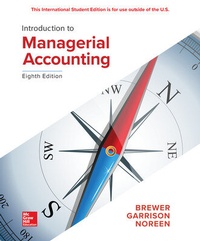
ISE Introduction to Managerial Accounting
8th Edition
Published on 24. February 2018
Book
Paperback/Softback
754 pages
978-1-260-09175-5 (ISBN)
Description
Brewer's Introduction to Managerial Accounting has earned a reputation as the most accessible and readable book on the market. Its manageable chapters and clear presentation point students toward understanding just as the needle of a compass provides direction to travelers. However, the book's authors also understand that everyone's destinations are different. Some students will become accountants, while others are destined for careers in management, marketing, or finance. Not only does the Brewer text teach students managerial accounting concepts in a clear and concise way, but it also asks students to consider how the concepts they're learning will apply to the real world situations they will eventually confront in their careers. This combination of conceptual understanding and the ability to apply that knowledge directs students toward success, whatever their final destination happens to be.
More details
Edition
8th edition
Language
English
Place of publication
OH
United States
Target group
College/higher education
US School Grade: From College Freshman to College Graduate Student
Illustrations
88 Illustrations
Dimensions
Height: 274 mm
Width: 229 mm
Thickness: 25 mm
Weight
1329 gr
ISBN-13
978-1-260-09175-5 (9781260091755)
Copyright in bibliographic data and cover images is held by Nielsen Book Services Limited or by the publishers or by their respective licensors: all rights reserved.
Schweitzer Classification
Persons
Peter C. Brewer (B.S. Penn State University, M.S. University of Virginia, Ph.D. University of Tennessee) is a professor in the Department of Accountancy at Miami University, Oxford, Ohio. He has published widely in academic business journals, and several of his articles have won major awards. He serves on several editorial boards of journals specializing in accounting education, and has received awards for teaching excellence from Miami Universitys school of business and from its student government. He is a leading thinker in undergraduate management accounting curriculum innovation and is a frequent presenter at various professional and academic conferences. A former auditor, he continues as a consultant on case writing to numerous firms.
Ray H. Garrison (B.S. and M.S. Brigham Young University, D.B.A. Indiana University) is emeritus Professor of Accounting at Brigham Young University, Provo, Utah. As a certified public accountant, he has been involved in management consulting work with both national and regional accounting firms. He has published articles in The Accounting Review, Management Accounting, and other professional journals. Innovation in the classroom has earned him the Karl G. Maeser Distinguished Teaching Award from Brigham Young University.
Eric W. Noreen (B.A. University of Washington, M.B.A. and Ph.D. Stanford University) is the Ac-counting Circle Professor of Accounting, Fox School of Business, Temple University. He has taught at INSEAD in France and the Hong Kong Institute of Science and Technology. An award-winning certified management accountant, he has served as associate editor of The Accounting Review and the Journal of Accounting and Economics, and has published his research in important accounting journals. He has also won a number of awards from students for his teach-ing.
Ray H. Garrison (B.S. and M.S. Brigham Young University, D.B.A. Indiana University) is emeritus Professor of Accounting at Brigham Young University, Provo, Utah. As a certified public accountant, he has been involved in management consulting work with both national and regional accounting firms. He has published articles in The Accounting Review, Management Accounting, and other professional journals. Innovation in the classroom has earned him the Karl G. Maeser Distinguished Teaching Award from Brigham Young University.
Eric W. Noreen (B.A. University of Washington, M.B.A. and Ph.D. Stanford University) is the Ac-counting Circle Professor of Accounting, Fox School of Business, Temple University. He has taught at INSEAD in France and the Hong Kong Institute of Science and Technology. An award-winning certified management accountant, he has served as associate editor of The Accounting Review and the Journal of Accounting and Economics, and has published his research in important accounting journals. He has also won a number of awards from students for his teach-ing.
Content
PROLOGUE: Managerial Accounting: An Overview
CHAPTER ONE: Managerial Accounting and Cost Concepts
CHAPTER TWO: Job-Order Costing: Calculating Unit Product Costs
CHAPTER THREE: Job-Order Costing: Cost Flows and External Reporting
CHAPTER FOUR: Activity-Based Costing
CHAPTER FIVE: Process Costing
CHAPTER SIX: Cost-Volume-Profit Relationships
CHAPTER SEVEN: Variable Costing and Segment Reporting: Tools for Management
CHAPTER EIGHT: Master Budgeting
CHAPTER NINE: Flexible Budgets, Standard Costs, and Variance Analysis
CHAPTER TEN: Performance Measurement in Decentralized Organizations
CHAPTER ELEVEN: Differential Analysis: The Key to Decision Making
CHAPTER TWELVE: Capital Budgeting Decisions
CHAPTER THIRTEEN: Statement of Cash Flows
CHAPTER FOURTEEN: Financial Statement Analysis
CHAPTER ONE: Managerial Accounting and Cost Concepts
CHAPTER TWO: Job-Order Costing: Calculating Unit Product Costs
CHAPTER THREE: Job-Order Costing: Cost Flows and External Reporting
CHAPTER FOUR: Activity-Based Costing
CHAPTER FIVE: Process Costing
CHAPTER SIX: Cost-Volume-Profit Relationships
CHAPTER SEVEN: Variable Costing and Segment Reporting: Tools for Management
CHAPTER EIGHT: Master Budgeting
CHAPTER NINE: Flexible Budgets, Standard Costs, and Variance Analysis
CHAPTER TEN: Performance Measurement in Decentralized Organizations
CHAPTER ELEVEN: Differential Analysis: The Key to Decision Making
CHAPTER TWELVE: Capital Budgeting Decisions
CHAPTER THIRTEEN: Statement of Cash Flows
CHAPTER FOURTEEN: Financial Statement Analysis