

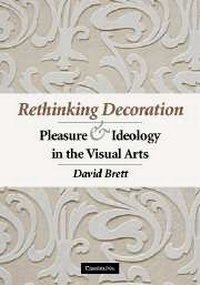
Rethinking Decoration
Pleasure and Ideology in the Visual Arts
Published on 30. May 2005
Book
Hardback
302 pages
978-0-521-83676-0 (ISBN)
Description
This book offers theoretical and practical reinterpretations of the decorative by addressing a neglected topic: the significance of decoration. Concerned with the central problem of taste, David Brett asks how individual pleasure and social function suffuse one another, drawing examples from architecture, fashion, textiles, ceramics, and the whole domain of visual and plastic arts. Using theoretical propositions derived from a critical approach to the concept of aesthetic experience, and from study of perceptual psychology and psychoanalytic theory, Brett focuses on historical instances of decoration and ornament significant to the development of a 'visual ideology'. He considers a variety of attempts at the rejection of decorative value, and proposes a 'poetics of workmanship', which deals with the metaphorical power of material processes.
More details
Language
English
Place of publication
Cambridge
United Kingdom
Target group
Professional and scholarly
Illustrations
8 Plates, color; 65 Halftones, unspecified; 11 Line drawings, unspecified
Dimensions
Height: 254 mm
Width: 182 mm
Thickness: 20 mm
Weight
860 gr
ISBN-13
978-0-521-83676-0 (9780521836760)
Copyright in bibliographic data and cover images is held by Nielsen Book Services Limited or by the publishers or by their respective licensors: all rights reserved.
Schweitzer Classification
Person
David Brett is Emeritus Reader in the History of Design at the University of Ulster. He is the author of books on a variety of subjects including the history and theory of design, among them, The Plain Style in Protestant Theology in the History of Design and C. R. Mackintosh: The Poetics of Workmanship.
Content
Introduction; 1. Discourse and experience; 2. Touching and seeing; 3. Thresholds and transitions; 4. Sociability and pleasure; 5. The refusal; 6. Toward a poetics of workmanship; 7. The task of rethinking: an afterword.