

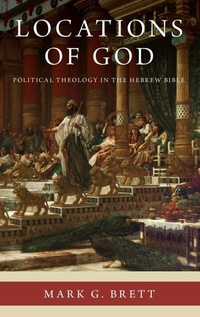
Locations of God
Political Theology in the Hebrew Bible
Published on 25. October 2019
Book
Hardback
228 pages
978-0-19-006023-7 (ISBN)
Description
The Hebrew Bible is hardly what might be called a "unified" account of the national history of Israel. The texts, with their myriad genres and competing perspectives, show the forming and re-forming of Ancient Israel's social body in a number of geographical settings. The communities are shown in and out of political power. We read about in-fighting and peace, good kings and bad, freedom and subjugation. Ultimately, the Hebrew Bible is a text about nationhood and empire in the ancient world.
Critical reflection on the intersections of religious and political life -- which includes such topics as sovereignty, leadership, law, peoplehood, hospitality, redemption, creation, and eschatology -- can be broadly termed "Political Theology." In Locations of God, Mark G. Brett focuses primarily on the historical books of the Bible, comparing them with selected prophetic and wisdom books, setting all of them against the lived realities under the shadow of successive empires. Brett suggests that national ideas and their imperial alternatives were woven into the biblical traditions by authors who enjoyed very little in the way of political sovereignty. Using political theology to motivate the discussion, Brett shows us just how the earthly situation of ancient Israel contributed to its theology as reflected in the Hebrew Bible.
Critical reflection on the intersections of religious and political life -- which includes such topics as sovereignty, leadership, law, peoplehood, hospitality, redemption, creation, and eschatology -- can be broadly termed "Political Theology." In Locations of God, Mark G. Brett focuses primarily on the historical books of the Bible, comparing them with selected prophetic and wisdom books, setting all of them against the lived realities under the shadow of successive empires. Brett suggests that national ideas and their imperial alternatives were woven into the biblical traditions by authors who enjoyed very little in the way of political sovereignty. Using political theology to motivate the discussion, Brett shows us just how the earthly situation of ancient Israel contributed to its theology as reflected in the Hebrew Bible.
Reviews / Votes
Brett's seminal work presupposes a deep understanding of the Hebrew Bible's diverse and complexly-layered narratives to underscore the nuances of positions within the prose, prophetic, poetic, and wisdom traditions. * ANDY S.J. LIE, Journal for the Study of the Old Testament * Nearly every chapter stands up well on its own, and researchers focused on one of the texts or traditions concerned could easily consult parts of Brett's work with profit. But readers who engage the whole will find a subtly advanced argument bearing on place, both human and divine, that merits a serious dialogue with our existing theologies and anthropologies. * Joseph McDonald, Brite Divinity School at Texas Christian University, Review of Biblical Literature * Mark Brett's excavation of Israel's evolving conceptions of nationhood and empire, sovereignty and hospitality, rule and redemption, and the role of these concepts in shaping and reshaping Israel's self-understanding and political life is remarkable. It is also timely, giventhe dramatic shifts in the imaginations of political communities that we see today.Locations of God should spark vital conversations among students of theology, political theory, international relations, and more. * Luke Glanville, Australian National University and author of Sovereignty and the Responsibility to Protect * In this important and original study, the author sets a series of political ideologies in the Hebrew Bible in relation to theological convictions about the location of God in the world. While throwing new light on development within biblical texts, this exceptional book has far reaching implications for such modern issues as covenant-making, sovereignty and human rights, and it develops a remarkable theology of place which deserves attention across a wide range of disciplines. * Paul S. Fiddes, Professor of Systematic Theology, University of Oxford * Mark Brett's Locations of God is a courageous and truly illuminating tour de force. He shows the highly political nature of the Hebrew Bible, in which various concepts from various times and groups interact with each other. In a very modern way, Brett uncovers and explains these concepts, their interdependence and enduring significance. Undoubtedly, Brett's book is the new opus magnum for any political reading of the Hebrew Bible. * Jakob Woehrle, Professor of Old Testament, Eberhard Karls Universitaet Tuebingen, Germany *More details
Language
English
Place of publication
New York
United States
Dimensions
Height: 240 mm
Width: 161 mm
Thickness: 17 mm
Weight
505 gr
ISBN-13
978-0-19-006023-7 (9780190060237)
Copyright in bibliographic data and cover images is held by Nielsen Book Services Limited or by the publishers or by their respective licensors: all rights reserved.
Schweitzer Classification
Other editions
Additional editions
E-Book
09/2019
OUP eBook
€66.49
Available for download
E-Book
09/2019
OUP eBook
€66.49
Available for download
Person
Mark Brett is a Professor of Hebrew Bible at Whitley College, the University of Divinity, in Melbourne, Australia. His recent books include Political Trauma and Healing: Biblical Ethics for a Postcolonial World and Decolonizing God: The Bible in the Tides of Empire.
Content
- Introduction
- 1. Social Contracts: The Formation of Political Sovereignty
- 2. Performance Indicators: The Kingdoms of Israel and Judah
- 3. Nation Dreaming: Deuteronomy and Joshua
- 4. Redeeming Eden: A Priestly Dialogue in Genesis-Leviticus
- 5. Intergenerational Trauma: Children of the exile
- 6. Mimicking Empire: Divine Administration in Isaiah
- 7. Legal Compromises: Imperial Contexts of the Pentateuch
- 8. Wise Reservations: Places of Understanding in Job
- 9. Colonial Inversions: Roger Williams and Wiremu Tamihana
- Postlude
- Bibliography
- Index