

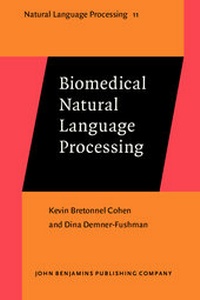
Biomedical Natural Language Processing
Published on 27. February 2014
Book
Paperback/Softback
160 pages
978-90-272-4998-2 (ISBN)
Description
Biomedical Natural Language Processing is a comprehensive tour through the classic and current work in the field. It discusses all subjects from both a rule-based and a machine learning approach, and also describes each subject from the perspective of both biological science and clinical medicine. The intended audience is readers who already have a background in natural language processing, but a clear introduction makes it accessible to readers from the fields of bioinformatics and computational biology, as well. The book is suitable as a reference, as well as a text for advanced courses in biomedical natural language processing and text mining.
More details
Series
Language
English
Place of publication
Amsterdam
Netherlands
Target group
Professional and scholarly
Illustrations
+ index
Dimensions
Height: 240 mm
Width: 160 mm
Weight
320 gr
ISBN-13
978-90-272-4998-2 (9789027249982)
Copyright in bibliographic data and cover images is held by Nielsen Book Services Limited or by the publishers or by their respective licensors: all rights reserved.
Schweitzer Classification
Other editions
Additional editions
Kevin Bretonnel Cohen | Dina Demner-Fushman
Biomedical Natural Language Processing
Book
02/2014
John Benjamins Publishing Co
€100.70
Shipment within 10-15 days
Kevin Bretonnel Cohen | Dina Demner-Fushman
Biomedical Natural Language Processing
Fetal Cell Experiments from Cyberspace to China
E-Book
02/2014
1st Edition
John Benjamins Publishing Company
€118.99
Available for download
Persons
Content
1. Acknowledgments; 2. List of figures; 3. 1. Introduction to natural language processing; 4. 2. Historical background; 5. 3. Named entity recognition; 6. 4. Relation extraction; 7. 5. Information retrieval/document classification; 8. 6. Concept normalization; 9. 7. Ontologies and computational lexical semantics; 10. 8. Summarization; 11. 9. Question-answering; 12. 10. Software engineering; 13. 11. Corpus construction and annotation; 14. References; 15. Index