

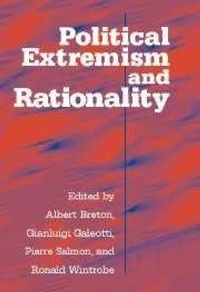
Political Extremism and Rationality
Published on 9. December 2010
Book
Paperback/Softback
264 pages
978-0-521-16861-8 (ISBN)
Description
Political extremism is widely considered to be the product of irrational behavior. The distinguishing feature of this collection by well-known economists and political scientists from North America, Europe and Australia is to propose a variety of explanations which all insist on the rationality of extremism. Contributors use variants of this approach to shed light on subjects such as the conditions under which democratic parties take extremist positions, the relationship between extremism and conformism, the strategies adopted by revolutionary movements, and the reasons why extremism often leads to violence. The authors identify four core issues in the study of the phenomenon: the nature (definition) of extremism and its origins in both democratic and authoritarian settings, the capacity of democratic political systems to accommodate extremist positions, the strategies (civil disobedience, assassination, lynching) chosen by extremist groups, and the circumstances under which extremism becomes a threat to democracy.
Reviews / Votes
Review of the hardback: 'The existence of extremism seems to contradict the idea that participation to political activities is guided by the rational choices of the individuals. This book shows that this is not the case. Extremism may be explained as a rational reaction of the individuals when they face some circumstances such as a 'social hole' in thrust between groups and some asymmetry in the distribution of political rents. The original and challenging contributions of this book were conceived with some unintended foresight. Their publication occurs at a time when, once again, a numerous movement of young people faces the choice among more and less extremist policies. Both the members of the anti-globalization movement and the policy makers who want to avoid it taking an extremist direction may benefit from reading this book. Its insights elucidate the specific circumstances under which extremist, but somehow rational, choices may arise.' Ugo Pagano, University of Siena Review of the hardback: 'Much of modern political theory, such as the theory of justice developed by John Rawls and his followers, rests on the premise that people are 'reasonable'. But is this premise reasonable? 'Extremism' is a word we use to dismiss views with which we disagree. But, as the authors in this well-argued and compelling volume point out, the concept of extremism can be defined and used as a powerful tool for understanding political conflict. After nailing down extremism's multiple meanings, the authors then provide a variety of views on its importance. If we are to deal with extremism in the political world views of other people, it is crucial that we understand where extremism comes from, how it works, and how a rational person might also be 'extreme'.' Michael Munger, Duke University Review of the hardback: '... this book deserves a significant and often innovative contribution to the rapidly growing literature on political extremism.' Hans-George Betz, University of GenevaMore details
Language
English
Place of publication
Cambridge
United Kingdom
Target group
Professional and scholarly
Product notice
Paperback (trade)
Illustrations
Worked examples or Exercises
Dimensions
Height: 229 mm
Width: 152 mm
Thickness: 16 mm
Weight
434 gr
ISBN-13
978-0-521-16861-8 (9780521168618)
Copyright in bibliographic data and cover images is held by Nielsen Book Services Limited or by the publishers or by their respective licensors: all rights reserved.
Schweitzer Classification
Other editions
Additional editions
Albert Breton | Gianluigi Galeotti | Pierre Salmon
Political Extremism and Rationality
Book
01/2002
Cambridge University Press
€88.60
Shipment within 15-20 days
Persons
Content
List of figures and tables; Introduction Albert Breton, Gianluigi Galeotti, Pierre Salmon, and Ronald Wintrobe; Part I. Extremism and Rationality: 1. The crippled epistemology of extremism Russell Hardin; 2. Leadership and passion in extremist politics Ronald Wintrobe; 3. Information control, loss of autonomy, and the emergence of political extremism Albert Breton and Silvana Dalmazzone; Part II. Extremism in Constitutional Democracies: 4. Extremism and monomania Pierre Salmon; 5. Some democratic propensities for extreme results Geoffrey Brennan; 6. Strategic positioning and campaigning Amihai Glazer; 7. At the outskirts of the constitution Gianluigi Galeotti; 8. Is democracy an antidote to extremism? Harold Hochman; Part III. Extremism in Non-Democratic Settings: 9. The political life cycle of extremist organizations Mario Ferrero; 10. Rationally violent tactics: evidence from modern Islamic fundamentalism Luisa Giurato and Maria Cristina Molinari; 11. De Bello Omniumi Contra Omnesj Guido Ortona; Index.