

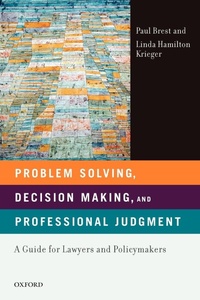
Problem Solving, Decision Making, and Professional Judgment
A Guide for Lawyers and Policymakers
Published on 17. June 2010
Book
Paperback/Softback
696 pages
978-0-19-536632-7 (ISBN)
Description
Problem Solving, Decision Making, and Professional Judgment: A Guide for Lawyers and Policymakers will prepare students and professionals for their roles as creative problem solvers. Paul Brest and Linda Hamilton Krieger discuss essential qualities of practical wisdom that are important across disciplines and essential to one's everyday life as a decisionmaker, consumer, and citizen. This book can stand alone as a text or work as a supplement to a core law or public policy curriculum.
Professor Brest and Professor Krieger aim to prepare students to exercise problem solving and decision making skills in the complex social environments in which they will work. They include bodies of knowledge drawn from statistics, decision science, social and cognitive psychology, and "judgment and decision making" (JDM) psychological literature. They combine quantitative approaches to empirical analysis and decisionmaking (statistics and decision science) with the psychological literature that demonstrates the systematic errors of the intuitive and social empiricist or decisionmaker. Their ultimate goal is to help readers "get it right" in their roles as professionals, citizens, and individuals.
Professor Brest and Professor Krieger aim to prepare students to exercise problem solving and decision making skills in the complex social environments in which they will work. They include bodies of knowledge drawn from statistics, decision science, social and cognitive psychology, and "judgment and decision making" (JDM) psychological literature. They combine quantitative approaches to empirical analysis and decisionmaking (statistics and decision science) with the psychological literature that demonstrates the systematic errors of the intuitive and social empiricist or decisionmaker. Their ultimate goal is to help readers "get it right" in their roles as professionals, citizens, and individuals.
Reviews / Votes
"Brest and Krieger fill a huge vacuum. Their book is likely to transform the curricula of law schools and public policy schools by providing an excellent text for courses that systematically analyze the crucially important, but hitherto largely neglected, processes by which lawyers and policymakers exercise their judgment. Their multidisciplinary approach is ambitious and rigorous yet clear and accessible."-- Richard L. Revesz
Dean and Lawrence King Professor of Law, New York University School of Law
"Brest and Krieger pull off quite a trick here. The book is at once lucid, practical, and intellectually deep. The authors demonstrate admirable sophistication in interpreting the seminal psychological findings, as well as the rational choice inference and decision making models. At the same time, they repeatedly demonstrate how professionals might really improve how they do their work."
--Mark G. Kelman
James C. Gaither Professor of Law and Vice Dean, Stanford Law School
"Brest and Krieger have written a book of extraordinary scope and depth. Practical examples effectively motivate the material, and the exposition is always clear and extremely insightful. There is much to learn from reading this book. I am eager to use it in my own undergraduate course."
--Barry Schwartz
Dorwin Cartwright Professor of Social Theory and Social Action, Swarthmore College
"Brest and Krieger provide a holistic process for making effective decisions as problem-solving lawyers and policymakers. This textbook is groundbreaking in its breadth, depth, and versatility. There is nothing comparable for teaching students about the theoretical and practical dimensions of decision making. It is a brilliant tour de force."
--Mark Neal Aaronson
Professor of Law, University of California, Hastings College of the Law
"This book employs a much needed academic and non-skills approach to illuminate lawyers' work and thinking. The multi-disciplinary methodology enriches our understanding of interviewing, counseling, and negotiation and brings to the fore the decisions some lawyers make unconsciously. It does this by examining lawyers' tasks from a rational and empirical basis and grounding them in a larger context. Those interested in clinical teaching will appreciate this
supplement to their pedagogy."
--Kandis Scott
Professor of Law, Santa Clara Law
"This book presents an excellent and comprehensive analysis of how we solve problems and make decisions in legal matters. It is a great tool for teaching novice legal decision makers about these critical skills because it breaks down the process into several easily understood but helpful steps. It also is an engaging resource for experienced practitioners and policy makers because it explores the behavioral aspects and systematic biases that underlie our
decision making processes. It is a great book for any law student or lawyer who wants to improve her problem solving skills and make better decisions."
-- Kenneth R. Margolis
Professor of Law, Director of the CaseArc Integrated Lawyering Skills Program,
Case Western Reserve University School of Law
"Brest and Krieger offer a thorough and insightful integration of the field of decision making and the legal context. This work offers the necessary overview of behavioral decision research and behavioral economics for legal scholars, and wisdom for any lawyer who wants to make better decisions."
--Max H. Bazerman,
Jesse Isidor Straus Professor of Business Administration, Harvard Business School
"This book has the rare combination of being accessible to people without any experience in the field, while still being interesting and useful to experts. The authors have done a wonderful job of being both engaging and clear while maintaining rigor, accuracy, and thoroughness. This is an authoritative source for policy makers who want to create psychologically informed policy. I will most certainly be adopting it for courses I teach on the interplay
between psychology and public affairs."
-- Daniel M. Oppenheimer,
Associate Professor of Psychology and Public Affairs, Princeton University
"This book is not only the most comprehensive text yet written in the field of judgment and decision making. It is an impressive and beautifully organized compilation of the knowledge and insight created during a half-century of research. It will educate veteran researchers as well as students and anyone making important decisions."
--Paul Slovic,
President, Decision Research
More details
Language
English
Place of publication
New York
United States
Target group
Professional and scholarly
Dimensions
Height: 234 mm
Width: 156 mm
Thickness: 37 mm
Weight
1039 gr
ISBN-13
978-0-19-536632-7 (9780195366327)
Copyright in bibliographic data and cover images is held by Nielsen Book Services Limited or by the publishers or by their respective licensors: all rights reserved.
Schweitzer Classification
Other editions
Additional editions
Paul Brest | Linda Hamilton Krieger
Problem Solving, Decision Making, and Professional Judgment
A Guide for Lawyers and Policymakers
E-Book
05/2010
1st Edition
OUP eBook
€52.49
Available for download
Persons
Paul Brest is the President of the William and Flora Hewlett Foundation in Menlo Park, California. Mr. Brest received an A.B. from Swarthmore College in 1962 and an LL.B from Harvard Law School in 1965. He served as law clerk to Judge Bailey Aldrich and Supreme Court Justice John M. Harlan, and practiced with the NAACP Legal Defense and Educational Fund, Inc., in Jackson, Mississippi, doing civil rights litigation before joining the Stanford Law School faculty in 1969, where his research and teaching focused on constitutional law and problem solving/decision making. From 1987 to 1999, he served as the dean of Stanford Law School. Mr. Brest is co-author of Processes of Constitutional Decisionmaking (5th ed. 2006), and currently teaches a course on Judgment and Decisionmaking in a graduate program in Public Policy at Stanford University.
Linda Hamilton Krieger is a lawyer, law professor, organization development facilitator, and social activist who has long worked to help individuals and progressive community organizations improve their strategic decision making by incorporating into their thinking insights from cognitive social psychology, statistics, and organization theory. Professor Krieger received her A.B. from Stanford University in 1975, and a J.D. from the New York University School of Law in 1978. She practiced as a civil rights lawyer in San Francisco from 1978 to 1996. During that time she also helped found and govern three nonprofit community organizations emerging in response to the HIV/AIDS, including the San Francisco AIDS Foundation, the AIDS Interfaith Network, Hale Laulima, and the San Francisco Gay Bar Association's AIDS Legal Referral Service.
Linda Hamilton Krieger is a lawyer, law professor, organization development facilitator, and social activist who has long worked to help individuals and progressive community organizations improve their strategic decision making by incorporating into their thinking insights from cognitive social psychology, statistics, and organization theory. Professor Krieger received her A.B. from Stanford University in 1975, and a J.D. from the New York University School of Law in 1978. She practiced as a civil rights lawyer in San Francisco from 1978 to 1996. During that time she also helped found and govern three nonprofit community organizations emerging in response to the HIV/AIDS, including the San Francisco AIDS Foundation, the AIDS Interfaith Network, Hale Laulima, and the San Francisco Gay Bar Association's AIDS Legal Referral Service.
Content
PART ONE
INTRODUCTION TO PROBLEM SOLVING AND DECISIONMAKING
Chapter 0. Preface
Chapter 1. The Lawyer and Policymaker as Problem solver and Decisionmaker: The Roles of Deliberation, Intuition, and Expertise
Chapter 2. Framing Problems and Identifying Objectives And Identifying Problem Causes
Chapter 3. Generating Alternatives: Creativity in Legal and Policy Problem Solving
Chapter 4. Choosing Among Alternatives
PART TWO
Making Sense of an Uncertain World
Introduction to Part Two
Chapter 5. Introduction to Statistics and Probability
Chapter 6. Scores, Dollars, and Other Quantitative Variables
Chapter 7. Interpreting Statistical Results
Chapter 8. Explaining and predicting one-time events
Chapter 9. Biases in Perception and Memory
Chapter 10. Biases in Processing and Judging Information
Chapter 11. The Social Perceiver: Processes and Problems in Social Cognition
PART THREE
MAKING DECISIONS
Introduction to Part Three
Chapter 12. Choices, Consequences, and Tradeoffs
Chapter 13. Complexities of Decisionmaking: Relationships to our Future Selves
Chapter 14. Complexities of Decisionmaking: The Power of Frames
Chapter 15. Decisionmaking Under risk
Chapter 16. The Role of Affect in Risky Decisions
Conclusion to Part Three
Part Four
Influencing Decisions
Introduction to Part Four
Chapter 17: Social Influence
Chapter 18: Influencing Behavior Through Cognition
Chapter 19. Group Decisionmaking
Chapter 20. Conclusion: Learning from Experience
INTRODUCTION TO PROBLEM SOLVING AND DECISIONMAKING
Chapter 0. Preface
Chapter 1. The Lawyer and Policymaker as Problem solver and Decisionmaker: The Roles of Deliberation, Intuition, and Expertise
Chapter 2. Framing Problems and Identifying Objectives And Identifying Problem Causes
Chapter 3. Generating Alternatives: Creativity in Legal and Policy Problem Solving
Chapter 4. Choosing Among Alternatives
PART TWO
Making Sense of an Uncertain World
Introduction to Part Two
Chapter 5. Introduction to Statistics and Probability
Chapter 6. Scores, Dollars, and Other Quantitative Variables
Chapter 7. Interpreting Statistical Results
Chapter 8. Explaining and predicting one-time events
Chapter 9. Biases in Perception and Memory
Chapter 10. Biases in Processing and Judging Information
Chapter 11. The Social Perceiver: Processes and Problems in Social Cognition
PART THREE
MAKING DECISIONS
Introduction to Part Three
Chapter 12. Choices, Consequences, and Tradeoffs
Chapter 13. Complexities of Decisionmaking: Relationships to our Future Selves
Chapter 14. Complexities of Decisionmaking: The Power of Frames
Chapter 15. Decisionmaking Under risk
Chapter 16. The Role of Affect in Risky Decisions
Conclusion to Part Three
Part Four
Influencing Decisions
Introduction to Part Four
Chapter 17: Social Influence
Chapter 18: Influencing Behavior Through Cognition
Chapter 19. Group Decisionmaking
Chapter 20. Conclusion: Learning from Experience