

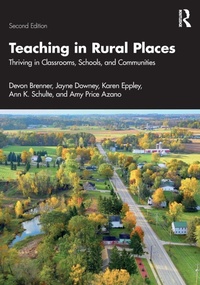
Teaching in Rural Places
Thriving in Classrooms, Schools, and Communities
2nd Edition
Will be published approx. on 18. March 2026
Book
Paperback/Softback
328 pages
978-1-032-88753-1 (ISBN)
Description
This fully updated teacher education textbook invites pre-service and new teachers to think critically about the impact of rurality on their work and provides an overview of what it means to live, teach, learn, and thrive in rural communities. It underscores the importance of teaching in rural schools as an act of social justice-work that dismantles spatial barriers to economic, social, and
political justice. Teaching in Rural Places, 2nd Edition provides concrete strategies for understanding rural communities, valuing rural ways of being, and teaching in rural schools by addressing topics such as working with families, building professional networks, addressing trauma, teaching in multi-grade classrooms, and planning place-conscious instruction.
New features to this edition include:
New vignettes, visuals, and boxes throughout the book to aid accessibility and comprehension;
A new chapter on student and teacher well-being;
An updated chapter on the unique structures of rural schools, which addresses multi-grade teaching, itinerant teaching, rural careers and technical education (CTE) teaching, and more;
A fully updated chapter on technology, which now includes discussions of the challenges and opportunities of AI and other innovations for rural teaching and learning.
This comprehensive textbook for rural teacher education is targeted toward pre-service and new teachers in traditional and alternative teacher education programs, as well as new rural teachers participating in induction and mentoring programs. Teaching in Rural Places, 2nd Edition will help ensure that rural students have the well-prepared teachers they deserve.
political justice. Teaching in Rural Places, 2nd Edition provides concrete strategies for understanding rural communities, valuing rural ways of being, and teaching in rural schools by addressing topics such as working with families, building professional networks, addressing trauma, teaching in multi-grade classrooms, and planning place-conscious instruction.
New features to this edition include:
New vignettes, visuals, and boxes throughout the book to aid accessibility and comprehension;
A new chapter on student and teacher well-being;
An updated chapter on the unique structures of rural schools, which addresses multi-grade teaching, itinerant teaching, rural careers and technical education (CTE) teaching, and more;
A fully updated chapter on technology, which now includes discussions of the challenges and opportunities of AI and other innovations for rural teaching and learning.
This comprehensive textbook for rural teacher education is targeted toward pre-service and new teachers in traditional and alternative teacher education programs, as well as new rural teachers participating in induction and mentoring programs. Teaching in Rural Places, 2nd Edition will help ensure that rural students have the well-prepared teachers they deserve.
More details
Edition
2nd edition
Language
English
Place of publication
London
United Kingdom
Publishing group
Taylor & Francis Ltd
Target group
College/higher education
Postgraduate, Undergraduate Advanced, and Undergraduate Core
Illustrations
10 s/w Tabellen, 4 s/w Zeichnungen, 6 s/w Photographien bzw. Rasterbilder, 10 s/w Abbildungen
10 Tables, black and white; 4 Line drawings, black and white; 6 Halftones, black and white; 10 Illustrations, black and white
Dimensions
Height: 254 mm
Width: 178 mm
Thickness: 16 mm
Weight
550 gr
ISBN-13
978-1-032-88753-1 (9781032887531)
Copyright in bibliographic data and cover images is held by Nielsen Book Services Limited or by the publishers or by their respective licensors: all rights reserved.
Schweitzer Classification
Other editions
Additional editions
Devon Brenner | Jayne Downey | Karen Eppley
Teaching in Rural Places
Thriving in Classrooms, Schools, and Communities
E-Book
03/2026
2nd Edition
Routledge
€60.49
Available for download
Devon Brenner | Jayne Downey | Karen Eppley
Teaching in Rural Places
Thriving in Classrooms, Schools, and Communities
Book
approx. 03/2026
2nd Edition
Routledge
€211.40
Not yet published
Devon Brenner | Jayne Downey | Karen Eppley
Teaching in Rural Places
Thriving in Classrooms, Schools, and Communities
E-Book
03/2026
2nd Edition
Routledge
€60.49
Available for download
Previous edition
Amy Price Azano | Devon Brenner | Jayne Downey
Teaching in Rural Places
Thriving in Classrooms, Schools, and Communities
Book
12/2020
1st Edition
Routledge
€58.00
Shipment within 15-20 days
Persons
Devon Brenner transplanted from Michigan to Mississippi over 25 years ago. She is director of the Social Science Research Center, coordinator of Rural Education Research and Initiatives, and professor of teacher education at Mississippi State University, where she engages in research that focuses on rural education policy and practice.
Jayne Downey is a professor at Montana State University and directs the Center for Research on Rural Education. Born and raised on a farm on the prairies, her research and service are dedicated to working with and for rural schools and communities around the world.
Karen Eppley is a first-generation college graduate, former rural K-12 student and rural fifth-grade teacher in Northern Appalachia. She currently is an Associate Professor of Rural Education at Kansas State University where she directs the Rural Education Center.
Ann K. Schulte grew up in Yankton, South Dakota where she was a teacher and high school debate coach for several years in nearby small towns. She has retired from California State University, Chico after 24 years where she prepared teachers and mentored first-generation college students like herself.
Amy Price Azano is a first-generation college student and eighth-generation Appalachian from Luray, Virginia. She is a Professor of rural education and the founding director of the Center for Rural Education at Virginia Tech where her scholarship focuses on educational equity for rural learners.
Jayne Downey is a professor at Montana State University and directs the Center for Research on Rural Education. Born and raised on a farm on the prairies, her research and service are dedicated to working with and for rural schools and communities around the world.
Karen Eppley is a first-generation college graduate, former rural K-12 student and rural fifth-grade teacher in Northern Appalachia. She currently is an Associate Professor of Rural Education at Kansas State University where she directs the Rural Education Center.
Ann K. Schulte grew up in Yankton, South Dakota where she was a teacher and high school debate coach for several years in nearby small towns. She has retired from California State University, Chico after 24 years where she prepared teachers and mentored first-generation college students like herself.
Amy Price Azano is a first-generation college student and eighth-generation Appalachian from Luray, Virginia. She is a Professor of rural education and the founding director of the Center for Rural Education at Virginia Tech where her scholarship focuses on educational equity for rural learners.
Content
Introduction Part One: Rural Contexts 1. Becoming a Rural Teacher 2. Historical Contexts for Today's Rural Schools and Communities 3. Understanding Rural Places 4. Why Place Matters Part Two: Thriving in Rural Communities 5. Rural Literacies 6. Understanding Strengths and Assets in Rural Communities 7. Families as Partners in Rural Communities 8. From Here or Away: Relating to Students Part Three: Thriving in Rural Schools 9. Building Professional Networks in Rural Schools 10. Policy, Advocacy, and the Rural Teacher 11. Thriving Communities, Healthy Schools 12. The Structures of Rural Schools and Classrooms Part Four: Thriving in Rural Classrooms 13. Place-Based Instruction 14. Technology for Learning in Rural Classrooms 15. Supporting All Learners in Rural Classrooms 16. Teaching Exceptional Learners in Rural Classrooms 17. Finding What Works in Rural Classrooms 18. Conclusion: Thriving as a Rural Teacher