

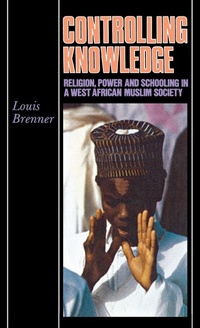
Controlling Knowledge
Religion, Power, and Schooling in a West African Muslim Society
Published on 22. March 2001
Book
Hardback
360 pages
978-0-253-33917-1 (ISBN)
Description
"I know of no one who has taken such an ambitious swath of time and done such a good job of showing the continuity and change across those one hundred years. . . . a splendid achievement, the result of decades of research and reflection." -David Robinson
Controlling Knowledge examines the history of West African Muslim society in the Republic of Mali, formerly the Soudan Francais, in the 20th century. Focusing on the transformation of Muslim institutions-especially modernized Muslim schools (medersas) and voluntary organizations-over the past hundred years, Louis Brenner uncovers the social and political processes that have produced new forms, definitions, and expressions of Islam that are patently different from those that prevailed a century earlier. Brenner's study shows that Muslim society in Mali is religiously pluralistic and that it has developed different ways of relating religious obligations to prevailing social and political conditions. Although they were heavily influenced by French and Middle Eastern models, Brenner demonstrates that it was in opposition to French colonial authority that the first medersas and voluntary associations appeared. The complex array of power relations within which these institutions evolved, under French colonial rule and in the postcolonial secularist state, is revealed in this thoughtful book. Controlling Knowledge makes a major contribution to our understanding of Muslim history in Mali and West Africa, both in recent decades and over the long term.
Controlling Knowledge examines the history of West African Muslim society in the Republic of Mali, formerly the Soudan Francais, in the 20th century. Focusing on the transformation of Muslim institutions-especially modernized Muslim schools (medersas) and voluntary organizations-over the past hundred years, Louis Brenner uncovers the social and political processes that have produced new forms, definitions, and expressions of Islam that are patently different from those that prevailed a century earlier. Brenner's study shows that Muslim society in Mali is religiously pluralistic and that it has developed different ways of relating religious obligations to prevailing social and political conditions. Although they were heavily influenced by French and Middle Eastern models, Brenner demonstrates that it was in opposition to French colonial authority that the first medersas and voluntary associations appeared. The complex array of power relations within which these institutions evolved, under French colonial rule and in the postcolonial secularist state, is revealed in this thoughtful book. Controlling Knowledge makes a major contribution to our understanding of Muslim history in Mali and West Africa, both in recent decades and over the long term.
More details
Language
English
Place of publication
Bloomington, IN
United States
Target group
Professional and scholarly
Product notice
Paper over boards
Dimensions
Height: 222 mm
Width: 145 mm
Thickness: 24 mm
Weight
614 gr
ISBN-13
978-0-253-33917-1 (9780253339171)
Copyright in bibliographic data and cover images is held by Nielsen Book Services Limited or by the publishers or by their respective licensors: all rights reserved.
Schweitzer Classification
Person
Louis Brenner is Professor of the History of Religion in Africa at the School of Oriental and African Studies, University of London. He is the author of West African Sufi: The Religious Heritage and Spiritual Search of Cerno Bokar Saalif Taal and editor of Muslim Identity and Social Change in Sub-Saharan Africa (Indiana University Press).
Content
Preliminary Table of Contents:
Introduction: Defining the Terms of Analysis
1. Knowledge and Power in Pre-Colonial Muslim Societies
2. Medersas, French and Islamic
3. Reform and Counter-Reform: The Politics of Muslim Schooling in the 1950s
4. Discourses of Knowledge, Power, and Identity
5. Power Relations in the Postcolony
6. The Dynamics of Medersa Schooling
7. Islam, the State, and the Ideology of Development: The Politics of Muslim Schooling in the 1980s
8. Reprise: Reassessing the Terms of Analysis
Introduction: Defining the Terms of Analysis
1. Knowledge and Power in Pre-Colonial Muslim Societies
2. Medersas, French and Islamic
3. Reform and Counter-Reform: The Politics of Muslim Schooling in the 1950s
4. Discourses of Knowledge, Power, and Identity
5. Power Relations in the Postcolony
6. The Dynamics of Medersa Schooling
7. Islam, the State, and the Ideology of Development: The Politics of Muslim Schooling in the 1980s
8. Reprise: Reassessing the Terms of Analysis