

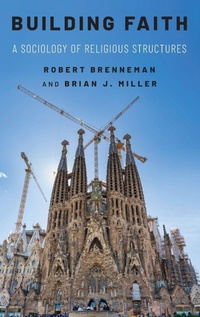
Building Faith
A Sociology of Religious Structures
Published on 4. September 2020
Book
Hardback
208 pages
978-0-19-088344-7 (ISBN)
Description
The social sciences have mostly ignored the role of physical buildings in shaping the social fabric of communities and groups. Although the emerging field of the sociology of architecture has started to pay attention to physical structures, Brenneman and Miller are the first to combine the light of sociological theory and the empirical method in order to understand the impact of physical structures on religious groups that build, transform, and maintain them. Religious buildings not only reflect the groups that build them or use them; these physical structures actually shape and change those who gather and worship there.
Religious buildings are all around us. From Wall Street to Main Street, from sublime and historic cathedrals to humble converted storefronts, these buildings shape the global religious landscape, "building faith" among those who worship in them while providing a testament to the shape and duration of the faith of those who built them and those who maintain them. Building Faith explores the social impact of religious buildings in places as diverse as a Chicago suburb and a Guatemalan indigenous Mayan village, all the while asking the questions, "How does space shape community?" and "How do communities shape the spaces that speak for them?"
Religious buildings are all around us. From Wall Street to Main Street, from sublime and historic cathedrals to humble converted storefronts, these buildings shape the global religious landscape, "building faith" among those who worship in them while providing a testament to the shape and duration of the faith of those who built them and those who maintain them. Building Faith explores the social impact of religious buildings in places as diverse as a Chicago suburb and a Guatemalan indigenous Mayan village, all the while asking the questions, "How does space shape community?" and "How do communities shape the spaces that speak for them?"
Reviews / Votes
The book develops interaction ritual chains in a novel way and provides an assortment of future research directions, both in the United States and internationally. * Rory Jones, Review of Religious Research * This book demonstrates the relevance of studying religious buildings from a sociological perspective ... the proliferation of described observations offers the reader a wealth of leads to initiate new research into the social impact of religious buildings. * Anneke Pons-de Wit, Sociology of Religion * An engaging preliminary consideration of the sociology of religious buildings. * J.H. Rubin, emeritus, University of Saint Joseph, CHOICE * Too long ignored, religious buildings shape - in ever-changing ways * the groups that worship in them and the communities that surround them. Brenneman and Miller show us why and how that matters, with examples that range from simple Guatemalan pentecostal structures to mosques in Vermont. In lively fashion, this book expands our understanding of how religion works.Nancy T. Ammerman, author of Sacred Stories, Spiritual Tribes: Finding Religion in Everyday Life * Whether church, mosque, or temple, Brenneman and Miller guide readers to see religious architecture as more than private devotional spaces. These public spaces structure individual and collective behavior, providing an infrastructure that shapes and re-shapes social life - even as the buildings themselves are innovatively re-shaped over time. A necessary read that resources a much-needed focus on the material basis of religion. * Gerardo Marti, co-author of The Glass Church: Robert H. Schuller, the Crystal Cathedral, and the Strain of Megachurch Ministry * Is it true that a church is not the building but the people? If so, why do congregations invest so much time and money in their places of worship and have such strong opinions about them? Brenneman and Miller demonstrate that religious buildings continue to matter today. They need to be taken seriously by their congregations and by society at large. * Duncan Stroik, architect and author of The Church Building as a Sacred Place *More details
Language
English
Place of publication
New York
United States
Target group
Professional and scholarly
Illustrations
24 illus.
Dimensions
Height: 240 mm
Width: 161 mm
Thickness: 16 mm
Weight
476 gr
ISBN-13
978-0-19-088344-7 (9780190883447)
Copyright in bibliographic data and cover images is held by Nielsen Book Services Limited or by the publishers or by their respective licensors: all rights reserved.
Schweitzer Classification
Other editions
Additional editions
E-Book
06/2020
OUP eBook
€16.99
Available for download
E-Book
06/2020
OUP eBook
€16.99
Available for download
Persons
Brian J. Miller is Associate Professor of Sociology at Wheaton College where he studies multiple aspects of suburbs, social media use among emerging adults, and religion and place.
Content
Acknowledgments
Prologue
Chapter 1: Introduction
Chapter 2: What Religious Buildings Do
Chapter 3: Ours till Jesus Comes
Chapter 4: Religious Buildings Need Not Apply
Chapter 5: Architects, Community, and Transcendence
Chapter 6 : Space Bending When Matter Matters
Chapter 7: Aging in Place over Eight Decades
Chapter 8: Conclusion
Bibliography
Index
Notes
Prologue
Chapter 1: Introduction
Chapter 2: What Religious Buildings Do
Chapter 3: Ours till Jesus Comes
Chapter 4: Religious Buildings Need Not Apply
Chapter 5: Architects, Community, and Transcendence
Chapter 6 : Space Bending When Matter Matters
Chapter 7: Aging in Place over Eight Decades
Chapter 8: Conclusion
Bibliography
Index
Notes