

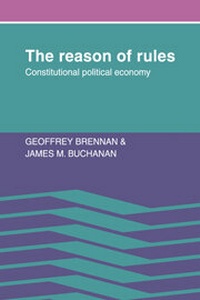
The Reason of Rules
Constitutional Political Economy
Published on 31. January 1986
Book
Hardback
176 pages
978-0-521-25655-1 (ISBN)
Description
Societies function on the basis of rules. These rules, rather like the rules of the road, coordinate the activities of individuals who have a variety of goals and purposes. Whether the rules work well or ill, and how they can be made to work better, is a matter of major concern. Appropriately interpreted, the working of social rules is also the central subject matter of modern political economy. This book is about rules - what they are, how they work, and how they can be properly analysed. The authors' objective is to understand the workings of alternative political institutions so that choices among such institutions (rules) can be more fully informed. Thus, broadly defined, the methodology of constitutional political economy is the subject matter of The Reason of Rules. The authors have examined how rules for political order work, how such rules might be chosen, and how normative criteria for such choices might be established.
More details
Language
English
Place of publication
Cambridge
United Kingdom
Target group
Professional and scholarly
Dimensions
Height: 228 mm
Width: 152 mm
Thickness: 18 mm
Weight
360 gr
ISBN-13
978-0-521-25655-1 (9780521256551)
Copyright in bibliographic data and cover images is held by Nielsen Book Services Limited or by the publishers or by their respective licensors: all rights reserved.
Schweitzer Classification
Other editions
New editions
Book
08/2008
Cambridge University Press
€56.80
Shipment within 15-20 days
Additional editions
Book
08/2008
Cambridge University Press
€56.80
Shipment within 15-20 days
Content
1. The constitutional imperative; 2. The contractarian vision; 3. The myth of benevolence; 4. Modelling the individual for constitutional analysis; 5. Time, temptation, and the constrained future; 6. Politics without rules, I: Time and non-constrained collective action; 7. rules and justice; 8. Politics without rules, II: Distributive justice and distributive politics; 9. Is constitutional revolution possible in democracy?