

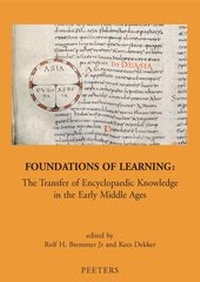
Foundations of Learning
The Transfer of Encyclopaedic Knowledge in the Early Middle Ages
1st Edition
Published on 26. October 2007
Book
Paperback/Softback
393 pages
978-90-429-1979-2 (ISBN)
Unfortunately, price unknown
Available (delivery time upon request)
Not available
Description
No period in the intellectual history of North-Western Europe has been so formative as the early Middle Ages, when missionaries transferred the learning accumulated for centuries in the Mediterranean basin to recently founded centres of religious scholarship in the ever expanding Christian world. The aim of this scholarship focused, first and foremost, on a proper understanding of the Bible as God's Word and Nature as God's Creation. During this period the foundations of medieval learning were laid in the monasteries and schools by men from distant shores who considered it their calling to entrust this precious knowledge to future generations of indigenous scholars. In this process, Syrians ended up in England, Irishmen in Italy, and Anglo-Saxons in Frisia and Bavaria and thus helped build a common intellectual culture in Europe.
Even though the memories of these missionaries were fed with vast amounts of reproducible knowledge far beyond the capacity of modern man, the most important means of storing and conveying knowledge was the written word stored in what was then modern technology: the parchment codex. The composition of these books reflect the extent and diversity of early medieval learning. Sometimes they contain a single work, but often enough they contain compilations of diverse material which at first sight shows little coherence to the modern reader, and rightly so. In a way such miscellanies are mini-libraries. Nevertheless, they are storehouses of wholesome learning in their own right; further study reveals a rationale in such collections that leads us to a monastic learning environment, in some cases even to the classroom.
The present volume demonstrates how the study of texts and manuscripts combined opens up windows on the early medieval world of learning as represented by glossaries, proto-encyclopedias, biblical companions, hagiographical guides, didactic verse, or descriptions of the world in word and image. The essays demonstrate that scholars have too often concentrated on the study of single texts, but especially that the compilations of manuscripts and libraries reflect the kind of knowledge that was required of monks, ministers and missionaries for the contemplation, celebration and promulgation of the Christian message.
Even though the memories of these missionaries were fed with vast amounts of reproducible knowledge far beyond the capacity of modern man, the most important means of storing and conveying knowledge was the written word stored in what was then modern technology: the parchment codex. The composition of these books reflect the extent and diversity of early medieval learning. Sometimes they contain a single work, but often enough they contain compilations of diverse material which at first sight shows little coherence to the modern reader, and rightly so. In a way such miscellanies are mini-libraries. Nevertheless, they are storehouses of wholesome learning in their own right; further study reveals a rationale in such collections that leads us to a monastic learning environment, in some cases even to the classroom.
The present volume demonstrates how the study of texts and manuscripts combined opens up windows on the early medieval world of learning as represented by glossaries, proto-encyclopedias, biblical companions, hagiographical guides, didactic verse, or descriptions of the world in word and image. The essays demonstrate that scholars have too often concentrated on the study of single texts, but especially that the compilations of manuscripts and libraries reflect the kind of knowledge that was required of monks, ministers and missionaries for the contemplation, celebration and promulgation of the Christian message.
More details
Series
Language
English
Place of publication
Leuven
Belgium
Target group
Professional and scholarly
Weight
1020 gr
ISBN-13
978-90-429-1979-2 (9789042919792)
Copyright in bibliographic data and cover images is held by Nielsen Book Services Limited or by the publishers or by their respective licensors: all rights reserved.
Schweitzer Classification