

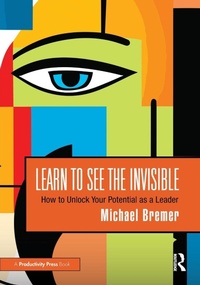
Learn to See the Invisible
How to Unlock Your Potential as a Leader
1st Edition
Published on 31. October 2024
Book
Paperback/Softback
164 pages
978-1-032-80070-7 (ISBN)
Description
Most improvement consultants say improvement efforts must be led by the CEO, and that is certainly ideal. But the actual reality is most CEOs do not actively drive/guide improvement. They want it to happen, but they focus most of their energy on other issues. According to surveys from Gallup and others, the number one reason people say, "I am not engaged" is due to the behaviors of their direct boss! Those leaders (in the middle of an organization) have a tremendous amount of leverage; first- and second-line leaders directly touch 80% of the people in their organization. They have a tremendous amount of influence and more power than they might realize. This book focuses on that demographic.
This book describes four key foundations and 25 different actions leaders can practice to become more effective in training their eyes to see things tomorrow that are currently invisible. It helps leaders and managers to become better observers of their current reality by practicing getting better at getting better. The goal is to get better in the way we lead, the way our team performs, and the results we accomplish. If done in the right way, visually posting your improvement targets is the key to driving more personal growth, as well as more cross-functional collaboration and cooperation in your work activities. The most unique aspect of this book is that it suggests leaders use visual tools.
Visual Leadership is the fourth foundational element the author encourages people to practice. The primary purpose of visual performance metrics isn't to make sure things are working well in your department. It's to create a thinking environment that makes it easier for multiple departments, teams, and groups to work together. It is relatively easy to come up with performance metrics for your team, but what about metrics that help "us" to work more effectively together? Good visual reporting practices create "information democracy." They eliminate filters that obscure knowledge between layers of management and between departments. They help to create an environment that is much more robust and open, making it easier to be in touch with the "actual reality." And perhaps the most exciting of all, visual tools can help an individual learn to lead more effectively. The power of using visuals in this way is underutilized in most organizations.
Whatever new behaviors a leader is trying to accomplish, visual reporting can facilitate progress and ensure accountability in developing those new habits.
This book describes four key foundations and 25 different actions leaders can practice to become more effective in training their eyes to see things tomorrow that are currently invisible. It helps leaders and managers to become better observers of their current reality by practicing getting better at getting better. The goal is to get better in the way we lead, the way our team performs, and the results we accomplish. If done in the right way, visually posting your improvement targets is the key to driving more personal growth, as well as more cross-functional collaboration and cooperation in your work activities. The most unique aspect of this book is that it suggests leaders use visual tools.
Visual Leadership is the fourth foundational element the author encourages people to practice. The primary purpose of visual performance metrics isn't to make sure things are working well in your department. It's to create a thinking environment that makes it easier for multiple departments, teams, and groups to work together. It is relatively easy to come up with performance metrics for your team, but what about metrics that help "us" to work more effectively together? Good visual reporting practices create "information democracy." They eliminate filters that obscure knowledge between layers of management and between departments. They help to create an environment that is much more robust and open, making it easier to be in touch with the "actual reality." And perhaps the most exciting of all, visual tools can help an individual learn to lead more effectively. The power of using visuals in this way is underutilized in most organizations.
Whatever new behaviors a leader is trying to accomplish, visual reporting can facilitate progress and ensure accountability in developing those new habits.
More details
Language
English
Place of publication
London
United Kingdom
Publishing group
Taylor & Francis Ltd
Target group
Professional and scholarly
Professional Practice & Development
Illustrations
36 s/w Zeichnungen, 36 s/w Abbildungen
36 Line drawings, black and white; 36 Illustrations, black and white
Dimensions
Height: 254 mm
Width: 178 mm
Thickness: 10 mm
Weight
351 gr
ISBN-13
978-1-032-80070-7 (9781032800707)
Copyright in bibliographic data and cover images is held by Nielsen Book Services Limited or by the publishers or by their respective licensors: all rights reserved.
Schweitzer Classification
Other editions
Additional editions

Book
10/2024
1st Edition
Productivity Press
€185.80
Shipment within 10-20 days
E-Book
10/2024
1st Edition
Productivity Press
€40.99
Available for download
E-Book
10/2024
1st Edition
Productivity Press
€40.99
Available for download
Person
Michael Bremer has held many positions including director of the information systems for Beatrice Foods, Chief Financial Officer and Board member for the Association of Manufacturing Excellence (AME), and President of the Cumberland Group in Chicago for 28 years (global consulting company). Served as adjunct faculty for the University of Chicago's Graham School for 15 years and also served as a senior mentor at a new business start-up incubator focused on manufacturing (mHub Chicago).
Awards:
2016 Shingo Prize Research Award for How to Do a Gemba Walk.
2019 recipient of the Mac McCulloch Lifetime Achievement Award from AME.
Author of four books:
Six Sigma Black Belt Handbook
Six Sigma Financial Tracking & Reporting
Escape the Improvement Trap
How to Do a Gemba Walk
Current activities:
Serve as a volunteer V.P. for the Association of Manufacturing Excellence Award -- activities included managing a network of 50+ volunteer assessors and leading a site visit team to Malaysia in 2022.
Moderate Global Issues discussion group for Dominican University's OLLI program..
Feel free to connect on LinkedIn, Twitter @michaelbremer, or michael@michaelbremer.net
Awards:
2016 Shingo Prize Research Award for How to Do a Gemba Walk.
2019 recipient of the Mac McCulloch Lifetime Achievement Award from AME.
Author of four books:
Six Sigma Black Belt Handbook
Six Sigma Financial Tracking & Reporting
Escape the Improvement Trap
How to Do a Gemba Walk
Current activities:
Serve as a volunteer V.P. for the Association of Manufacturing Excellence Award -- activities included managing a network of 50+ volunteer assessors and leading a site visit team to Malaysia in 2022.
Moderate Global Issues discussion group for Dominican University's OLLI program..
Feel free to connect on LinkedIn, Twitter @michaelbremer, or michael@michaelbremer.net
Content
1 Introduction
2 Reflection
3 Define a Unifying Purpose
4 Elevate the People Around You - Build Relationships
5 Visual Leadership
6 How Do You Change a Habit?
2 Reflection
3 Define a Unifying Purpose
4 Elevate the People Around You - Build Relationships
5 Visual Leadership
6 How Do You Change a Habit?