

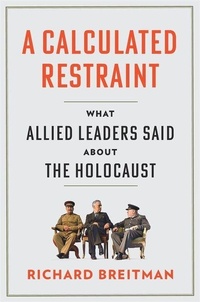
A Calculated Restraint
What Allied Leaders Said about the Holocaust
Published on 6. May 2025
Book
Hardback
352 pages
978-0-674-29364-9 (ISBN)
Description
An eminent historian of the Holocaust examines why Churchill, Roosevelt, and Stalin, though faced with mounting evidence of the Nazi extermination of Jews, were reluctant to speak out against the atrocities.
The Allied leaders rarely spoke directly about the Holocaust in public. When Churchill and Stalin alluded to Nazi mass murder of civilians in early speeches, they said much less than they knew. Not until December 1942 did Allied governments issue a joint statement about Nazi Germany's policy of exterminating the Jews of Europe. Roosevelt deferred his own public statement until March 1944. Why didn't these leaders speak up sooner?
Through close readings of public and private statements, Richard Breitman pieces together the competing motivations that drove each leader's response to the atrocities. All three knew that their reactions would be politically sensitive, as Nazi propagandists frequently alleged that the Allies were fighting on behalf of Jews, and that Jews were the puppet masters behind their governments. At a time of globally prevalent antisemitism, these calumnies had force. After the German invasion of the USSR, moreover, Stalin clearly wanted to focus on the threat to the Soviet state and people. At the same time, Churchill and Roosevelt realized that complete silence would prompt accusations of willful blindness. They usually finessed this dilemma by denouncing Nazi atrocities in general, prioritizing wartime constraints over moral considerations.
Timely and incisive, A Calculated Restraint sheds new light on the relationship between World War II and the Holocaust. Ultimately, the Allied leaders' responses cannot be reduced to a matter of character. What they said-and chose not to say-about the Holocaust must be understood in light of the political and military exigencies that drove their decision-making.
The Allied leaders rarely spoke directly about the Holocaust in public. When Churchill and Stalin alluded to Nazi mass murder of civilians in early speeches, they said much less than they knew. Not until December 1942 did Allied governments issue a joint statement about Nazi Germany's policy of exterminating the Jews of Europe. Roosevelt deferred his own public statement until March 1944. Why didn't these leaders speak up sooner?
Through close readings of public and private statements, Richard Breitman pieces together the competing motivations that drove each leader's response to the atrocities. All three knew that their reactions would be politically sensitive, as Nazi propagandists frequently alleged that the Allies were fighting on behalf of Jews, and that Jews were the puppet masters behind their governments. At a time of globally prevalent antisemitism, these calumnies had force. After the German invasion of the USSR, moreover, Stalin clearly wanted to focus on the threat to the Soviet state and people. At the same time, Churchill and Roosevelt realized that complete silence would prompt accusations of willful blindness. They usually finessed this dilemma by denouncing Nazi atrocities in general, prioritizing wartime constraints over moral considerations.
Timely and incisive, A Calculated Restraint sheds new light on the relationship between World War II and the Holocaust. Ultimately, the Allied leaders' responses cannot be reduced to a matter of character. What they said-and chose not to say-about the Holocaust must be understood in light of the political and military exigencies that drove their decision-making.
Reviews / Votes
A solid guide to a crisis in which leaders found themselves constrained by many obstacles from doing more. -- Richard Overy * Literary Review * A Calculated Restraint is Richard Breitman's magnum opus, the culmination of decades of brilliant scholarship. In an ideal world, this book should finally resolve the questions and dispel the myths that so many still have about the Allied leaders' knowledge of and response to the Holocaust as it was unfolding. I highlighted so many passages I ran out of ink. -- Rebecca Erbelding, author of <i>Rescue Board: The Untold Story of America's Efforts to Save the Jews of Europe</i> In this brilliantly interwoven study, eminent historian Richard Breitman illuminates what three of the twentieth century's most consequential leaders-Churchill, Roosevelt, and Stalin-knew privately and said publicly about the Holocaust. A riveting storyteller and a keen analyst of the sources, Breitman stays true to the record and to the facts known at the time. His account of the moral limitations and political calculations of these powerful men could not be more timely or instructive. -- Wendy Lower, author of <i>Hitler's Furies: German Women in the Nazi Killing Fields</i> This fine book is vintage Richard Breitman: grounded in a mastery of relevant sources, guided by close and careful reading, insistent on historical contextualization, and suspicious of pieties. Breitman shows that one can understand the past only by immersing oneself in it, not by projecting present concerns or retrospective desires onto it. -- Peter Hayes, author of <i>Why? Explaining the Holocaust</i> Richard Breitman sets out with a seemingly simple goal: to contextualize the Allied leaders' statements about what we now call the Holocaust. It is an indispensable task for historians, and a particularly urgent one in the field of Holocaust Studies, where all too often such statements are taken out of context. Drawing on his vast expertise, Breitman not only achieves this goal but also incisively analyzes Allied leaders' policies regarding the Holocaust. With clarity and precision, he debunks many conventional myths and makes a significant contribution to our understanding of the Allied response to the murder of European Jews. -- Michael Berenbaum, author of <i>The World Must Know</i>More details
Language
English
Place of publication
Cambridge, Mass
United States
Target group
College/higher education
Illustrations
2 Karten
2 Maps
Dimensions
Height: 213 mm
Width: 144 mm
Thickness: 31 mm
Weight
530 gr
ISBN-13
978-0-674-29364-9 (9780674293649)
Copyright in bibliographic data and cover images is held by Nielsen Book Services Limited or by the publishers or by their respective licensors: all rights reserved.
Schweitzer Classification
Person
Richard Breitman is Distinguished Professor Emeritus at American University. His many books include The Berlin Mission: The American Who Resisted Nazi Germany from Within; FDR and the Jews, coauthored with Allan J. Lichtman; Official Secrets: What the Nazis Planned, What the British and Americans Knew; and The Architect of Genocide: Himmler and the Final Solution.