

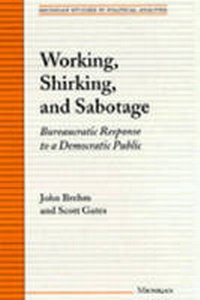
Working, Shirking, and Sabotage
Bureaucratic Response to a Democratic Public
Published on 23. April 1999
Book
Paperback/Softback
280 pages
978-0-472-08612-2 (ISBN)
Description
Bureaucrats perform most of the tasks of government, profoundly influencing the daily lives of Americans. But who, or what, controls what bureaucrats do?
John Brehm and Scott Gates examine who influences whether federal, state, and local bureaucrats work, shirk, or sabotage policy. The authors combine deductive models and computer simulations of bureaucratic behavior with statistical analysis in order to assess the competing influences over how bureaucrats expend their efforts. Drawing upon surveys, observational studies, and administrative records of the performance of public employees in a variety of settings, Brehm and Gates demonstrate that the reasons bureaucrats work as hard as they do include the nature of the jobs they are recruited to perform and the influence of both their fellow employees and their clients in the public. In contrast to the conclusions of principal-agency models, the authors show that the reasons bureaucrats work so hard have little to do with the coercive capacities of supervisors.
This book is aimed at students of bureaucracy and organizations and will be of interest to researchers in political science, economics, public policy, and sociology.
"This book is breathtaking in its use of models and techniques. . . . The approach developed by Brehm and Gates allows us to re-open empirical questions that have lain dormant for years." --Bryan D. Jones, University of Washington
John Brehm is Associate Professor of Political Science, Duke University. Scott Gates is Associate Professor of Political Science, Michigan State University.
John Brehm and Scott Gates examine who influences whether federal, state, and local bureaucrats work, shirk, or sabotage policy. The authors combine deductive models and computer simulations of bureaucratic behavior with statistical analysis in order to assess the competing influences over how bureaucrats expend their efforts. Drawing upon surveys, observational studies, and administrative records of the performance of public employees in a variety of settings, Brehm and Gates demonstrate that the reasons bureaucrats work as hard as they do include the nature of the jobs they are recruited to perform and the influence of both their fellow employees and their clients in the public. In contrast to the conclusions of principal-agency models, the authors show that the reasons bureaucrats work so hard have little to do with the coercive capacities of supervisors.
This book is aimed at students of bureaucracy and organizations and will be of interest to researchers in political science, economics, public policy, and sociology.
"This book is breathtaking in its use of models and techniques. . . . The approach developed by Brehm and Gates allows us to re-open empirical questions that have lain dormant for years." --Bryan D. Jones, University of Washington
John Brehm is Associate Professor of Political Science, Duke University. Scott Gates is Associate Professor of Political Science, Michigan State University.
Reviews / Votes
"This book is breathtaking in its use of models and techniques. . . . The approach developed by Brehm and Gates allows us to re-open empirical questions that have lain dormant for years."-Bryan D. Jones, University of Washington -- Bryan D. Jones, University of Washington "This is a stimulating book. It proposes a refreshing perspective on bureaucrats, who are portrayed as committed and hard workers. It is a useful reminder that there is no necessary connection between rational choice and the political Right."
-American Political Science Review * American Political Science Review * "This book asks, Who or what controls bureaucrats? Brehm and Gates find this issue crucial despite the multiple, redundant layers of controls heaped on career employees. . . . They find, contrary to predictions, that career employees in government work hard and are motivated by 'functional' and 'solidary' preferences (commitment to the job and its public importance, expectations by peers, and professional standards). Although these conclusions will surprise no one who has spent time inside government, they refute the antipublic biases favored by economists."
-Choice * Choice *
More details
Series
Language
English
Place of publication
Ann Arbor
United States
Target group
Professional and scholarly
Illustrations
39 tables, 29 figures
Dimensions
Height: 229 mm
Width: 152 mm
ISBN-13
978-0-472-08612-2 (9780472086122)
Copyright in bibliographic data and cover images is held by Nielsen Book Services Limited or by the publishers or by their respective licensors: all rights reserved.
Schweitzer Classification
Persons
John Brehm is Associate Professor of Political Science, Duke University.
Scott Gates is Associate Professor of Political Science, Michigan State University.
Scott Gates is Associate Professor of Political Science, Michigan State University.