

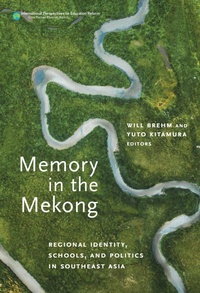
Memory in the Mekong
Regional Identity, Schools, and Politics in Southeast Asia
Published on 4. March 2022
Book
Hardback
216 pages
978-0-8077-6637-8 (ISBN)
Description
This edited collection explores the possibilities, perils, and politics of constructing a regional identity. The Association of Southeast Asian Nations (ASEAN), a multinational institution comprised of 10 member states, is dedicated to building a Southeast Asian regional identity that includes countries along Southeast Asia's Mekong River delta: Cambodia, Thailand, Vietnam, Laos, and Myanmar.
After successfully establishing an economic community in 2015, where capital and people can freely move across national borders, ASEAN and its partners now aim to develop a sociocultural community that is fully functional in a wide range of sectors by 2025. As part of this vision, ASEAN wishes to construct a regional identity by uniting over 600 million people, which will be achieved partly through national school systems that teach shared histories. In this text, the contributors critically examine the many questions that arise in the face of this significant change: What does an ASEAN identity look like? Is it even possible or desirable to create a common identity across the diverse peoples of Southeast Asia? Given the divergent memories of history, how would a regional identity exist alongside national identity? Memory in the Mekong grapples with these questions by exploring issues of shared history, national identity, and schooling in a region that is frequently underexamined and underrepresented in Western scholarship.
Book Features:
First comparative study of regional identity and schools in the Mekong.
In-depth analysis of UNESCO Bangkok's Shared Histories project.
Use of historical memory theoretical tools to understand identity formation, extending the work on imagined communities.
Chapters written by researchers from across the Mekong.
After successfully establishing an economic community in 2015, where capital and people can freely move across national borders, ASEAN and its partners now aim to develop a sociocultural community that is fully functional in a wide range of sectors by 2025. As part of this vision, ASEAN wishes to construct a regional identity by uniting over 600 million people, which will be achieved partly through national school systems that teach shared histories. In this text, the contributors critically examine the many questions that arise in the face of this significant change: What does an ASEAN identity look like? Is it even possible or desirable to create a common identity across the diverse peoples of Southeast Asia? Given the divergent memories of history, how would a regional identity exist alongside national identity? Memory in the Mekong grapples with these questions by exploring issues of shared history, national identity, and schooling in a region that is frequently underexamined and underrepresented in Western scholarship.
Book Features:
First comparative study of regional identity and schools in the Mekong.
In-depth analysis of UNESCO Bangkok's Shared Histories project.
Use of historical memory theoretical tools to understand identity formation, extending the work on imagined communities.
Chapters written by researchers from across the Mekong.
More details
Series
Language
English
Place of publication
New York
United States
Target group
Professional and scholarly
Product notice
sewn/stitched
Cloth over boards
Dimensions
Height: 230 mm
Width: 156 mm
Thickness: 18 mm
Weight
399 gr
ISBN-13
978-0-8077-6637-8 (9780807766378)
Copyright in bibliographic data and cover images is held by Nielsen Book Services Limited or by the publishers or by their respective licensors: all rights reserved.
Schweitzer Classification
Persons
Will Brehm is an associate professor at the UCL Institute of Education, University College London. Yuto Kitamura is a professor at the Graduate School of Education, University of Tokyo.
Content
Contents
Foreword?Thongchai Winichakul ?ix
Acknowledgments ?xi
Introduction: Toward a Southeast Asian Identity? Schools as Contested Sites of Collective Memory ?1
Will Brehm
Part I: Regional Memory
1. ?The UNESCO Shared Histories Curriculum: Paradoxes and Possibilities ?23
Rosalie Metro and Will Brehm
2. ?Regional Memory in Con-temporary Cambodia: "Cautious Resistance and Calculated Conformity" ?47
Will Brehm
Part II: National Memory
3. ?Whose Kingdoms and Whose Settlement? Hegemonic National Memory Inside Thai Textbooks ?75
Vong-on Phuaphansawat and -Will Brehm
4. ?Vietnamese Citizenship in Transition: State Curricula Pre- and Post-Doi Moi ?103
Bich-Hang Duong
Part III: Public Memory
5. ?Thinking With History in Pursuit of Truth in Myanmar ?133
Anna Zongollowicz
6. ?Finding Unity in Diversity: Public Identity Patterns in Lao PDR ?153
Will Brehm, Thongdeuane Nanthanavone, Somsanit Larvankham, and Yasushi Hirosato
7. ?Exploring Unity and Diversity in the Histories of Southeast Asia ?177
Yuto Kitamura
Afterword?Shigeru Aoyagi ?187
About the Editors and Contributors ?191
Index ?193
Foreword?Thongchai Winichakul ?ix
Acknowledgments ?xi
Introduction: Toward a Southeast Asian Identity? Schools as Contested Sites of Collective Memory ?1
Will Brehm
Part I: Regional Memory
1. ?The UNESCO Shared Histories Curriculum: Paradoxes and Possibilities ?23
Rosalie Metro and Will Brehm
2. ?Regional Memory in Con-temporary Cambodia: "Cautious Resistance and Calculated Conformity" ?47
Will Brehm
Part II: National Memory
3. ?Whose Kingdoms and Whose Settlement? Hegemonic National Memory Inside Thai Textbooks ?75
Vong-on Phuaphansawat and -Will Brehm
4. ?Vietnamese Citizenship in Transition: State Curricula Pre- and Post-Doi Moi ?103
Bich-Hang Duong
Part III: Public Memory
5. ?Thinking With History in Pursuit of Truth in Myanmar ?133
Anna Zongollowicz
6. ?Finding Unity in Diversity: Public Identity Patterns in Lao PDR ?153
Will Brehm, Thongdeuane Nanthanavone, Somsanit Larvankham, and Yasushi Hirosato
7. ?Exploring Unity and Diversity in the Histories of Southeast Asia ?177
Yuto Kitamura
Afterword?Shigeru Aoyagi ?187
About the Editors and Contributors ?191
Index ?193