

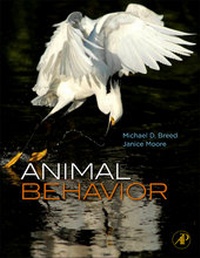
Animal Behavior
Published on 15. March 2011
Book
Paperback/Softback
496 pages
978-0-12-372581-3 (ISBN)
Description
Animal Behavior covers the broad sweep of animal behavior from its neurological underpinnings to the importance of behavior in conservation. The authors, Michael D. Breed and Janice Moore, bring almost 60 years of combined experience as university professors to this textbook, much of that teaching animal behavior.
An entire chapter is devoted to the vibrant new field of behavior and conservation, including topics such as social behavior and the relationship between parasites, pathogens, and behavior. Thoughtful coverage has also been given to foraging behavior, mating and parenting behavior, anti-predator behavior and learning.
This text addresses the physiological foundations of behavior in a way that is both accessible and inviting. Each chapter begins with learning objectives and concludes with thought-provoking questions. Additionally, special terms and definitions are highlighted throughout.
The book provides a rich resource for students (and professors) from a wide range of life science disciplines.
An entire chapter is devoted to the vibrant new field of behavior and conservation, including topics such as social behavior and the relationship between parasites, pathogens, and behavior. Thoughtful coverage has also been given to foraging behavior, mating and parenting behavior, anti-predator behavior and learning.
This text addresses the physiological foundations of behavior in a way that is both accessible and inviting. Each chapter begins with learning objectives and concludes with thought-provoking questions. Additionally, special terms and definitions are highlighted throughout.
The book provides a rich resource for students (and professors) from a wide range of life science disciplines.
Reviews / Votes
"Breed & Moore present an accessible introduction to behaviour that simultaneously captures the dynamic nature and diversity of the field. The text is focused on functional and evolutionary approaches to questions in behaviour, addressing only the bare bones of neural, physiological and genetic mechanisms. Thorough coverage is provided of empirical and theoretical approaches to learning and cognition, cooperation and social behaviour, foraging and movement, and sexual selection and parental care. Topical and relevant areas are emphasized, such as the intersection between conservation and behaviour, and predicting behavioural responses to climate change." --Animal Behaviour 84 (2012) 289-291More details
Language
English
Place of publication
San Diego
United States
Publishing group
Elsevier Science Publishing Co Inc
Target group
College/higher education
Intermediate and advanced undergraduate students in animal behavior courses
Dimensions
Height: 276 mm
Width: 216 mm
Weight
1440 gr
ISBN-13
978-0-12-372581-3 (9780123725813)
Copyright in bibliographic data and cover images is held by Nielsen Book Services Limited or by the publishers or by their respective licensors: all rights reserved.
Schweitzer Classification
Other editions
New editions
Michael D. Breed | Janice Moore
Animal Behavior
Book
07/2015
2nd Edition
Academic Press
€77.98
Article exhausted; check for reprint
Additional editions
Michael D. Breed | Janice Moore
Animal Behavior
E-Book
01/2011
1st Edition
Academic Press
€72.95
Available for download
Persons
After receiving his PhD from the University of Kansas in 1977, Dr. Breed began work as a faculty member at the University of Colorado, Boulder and taught as a Professor in the Department of Ecology and Evolutionary Biology until his retirement in 2019. He taught courses in general biology, animal behavior, insect biology, and tropical biology. His research program focused on the behavior and ecology of social insects, and he worked on ants, bees, and wasps. He studied many aspects of social behavior, including nestmate recognition, division of labor, the genetics of colony defense, the behavior of defensive bees, and communication during colony defense. Dr. Breed was the Executive Editor of the scientific journals Animal Behaviour from 2006-2009 and Insectes Sociaux from 2014-2018. As an undergraduate, I was inspired by parasitologist Clark P. Read to think about the ecology and evolution of parasites in new ways. I was especially excited to learn that parasites affected animal behavior, another favorite subject area. Most biologists outside the world of parasitology were not interested in parasites; they were relegated to a nether world someplace between the biology of free-living organisms and medicine. After peregrination through more than one graduate program, I completed my PhD studying parasites and behavior at the University of New Mexico. I did postdoctoral work on parasite community ecology with Dan Simberloff at Florida State University, and then accepted a faculty position at Colorado State University, where I have remained since 1983. I am currently a Professor in the Department of Biology where I teach courses in invertebrate zoology, animal behavior, and history of medicine. I study a variety of aspects of parasite ecology and host behavior ranging from behavioral fever and transmission behavior to the ecology of introduced parasite species.
Content
1. Of Cockroaches and Wolves: Framing Animal Behavior
2. Neurobiology and Endocrinology for Animal Behaviorists
3. Behavioral Genetics
4. Homeostasis and Time Budgets
5. Learning
6. Cognition
7. Communication
8. Movement: Search, Navigation, Migration, and Dispersal
9. Foraging
10. Self-defense
11. Mating Systems
12 . Nesting, Parenting and Territoriality
13. Social Behavior, Cooperation, and Kinship
14. Comparative Social Behavior
15. Conservation and Behavior
2. Neurobiology and Endocrinology for Animal Behaviorists
3. Behavioral Genetics
4. Homeostasis and Time Budgets
5. Learning
6. Cognition
7. Communication
8. Movement: Search, Navigation, Migration, and Dispersal
9. Foraging
10. Self-defense
11. Mating Systems
12 . Nesting, Parenting and Territoriality
13. Social Behavior, Cooperation, and Kinship
14. Comparative Social Behavior
15. Conservation and Behavior