

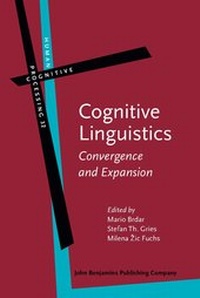
Cognitive Linguistics
Convergence and Expansion
Published on 10. November 2011
Book
Hardback
362 pages
978-90-272-2386-9 (ISBN)
Description
Cognitive Linguistics is not a unified theory of language but rather a set of flexible and mutually compatible theoretical frameworks. Whether these frameworks can or should stabilize into a unified theory is open to debate. One set of contributions to the volume focuses on evidence that strengthens the basic tenets of CL concerning e.g. non-modularity, meaning, and embodiment. A second set of chapters explores the expansion of the general CL paradigm and the incorporation of theoretical insights from other disciplines and their methodologies - a development that could lead to competing and mutually exclusive theories within the CL paradigm itself. The authors are leading experts in cognitive grammar, cognitive pragmatics, metaphor and metonymy theory, quantitative corpus linguistics, functional linguistics, and cognitive psychology. This volume is therefore of great interest to scholars and students wishing to inform themselves about the current state and possible future developments of Cognitive Linguistics.
More details
Series
Language
English
Place of publication
Amsterdam
Netherlands
Target group
Professional and scholarly
Illustrations
+ index
Dimensions
Height: 245 mm
Width: 164 mm
Weight
820 gr
ISBN-13
978-90-272-2386-9 (9789027223869)
Copyright in bibliographic data and cover images is held by Nielsen Book Services Limited or by the publishers or by their respective licensors: all rights reserved.
Schweitzer Classification
Other editions
Additional editions
E-Book
11/2011
1st Edition
John Benjamins Publishing Company
€118.99
Available for download
Persons
Content
1. Editors and contributors; 2. Introduction: Convergence and expansion in cognitive linguistics (by Brdar, Mario); 3. Part 1. Setting the scene; 4. Convergence in cognitive linguistics (by Langacker, Ronald W.); 5. An overview of cognitive linguistics (by Barcelona, Antonio); 6. Part 2. Consolidating the paradigm; 7. Pattern versus process concepts of grammar and mind: A cognitive-functional perspective (by Nuyts, Jan); 8. Metaphor in language and thought: How do we map the field? (by Steen, Gerard J.); 9. Emotion and desire in independent complement clauses: A case study from German (by Panther, Klaus-Uwe); 10. Schematic meaning of the Croatian verbal prefix iz-: Meaning chains and syntactic implications (by Belaj, Branimir); 11. The conceptual motivation of bahuvrihi compounds in English and Spanish (by Barcelona, Antonio); 12. On the subject of impersonals (by Langacker, Ronald W.); 13. Part 3. Expanding the paradigm; 14. Do people infer the entailments of conceptual metaphors during verbal metaphor understanding? (by Gibbs, Jr., Raymond W.); 15. Corpus data in usage-based linguistics: What's the right degree of granularity for the analysis of argument structure constructions? (by Gries, Stefan Th.); 16. Cognitive linguistics meets the corpus (by Stefanowitsch, Anatol); 17. Oops blush!: Beyond metaphors of emotion (by Tissari, Heli); 18. Conceptual construal and social construction (by Harder, Peter); 19. The biblical story retold: A cognitive linguistic perspective (by Kovecses, Zoltan); 20. Name index; 21. Subject index