

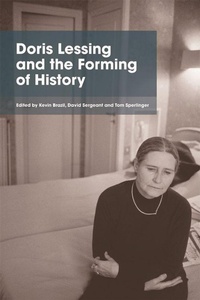
Doris Lessing and the Forming of History
Published on 19. October 2016
Book
Hardback
256 pages
978-1-4744-1443-2 (ISBN)
Description
Explores Doris Lessing's innovative engagement with historical change in her own lifetime and beyond
The death of Nobel Prize-winning Doris Lessing sparked a range of commemorations that cemented her place as one of the major figures of twentieth- and twenty-first-century world literature. This volume views Lessing's writing as a whole and in retrospect, focusing on her innovative attempts to rework literary form to engage with the challenges thrown up by the sweeping historical changes through which she lived. The 12 original chapters provide new readings of Lessing's work via contexts ranging from post-war youth politics and radical women's writing to European cinema, analyse her experiments with genres from realism to autobiography and science-fiction, and draw on previously unstudied archive material. The volume also explores how Lessing's writing can provide insight into some of the issues now shaping twenty-first century scholarship - including trauma, ecocriticism, the post-human, and world literature - as they emerge as defining challenges to our own present moment in history.
Key Features
Offers a critical overview of the full range of Lessing's work, setting the agenda for future study of her writingProvides new readings of an unprecedented range of Lessing's writing, including previously unstudied archive material, landmark novels such as The Golden Notebook, drama and reportage, essays, memoirs and short storiesSituates Lessing in relation to new literary and cultural contexts, including the nineteenth-century novel-series, cinema, and post-war youth cultureRelates Lessing's work to contemporary theoretical debates on post-humanism, trauma, ecocriticism, radical women's writing and world literature
The death of Nobel Prize-winning Doris Lessing sparked a range of commemorations that cemented her place as one of the major figures of twentieth- and twenty-first-century world literature. This volume views Lessing's writing as a whole and in retrospect, focusing on her innovative attempts to rework literary form to engage with the challenges thrown up by the sweeping historical changes through which she lived. The 12 original chapters provide new readings of Lessing's work via contexts ranging from post-war youth politics and radical women's writing to European cinema, analyse her experiments with genres from realism to autobiography and science-fiction, and draw on previously unstudied archive material. The volume also explores how Lessing's writing can provide insight into some of the issues now shaping twenty-first century scholarship - including trauma, ecocriticism, the post-human, and world literature - as they emerge as defining challenges to our own present moment in history.
Key Features
Offers a critical overview of the full range of Lessing's work, setting the agenda for future study of her writingProvides new readings of an unprecedented range of Lessing's writing, including previously unstudied archive material, landmark novels such as The Golden Notebook, drama and reportage, essays, memoirs and short storiesSituates Lessing in relation to new literary and cultural contexts, including the nineteenth-century novel-series, cinema, and post-war youth cultureRelates Lessing's work to contemporary theoretical debates on post-humanism, trauma, ecocriticism, radical women's writing and world literature
Reviews / Votes
The essays in this new collection... energize Lessing's engagement with several vectors of crisis deeply relevant for urgent contemporary challenges. -- Lara Choksey, University of Warwick * Doris Lessing Studies Issue 35 * The breadth and freshness of these essays, introduced by the co-editors' fine overview of Doris Lessing's expressions of historical change through literary forms, reinforces the author's undiminished appeal to contemporary scholars and readers. Exploring formal elements of Lessing's work-characterization, humour, readership, and film and dream analogues-along with politics and history, human evolution, climate change, and time travel, these essays are timely, ambitious, and intellectually engaging. -- Roberta Rubenstein, American UniversityMore details
Language
English
Place of publication
Edinburgh
United Kingdom
Target group
Professional and scholarly
Product notice
sewn/stitched
Cloth over boards
Dimensions
Height: 236 mm
Width: 155 mm
Thickness: 18 mm
Weight
522 gr
ISBN-13
978-1-4744-1443-2 (9781474414432)
Copyright in bibliographic data and cover images is held by Nielsen Book Services Limited or by the publishers or by their respective licensors: all rights reserved.
Schweitzer Classification
Other editions
Additional editions
Christina Hellmich | Lisa Purse
Disappearing War
Interdisciplinary Perspectives on Cinema and Erasure in the Post 9/11 World
E-Book
01/2017
1st Edition
Edinburgh University Press
€24.49
Available for download
Persons
Kevin Brazil is Lecturer in Late Twentieth and Early Twenty-First Century British Literature, University of Southampton. David Sergeant is Lecturer in English post-1850 at Plymouth University. Tom Sperlinger is Reader in English Literature and Community Engagement at the University of Bristol.
Content
Timeline; Introduction; 1. Early Lessing, Commitment, the World, Adam Guy; 2. 'I'm an adolescent. And that's how I'm going to stay': Lessing and Youth Culture 1956-1962, Nick Bentley; 3. Sequence, Series, and Character in Children of Violence, Kevin Brazil; 4. The Politics of Form: The Golden Notebook and Women's Radical Literary Tradition, Rowena Kennedy-Epstein; 5. Readers of Fiction and Readers in Fiction: Readership and The Golden Notebook, Sophia Barnes; 6. From The Grass is Singing to The Golden Notebook: Film, Literature, and Psychoanalysis, Laura Marcus; 7. 'A funny thing laughter, what's it for?': Humour and Form in Lessing's Fiction, Cornelius Collins; 8. Lessing and the Scale of Environmental Crisis, David Sergeant; 9. Lessing and Time Travel, David Punter; 10. Lessing's Interruptions, Tom Sperlinger; 11. Lessing's Witness Literature, Elizabeth Maslen; 12. A Catastrophic Universe: Lessing, Posthumanism, and Deep History, Clare Hanson; Select Bibliography.