

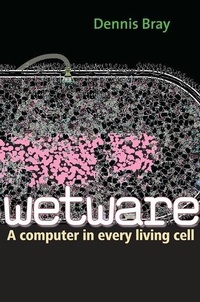
Wetware
A Computer in Every Living Cell
Published on 1. March 2011
Book
Paperback/Softback
288 pages
978-0-300-16784-9 (ISBN)
Description
In the tradition of as Erwin Schroedinger's What Is Life? and Richard Dawkins's The Selfish Gene, a distinguished cell biologist explains how living cells perform computations
How does a single-cell creature, such as an amoeba, lead such a sophisticated life? How does it hunt living prey, respond to lights, sounds, and smells, and display complex sequences of movements without the benefit of a nervous system? This book offers a startling and original answer.
In clear, jargon-free language, Dennis Bray taps the findings of the new discipline of systems biology to show that the internal chemistry of living cells is a form of computation. Cells are built out of molecular circuits that perform logical operations, as electronic devices do, but with unique properties. Bray argues that the computational juice of cells provides the basis of all the distinctive properties of living systems: it allows organisms to embody in their internal structure an image of the world, and this accounts for their adaptability, responsiveness, and intelligence.
In Wetware, Bray offers imaginative, wide-ranging and perceptive critiques of robotics and complexity theory, as well as many entertaining and telling anecdotes. For the general reader, the practicing scientist, and all others with an interest in the nature of life, the book is an exciting portal to some of biology's latest discoveries and ideas.
How does a single-cell creature, such as an amoeba, lead such a sophisticated life? How does it hunt living prey, respond to lights, sounds, and smells, and display complex sequences of movements without the benefit of a nervous system? This book offers a startling and original answer.
In clear, jargon-free language, Dennis Bray taps the findings of the new discipline of systems biology to show that the internal chemistry of living cells is a form of computation. Cells are built out of molecular circuits that perform logical operations, as electronic devices do, but with unique properties. Bray argues that the computational juice of cells provides the basis of all the distinctive properties of living systems: it allows organisms to embody in their internal structure an image of the world, and this accounts for their adaptability, responsiveness, and intelligence.
In Wetware, Bray offers imaginative, wide-ranging and perceptive critiques of robotics and complexity theory, as well as many entertaining and telling anecdotes. For the general reader, the practicing scientist, and all others with an interest in the nature of life, the book is an exciting portal to some of biology's latest discoveries and ideas.
Reviews / Votes
"'Whilst Bray doesn't shy away from using unfamiliar terms they are always explained in context. For a book delving into systems biology and comparing specific examples of biological processes to computational systems that's quite a welcome surprise... The style is elegant and very readable.' Celia Gitterman, Chemistry World 'Biology and information lie at the heart of a new scientific revolution. In this timely and illuminating volume, Dennis Bray passionately weaves a compelling case for a computational view of life.' Martyn Amos, author of Genesis Machines: The New Science of Biocomputing"More details
Language
English
Place of publication
United States
Target group
Professional and scholarly
Product notice
Paperback (trade)
Illustrations
23 b-w illus.
Dimensions
Height: 235 mm
Width: 156 mm
Thickness: 19 mm
Weight
402 gr
ISBN-13
978-0-300-16784-9 (9780300167849)
Copyright in bibliographic data and cover images is held by Nielsen Book Services Limited or by the publishers or by their respective licensors: all rights reserved.
Schweitzer Classification
Other editions
Additional editions
E-Book
05/2009
1st Edition
Yale University Press
from
€52.79
Available for download
Person
Dennis Bray is professor emeritus, University of Cambridge, and coauthor of several influential texts on molecular and cell biology. In 2007, he was awarded the prestigious European Science Prize in Computational Biology.