

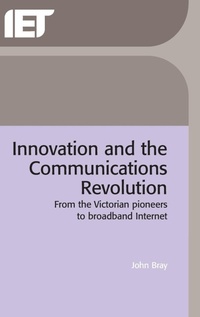
Innovation and the Communications Revolution
From the Victorian pioneers to broadband Internet
Published on 27. April 2002
Book
Hardback
336 pages
978-0-85296-218-3 (ISBN)
Description
This book describes the stage-by-stage creation and development, from the mid-nineteenth century to the present day, of the remarkable global communications technologies that have profoundly transformed the way that people live and work.
Written in a highly readable style, this book provides a fascinating account of the key innovators from Faraday, Maxwell and Hertz to the inventors of the transistor, microchip, optical fibre systems and the World Wide Web. The book explores the background and motivation of these pioneers and the social and economic environment in which they worked. The significance of each innovative step is shown in terms of the impact - in scale and relevance - on today's communications world. John Bray also looks to the future for innovations yet to come.
This book will be interest to all those interested in the human thread running through the history of technological advances in telecommunications and broadcasting.
Written in a highly readable style, this book provides a fascinating account of the key innovators from Faraday, Maxwell and Hertz to the inventors of the transistor, microchip, optical fibre systems and the World Wide Web. The book explores the background and motivation of these pioneers and the social and economic environment in which they worked. The significance of each innovative step is shown in terms of the impact - in scale and relevance - on today's communications world. John Bray also looks to the future for innovations yet to come.
This book will be interest to all those interested in the human thread running through the history of technological advances in telecommunications and broadcasting.
Reviews / Votes
'This is a book that should be in every secondary school library and would make an excellent introductory text for many undergraduate courses in many branches of engineering. It deserves a wide audience' -- Colin Gaskell 'Anyone who already knows a lot about communications and is interested in history will find this book absorbing' -- Laszlo Solymar * Times Higher Educational Supplement *More details
Series
Language
English
Place of publication
Stevenage
United Kingdom
Target group
College/higher education
Professional and scholarly
Product notice
Laminated cover
Dimensions
Height: 234 mm
Width: 156 mm
Thickness: 19 mm
Weight
645 gr
ISBN-13
978-0-85296-218-3 (9780852962183)
Copyright in bibliographic data and cover images is held by Nielsen Book Services Limited or by the publishers or by their respective licensors: all rights reserved.
Schweitzer Classification
Other editions
Additional editions
John Bray
Innovation and the Communications Revolution
From the Victorian pioneers to broadband Internet
E-Book
02/2009
1st Edition
Institution of Engineering and Technology
€92.09
Available for download
Person
John Bray was Director at the British Post Office Research Station, Dollis Hill, and later at the British Telecommunications Research Laboratories, Martlesham Heath, UK. He began his career with the British Post Office as an Assistant Engineer working on short-wave radio and went on to develop microwave radio relays for intercity communication. This led to the building of the BT Tower in London. In the 1950s, he studied telecommunications in the US, visiting Bell Labs and the Federal Communications Commission. He was responsible for the building of the BPO Satellite Communication Earth Station at Goonhilly Downs in Cornwall, which carried the first television transmission to the US via the TELSTAR satellite in 1962. He was Chairman of the Radio Consultative Committee of the International Consultative Committee of the ITU. In retirement he continued to work as Visiting Professor and external examiner at Imperial College London and UCL. His life-long work in telecommunications was recognised with a CBE, awarded in 1975.
Content
Chapter 1: Introduction
Chapter 2: Creators of the mathematical and scientific foundations
Chapter 3: The first telegraph and cable engineers
Chapter 4: The first telephone engineers
Chapter 5: Inventors of the thermionic valve
Chapter 6: The telegraph-telephone frequency-division multiplex transmission engineers
Chapter 7: Pioneers of radio communication
Chapter 8: Pioneers of sound radio broadcasting
Chapter 9: Pioneers of television broadcasting
Chapter 10: The engineers of the early multi-channel telephony coaxial cable systems: the first trans-Atlantic telephone cable
Chapter 11: The first microwave radio-relay engineers
Chapter 12: The inventors of the transistor and the microchip: a world-wide revolution in electronics
Chapter 13: The creators of information theory, pulse-code modulation and digital techniques
Chapter 14: The pioneers of electro-mechanical and computer-controlled electronic exchange switching systems
Chapter 15: The first satellite communication engineers
Chapter 16: Pioneers of long-distance waveguide systems: an unfulfilled vision
Chapter 17: Pioneers of optical fibre communication systems: the first trans- Atlantic system
Chapter 18: Inventors of the visual telecommunication systems
Chapter 19: Information technology and services: data communication
Chapter 20: Growth of the Internet and the World Wide Web
Chapter 21: The development of the mobile radio service
Chapter 22: Telecommunications and the future
Chapter 2: Creators of the mathematical and scientific foundations
Chapter 3: The first telegraph and cable engineers
Chapter 4: The first telephone engineers
Chapter 5: Inventors of the thermionic valve
Chapter 6: The telegraph-telephone frequency-division multiplex transmission engineers
Chapter 7: Pioneers of radio communication
Chapter 8: Pioneers of sound radio broadcasting
Chapter 9: Pioneers of television broadcasting
Chapter 10: The engineers of the early multi-channel telephony coaxial cable systems: the first trans-Atlantic telephone cable
Chapter 11: The first microwave radio-relay engineers
Chapter 12: The inventors of the transistor and the microchip: a world-wide revolution in electronics
Chapter 13: The creators of information theory, pulse-code modulation and digital techniques
Chapter 14: The pioneers of electro-mechanical and computer-controlled electronic exchange switching systems
Chapter 15: The first satellite communication engineers
Chapter 16: Pioneers of long-distance waveguide systems: an unfulfilled vision
Chapter 17: Pioneers of optical fibre communication systems: the first trans- Atlantic system
Chapter 18: Inventors of the visual telecommunication systems
Chapter 19: Information technology and services: data communication
Chapter 20: Growth of the Internet and the World Wide Web
Chapter 21: The development of the mobile radio service
Chapter 22: Telecommunications and the future