

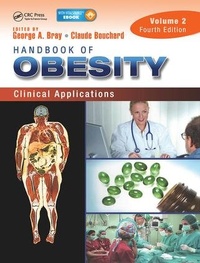
Handbook of Obesity - Volume 2
Clinical Applications, Fourth Edition
4th Edition
Published on 20. February 2014
Book
Hardback
522 pages
978-1-84184-981-2 (ISBN)
Description
Several major developments have occurred since the last edition of Handbook of Obesity: Clinical Applications, including new clinical trials, discoveries related to drug use, and greater understanding of the benefits of weight loss in obese patients. Now in its fourth edition, this volume continues to offer unparalleled depth and breadth of coverage concerning this global and chronic disease that affects and exacerbates associated conditions including diabetes and heart disease. The book is divided into five sections exploring essential factors involved in obesity prevention and treatment:
Prevention of Obesity: Strategies such as reengineering the environment to encourage physical activity and prevent excessive weight gain in children and adults
Evaluation of the Overweight or Obese Patient: Methods for assessing the overweight individual and the role of the primary care physician in patient management
Medical Treatment of Obesity and Weight Management Issues in the Treatment of Obesity: Lifestyle for weight loss and weight maintenance, diet and exercise, medications, herbal agents, and issues related to childhood obesity
Surgery: Screening for bariatric surgery, laparoscopic banding, liposuction, and other surgical techniques and strategies for operative and postoperative care
Epilogue: The economic assessment and cost-effectiveness of treatments for obesity, how obesity is viewed internationally, and governmental responses to challenges arising from the growing prevalence of obesity
Presenting the insight of international experts and edited by two eminent leaders in obesity research, the book is essential for health care providers in search of a comprehensive and up-to-date guide to treating obese patients.
Prevention of Obesity: Strategies such as reengineering the environment to encourage physical activity and prevent excessive weight gain in children and adults
Evaluation of the Overweight or Obese Patient: Methods for assessing the overweight individual and the role of the primary care physician in patient management
Medical Treatment of Obesity and Weight Management Issues in the Treatment of Obesity: Lifestyle for weight loss and weight maintenance, diet and exercise, medications, herbal agents, and issues related to childhood obesity
Surgery: Screening for bariatric surgery, laparoscopic banding, liposuction, and other surgical techniques and strategies for operative and postoperative care
Epilogue: The economic assessment and cost-effectiveness of treatments for obesity, how obesity is viewed internationally, and governmental responses to challenges arising from the growing prevalence of obesity
Presenting the insight of international experts and edited by two eminent leaders in obesity research, the book is essential for health care providers in search of a comprehensive and up-to-date guide to treating obese patients.
Reviews / Votes
"This two-volume set of books is the most comprehensive encyclopaedia of obesity that I have read ... Name any aspect of obesity and this book has it covered! Reading it from beginning to end is a pleasurable education, whilst digital access via VitalBook (eBook) on your VitalSource Bookshelf (included in the price) will enable immediate offline access in the clinic or seminar...The book is the product of a huge international college of contributors whose presentations are ably and intuitively orchestrated by the editors. As a comprehensive treatise on all aspects of obesity I cannot recommend it enough."-Jim Young, Editor-in-Chief, Glycosmedia
More details
Edition
4th edition
Language
English
Place of publication
London
United Kingdom
Publishing group
Taylor & Francis Ltd
Target group
Professional and scholarly
Professional and Professional Reference
Illustrations
84 s/w Abbildungen, 93 s/w Tabellen
93 Tables, black and white; 84 Illustrations, black and white
Dimensions
Height: 280 mm
Width: 210 mm
Weight
1680 gr
ISBN-13
978-1-84184-981-2 (9781841849812)
Copyright in bibliographic data and cover images is held by Nielsen Book Services Limited or by the publishers or by their respective licensors: all rights reserved.
Schweitzer Classification
Other editions
New editions
Book
12/2023
5th Edition
CRC Press
€260.41
Shipment within 10-20 days
Previous edition
Book
06/2008
3rd Edition
Informa Healthcare
€257.44
Article exhausted; check for reprint
Persons
George A. Bray, MD, MACP, MACE, is a former executive director and current Boyd Professor at the Pennington Biomedical Research Center of the Louisiana State University System in Baton Rouge, Louisiana. He is also a professor of medicine at the Louisiana State University Medical Center in New Orleans, an adjunct professor of physiology in the School of Veterinary Medicine, and an adjunct professor of food science in the College of Agriculture at Louisiana State University. His research focuses on physiological mechanisms for obesity and the evaluation of treatment for obesity and diabetes.
Claude Bouchard, PhD, is a former executive director and current John W. Barton, Sr. Endowed Chair in Genetics and Nutrition at the Pennington Biomedical Research Center of the Louisiana State University System in Baton Rouge, LA. His research focuses on the genetics of obesity and its comorbidities, as well as on the genetics of adaptation to regular exercise in terms of cardiovascular and diabetes risk factors.
Claude Bouchard, PhD, is a former executive director and current John W. Barton, Sr. Endowed Chair in Genetics and Nutrition at the Pennington Biomedical Research Center of the Louisiana State University System in Baton Rouge, LA. His research focuses on the genetics of obesity and its comorbidities, as well as on the genetics of adaptation to regular exercise in terms of cardiovascular and diabetes risk factors.
Content
Prevention of Obesity. Dietary Changes in Human Evolution: Implications for Prevention of Obesity; Prevention in Adults; Prevention of Obesity in Childhood and Adolescence; Reengineering the Built Environment: Progress in Schools, Work Sites, Neighborhoods, and Parks; Obesity and Evolution: Implications for Prevention of Type 2 Diabetes; Evaluation of the Overweight or Obese Patient. Classification and Evaluation of the Overweight Patient; Waist Girth: A Critical Evaluation of Usefulness; Genetic Evaluation of Patients with Syndromic and Nonsyndromic Obesity; Impact of Voluntary Weight Loss on Morbidity and Mortality; Obesity and the Primary Care Physician; Medical Treatment of Obesity and Weight Management Issues in the Treatment of Obesity: Behavior, Diet, Exercise and Medications. Behavioral Approaches to the Treatment of Obesity; Preventing Weight Regain after Weight Loss; Strategies to Reduce Calories in Food; Diet Composition and Weight Loss; Dietary Protein and Weight Management; Exercise and Weight Management; Drugs That Cause Weight Gain and Clinical Alternatives to Their Use; Sibutramine, Phentermine, and Diethylpropion: Sympathomimetic Drugs in the Management of Obesity; Drugs That Modify Fat Absorption and Alter Metabolism; Serotonin Receptor Modulation in the Treatment of Obesity; Combination Therapy: Topiramate and Phentermine; Bupropion plus Naltrexone (Contrave); Glucagon-Like Peptide- Agonists and Weight Regulation; Brown Adipose Tissue as a Target; Herbal and Alternative Approaches to Obesity; Is There a Future for Gene Therapy in Obesity? Special Issues in Treatment of Pediatric Obesity; Prevention and Management of Dyslipidemia, Hyperglycemia, and the Metabolic Syndrome in Obese Patients; Surgery. Surgical Procedures in the Treatment of Obesity and Its Comorbidities; Swedish Obese Subjects, SOS; Laparoscopic Adjustable Gastric Banding; Evolving Surgical Therapy for Obesity; Liposuction and Obesity; Mechanisms Underlying the Endocrine Management of Postbariatric Surgical Patients; Epilogue. Cost-Effectiveness of Obesity Prevention and Treatment; Government's Evolving Role: Nutrition, Education, Regulation, Monitoring, and Research; Index.