

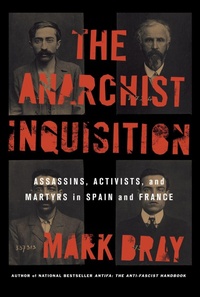
The Anarchist Inquisition
Assassins, Activists, and Martyrs in Spain and France
Published on 15. March 2022
Book
Hardback
344 pages
978-1-5017-6192-8 (ISBN)
Description
The Anarchist Inquisition explores the groundbreaking transnational human rights campaigns that emerged in response to a brutal wave of repression unleashed by the Spanish state to quash anarchist activities at the turn of the twentieth century. Mark Bray guides readers through this tumultuous era-from backroom meetings in Paris and torture chambers in Barcelona, to international antiterrorist conferences in Rome and human rights demonstrations in Buenos Aires.
Anarchist bombings in theaters and cafes in the 1890s provoked mass arrests, the passage of harsh anti-anarchist laws, and executions in France and Spain. Yet, far from a marginal phenomenon, this first international terrorist threat had profound ramifications for the broader development of human rights, as well as modern global policing, and international legislation on extradition and migration. A transnational network of journalists, lawyers, union activists, anarchists, and other dissidents related peninsular torture to Spain's brutal suppression of colonial revolts in Cuba and the Philippines to craft a nascent human rights movement against the "revival of the Inquisition." Ultimately their efforts compelled the monarchy to accede in the face of unprecedented global criticism.
Bray draws a vivid picture of the assassins, activists, torturers, and martyrs whose struggles set the stage for a previously unexamined era of human rights mobilization. Rather than assuming that human rights struggles and "terrorism" are inherently contradictory forces, The Anarchist Inquisition analyzes how these two modern political phenomena worked in tandem to constitute dynamic campaigns against Spanish atrocities.
Anarchist bombings in theaters and cafes in the 1890s provoked mass arrests, the passage of harsh anti-anarchist laws, and executions in France and Spain. Yet, far from a marginal phenomenon, this first international terrorist threat had profound ramifications for the broader development of human rights, as well as modern global policing, and international legislation on extradition and migration. A transnational network of journalists, lawyers, union activists, anarchists, and other dissidents related peninsular torture to Spain's brutal suppression of colonial revolts in Cuba and the Philippines to craft a nascent human rights movement against the "revival of the Inquisition." Ultimately their efforts compelled the monarchy to accede in the face of unprecedented global criticism.
Bray draws a vivid picture of the assassins, activists, torturers, and martyrs whose struggles set the stage for a previously unexamined era of human rights mobilization. Rather than assuming that human rights struggles and "terrorism" are inherently contradictory forces, The Anarchist Inquisition analyzes how these two modern political phenomena worked in tandem to constitute dynamic campaigns against Spanish atrocities.
Reviews / Votes
[T]he virtues of The Anarchist Inquisition are considerable, making it one of the most important studies of European politics at the turn of the twentieth century that I have ever read-whether it was part of the history of human rights or not.(Journal of Modern History)
More details
Language
English
Place of publication
Ithaca
United States
Product notice
Paper over boards
Illustrations
18 b&w halftones, 2 maps - 18 Halftones, black and white - 2 Maps
Dimensions
Height: 231 mm
Width: 154 mm
Thickness: 29 mm
Weight
597 gr
ISBN-13
978-1-5017-6192-8 (9781501761928)
Copyright in bibliographic data and cover images is held by Nielsen Book Services Limited or by the publishers or by their respective licensors: all rights reserved.
Schweitzer Classification
Other editions
Additional editions
E-Book
03/2022
Cornell University Press
€25.49
Available for download
Person
Mark Bray is a historian of human rights at Rutgers University. He is the author of the nationally bestselling Antifa and Translating Anarchy. Follow him on X @Mark__Bray.
Content
Introduction: Two Children of Modernity
Part I: The Propagandist by the Deed
1. "With Fire and Dynamite"
2. Propaganda by the Deed and Anarchist Communism
3. The Birth of the Propagandist by the Deed
4. Introducing the "Lottery of Death"
5. "There are no Innocent Bourgeois"
Part II: El Proceso de Montjuich
6. The Anarchist Inquisition
7. The Return of Torquemada
8. Germinal
9. Montjuich, Dreyfus, and "el Desastre"
10. "All of Spain is Montjuich"
Part III: The Shadow of Montjuich
11. The General Strike and the Montjuich Template of Resistance
12. The Iron Pineapple
13. Tossing the Bouquet at the Royal Wedding
14. "Truth on the March" for Francisco Ferrer
15. Francisco Ferrer and the Tragic Week
Epilogue: "Neither Innocent nor Guilty"
Part I: The Propagandist by the Deed
1. "With Fire and Dynamite"
2. Propaganda by the Deed and Anarchist Communism
3. The Birth of the Propagandist by the Deed
4. Introducing the "Lottery of Death"
5. "There are no Innocent Bourgeois"
Part II: El Proceso de Montjuich
6. The Anarchist Inquisition
7. The Return of Torquemada
8. Germinal
9. Montjuich, Dreyfus, and "el Desastre"
10. "All of Spain is Montjuich"
Part III: The Shadow of Montjuich
11. The General Strike and the Montjuich Template of Resistance
12. The Iron Pineapple
13. Tossing the Bouquet at the Royal Wedding
14. "Truth on the March" for Francisco Ferrer
15. Francisco Ferrer and the Tragic Week
Epilogue: "Neither Innocent nor Guilty"