

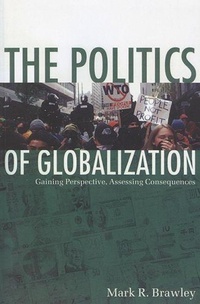
The Politics of Globalization
Gaining Perspective, Assessing Consequences
2nd Edition
Will be published approx. on 1. January 2003
Book
Paperback/Softback
224 pages
978-1-4426-0020-1 (ISBN)
Description
Since the end of the cold war, understandings of the development of relationships within and between states have taken on new meanings, generally bundled under the word "globalization." This word is used everywhere, but what does it mean? This book explores the political dimensions of globalization, considering different definitions of the term as well as several specific globalizing processes. While much of the emphasis is on political changes wrought by economic trends such as trade and international capital flows, other forces such as cultural changes, issues of identity, and so on are also involved. Evidence of changes in each of these areas is presented, and political consequences discussed. These issues are addressed in order to pursue a question that provides the theme for the volume: will globalization win over supporters and therefore have political momentum, or will it engender a backlash?
While there are now many books with the word "globalization" in their title, many are simply updates of traditional international relations texts. Others have one distinct point of view they wish to promote. Most do not bother to explore just what globalization entails, or what others from opposing perspectives have said about it. This book offers more of an overview of various points of view rooted in traditional and emerging theories and paradigms; these differing points of view are then assessed against the evidence from the current period, as well as the past. Specific chapters address issues of definition, expectations regarding politics from various perspectives, recent evidence, cultural and identity issues, past episodes of globalization, and opportunities for global governance. The book: explores views on whether "globalization" is a good thing or not; lays out the main features of different ideas of what globalization means and assesses these against current and historical evidence; and compares various theories and paradigms.
While there are now many books with the word "globalization" in their title, many are simply updates of traditional international relations texts. Others have one distinct point of view they wish to promote. Most do not bother to explore just what globalization entails, or what others from opposing perspectives have said about it. This book offers more of an overview of various points of view rooted in traditional and emerging theories and paradigms; these differing points of view are then assessed against the evidence from the current period, as well as the past. Specific chapters address issues of definition, expectations regarding politics from various perspectives, recent evidence, cultural and identity issues, past episodes of globalization, and opportunities for global governance. The book: explores views on whether "globalization" is a good thing or not; lays out the main features of different ideas of what globalization means and assesses these against current and historical evidence; and compares various theories and paradigms.
More details
Edition
2nd Revised edition
Language
English
Place of publication
Toronto
Canada
Target group
College/higher education
Professional and scholarly
Product notice
Paperback (trade)
Dimensions
Height: 229 mm
Width: 153 mm
Thickness: 13 mm
Weight
318 gr
ISBN-13
978-1-4426-0020-1 (9781442600201)
Copyright in bibliographic data and cover images is held by Nielsen Book Services Limited or by the publishers or by their respective licensors: all rights reserved.
Schweitzer Classification
Other editions
Previous edition
Book
01/2002
2nd Edition
Broadview Press Ltd
€43.56
Article exhausted; check for reprint
Person
Mark R. Brawley is Professor of Political Science at McGill University in Montreal. He has taught at McGill since 1990, except for 2000-2001, when he was a visitor at Harvard's Department of Government. He is the author of several books including Afterglow or Adjustment? (Columbia University Press, 1999) and Power, Money, and Trade: Decisions that Shape Global Economic Relations (University of Toronto Press, 2005).
Content
Acknowledgements
Defining Globalization
Theoretical Lenses for Viewing Globalization
What People Fear-or Anticipate-about Globalization
Is Globalization Occurring? Assessing the Evidence
Globalization and Domestic Politics
How Globalization's Impact Varies
Globalization and the Politics of Identity
Putting Globalization in Historical Perspective
Future Scenarios: Political Backlash, or Global Governance?
Grasping the Consequences of Globalization
Index
Defining Globalization
Theoretical Lenses for Viewing Globalization
What People Fear-or Anticipate-about Globalization
Is Globalization Occurring? Assessing the Evidence
Globalization and Domestic Politics
How Globalization's Impact Varies
Globalization and the Politics of Identity
Putting Globalization in Historical Perspective
Future Scenarios: Political Backlash, or Global Governance?
Grasping the Consequences of Globalization
Index