

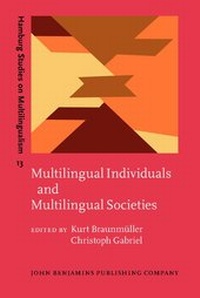
Multilingual Individuals and Multilingual Societies
Published on 22. August 2012
Book
Hardback
474 pages
978-90-272-1933-6 (ISBN)
Description
The 25 contributions of this volume represent a selection from the more than 120 papers originally presented at the International Conference on "Multilingual Individuals and Multilingual Societies" (MIMS), held in Hamburg (October 2010) and organized by the Collaborative Research Center "Multilingualism" after twelve years of successful research. It presents a panorama of contemporary research in multilingualism covering three fields of investigation: (1) the simultaneous and successive acquisition of more than one language, including language attrition in multilingual settings, (2) historical aspects of multilingualism and variance, and (3) multilingual communication. The papers cover a vast variety of linguistic phenomena including morphology, syntax, segmental and prosodic phonology as well as discourse production and language use, taking both individual and societal aspects of multilingualism into account. The languages addressed include numerous Romance, Slavic and Germanic varieties as well as Welsh, Hungarian, Turkish, and several South African autochthonous languages.
More details
Series
Language
English
Place of publication
Amsterdam
Netherlands
Target group
Professional and scholarly
Illustrations
+ index
Dimensions
Height: 245 mm
Width: 164 mm
Weight
1030 gr
ISBN-13
978-90-272-1933-6 (9789027219336)
Copyright in bibliographic data and cover images is held by Nielsen Book Services Limited or by the publishers or by their respective licensors: all rights reserved.
Schweitzer Classification
Other editions
Additional editions
Kurt Braunmüller | Christoph Gabriel
Multilingual Individuals and Multilingual Societies
E-Book
08/2012
1st Edition
John Benjamins Publishing Company
€93.49
Available for download
Persons
Content
1. Foreword (by Braunmuller, Kurt); 2. Part I. How language is acquired and lost in multilingual settings: First and second language acquisition,foreign language learning and language attrition; 3. Case marking in child L1 and early child L2 German (by Schonenberger, Manuela); 4. First exposure learners make use of top-down lexical knowledge when learning words (by Carroll, Susanne Elizabeth); 5. Wh-questions in Dutch: Bilingual and trilingual acquisition compared (by Strik, Nelleke); 6. The emergence of a new variety of Russian in a language contact situation: The case of a Russian-Swedish bilingual child (by Ringblom, Natasha); 7. The acquisition of gender agreement marking in Polish: A study of bilingual Polish-German-speaking children (by Brehmer, Bernhard); 8. Discourse cohesion in the elicited narratives of early Russian-German sequential bilinguals (by Gagarina, Natalia); 9. German segments in the speech of German-Spanish bilingual children (by Zaba, Aleksandra); 10. Agreement within early mixed DP: What mixed agreement can tell us about the bilingual language faculty (by Pierantozzi, Cristina); 11. Gender marking in L2 learners and Italian-German bilinguals with German as the weaker language (by Stohr, Antje); 12. A bidirectional study of object omissions in French-English bilinguals (by Pirvulescu, Mihaela); 13. Foreign language reforms in Swiss primary schools: Potentials and limitations (by Haenni Hoti, Andrea U.); 14. "Multilingual brains": Individual differences in multilinguals - a neuro-psycholinguistic perspective (by Festman, Julia); 15. Part II. How language changes in multilingual settings: Contact-induced language variation and change; 16. Subject-verb inversion in 13th century German and French: A comparative view (by Elsig, Martin); 17. Multilingual constructions: A diasystematic approach to common structures (by Hoder, Steffen); 18. Pseudo-coordinations in Faroese (by Heycock, Caroline); 19. Toward a fused lect: Mixed German-Hungarian concessive conditionals in a German dialect in Romania (by Szabo, Csilla-Anna); 20. The formation and distribution of the analytic future tense in Polish-German bilinguals (by Brehmer, Bernhard); 21. Changing conventions in English-German translations of popular scientific texts (by Kranich, Svenja); 22. Perception and interpretation of intonational prominence in varieties of South African English (by Zerbian, Sabine); 23. The prosody of Occitan-French bilinguals (by Sichel-Bazin, Rafeu); 24. Diachronic prosody of a contact variety: Analyzing Porteno Spanish spontaneous speech (by Peskova, Andrea); 25. Devoicing of sibilants as a segmental cue to the influence of Spanish onto current Catalan phonology (by Benet, Ariadna); 26. Part III. How language is used in multilingual settings: Linguistic practices and policies; 27. Explaining the interpreter's unease: Conflicts and contradictions in bilingual communication in clinical settings (by Buhrig, Kristin); 28. Measuring bilingual accommodation in Welsh rural pharmacies (by Prys, Myfyr); 29. Becoming bilingual in a multilingual context: A snapshot view of L2 competences in South Tyrol (by Vettori, Chiara); 30. List of contributors; 31. Name index; 32. Subject index