

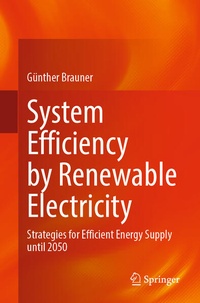
System Efficiency by Renewable Electricity
Strategies for Efficient Energy Supply until 2050
Published on 25. November 2021
Book
Paperback/Softback
XIII, 229 pages
978-3-658-35137-3 (ISBN)
Description
In this book, a more detailed analysis is performed on the basis of quarter-hourly time series of the supply of wind energy and photovoltaics. The end use including electromobility is also presented with more detailed time series of the load profiles for summer and winter and thereby for weekdays and weekends in each case. The subsequent analysis clarifies whether the renewable potentials are sufficient, what the optimal generation scenarios and infrastructures of the future could look like, and what the situation is with regard to affordability and environmental compatibility.
More details
Edition
1st ed. 2022
Language
English
Place of publication
Wiesbaden
Germany
Publishing group
Springer Fachmedien Wiesbaden GmbH
Target group
Professional and scholarly
Illustrations
5 s/w Abbildungen, 121 farbige Abbildungen
XIII, 229 p. 126 illus., 121 illus. in color.
Dimensions
Height: 235 mm
Width: 155 mm
Thickness: 14 mm
Weight
376 gr
ISBN-13
978-3-658-35137-3 (9783658351373)
DOI
10.1007/978-3-658-35138-0
Schweitzer Classification
Other editions
Additional editions
Günther Brauner
System Efficiency by Renewable Electricity
Strategies for Efficient Energy Supply until 2050
E-Book
11/2021
Springer
€90.94
Available for download
Person
Prof. Dr. Günther Brauner
was head of the technical-scientific department of one of the world's largest electrical corporations, held a professorship for energy systems at the Technical University of Vienna and holds various positions in several professional associations (World Energy Council, VDE, OVE, VDI).
Content
Energy demand, potential and resources.- Energy economy of efficiency.- Efficiency and Sufficiency.- Efficiency of storage technologies.- Efficiency of grids.- Efficiency of the decentralized energy supply.- Efficiency of buildings and heating demand.- Efficiency of Mobility.- Efficiency through sector coupling.- Options for action.